

On this page
Every year, the coastline of Odisha transforms into one of the world's largest nurseries. Under the cover of darkness, hundreds of thousands of female olive ridley sea turtles emerge from the surf to lay their eggs in the sand.
The Odisha coast hosts over 100,000 nests per year across beaches like Gahirmatha and Rushikulya. This spectacular event is not just a conservation success story; it is a masterclass in animal behaviour and ecology that biology students can learn from.
What is an arribada, and why does it happen?
The term arribada is Spanish for "arrival". It refers to a unique biological phenomenon where thousands of female turtles synchronize their nesting on a single beach over a few days. Among sea turtles, only the genus *Lepidochelys* (which includes the olive ridley and the Kemp's ridley) exhibits this mass nesting behaviour.
While the exact trigger remains a subject of research, marine biologists believe arribadas may be cued by lunar cycles, offshore winds, or pheromones released by the females. Nesting in such massive numbers is an evolutionary strategy known as predator satiation. By producing millions of hatchlings at once, the turtles ensure that local predators—such as feral pigs, dogs, cats, and crabs—cannot possibly eat them all, allowing a large number of the young to survive and reach the water.
The environment also dictates the sex of these hatchlings. Like many reptiles, olive ridleys use temperature-dependent sex determination. Warmer sand temperatures produce female hatchlings, while cooler sand produces males. If you want to review how environmental factors control genetics and development, you can search for sex determination in the Fermi Concept Library.
How do sea turtle hatchlings find the sea?
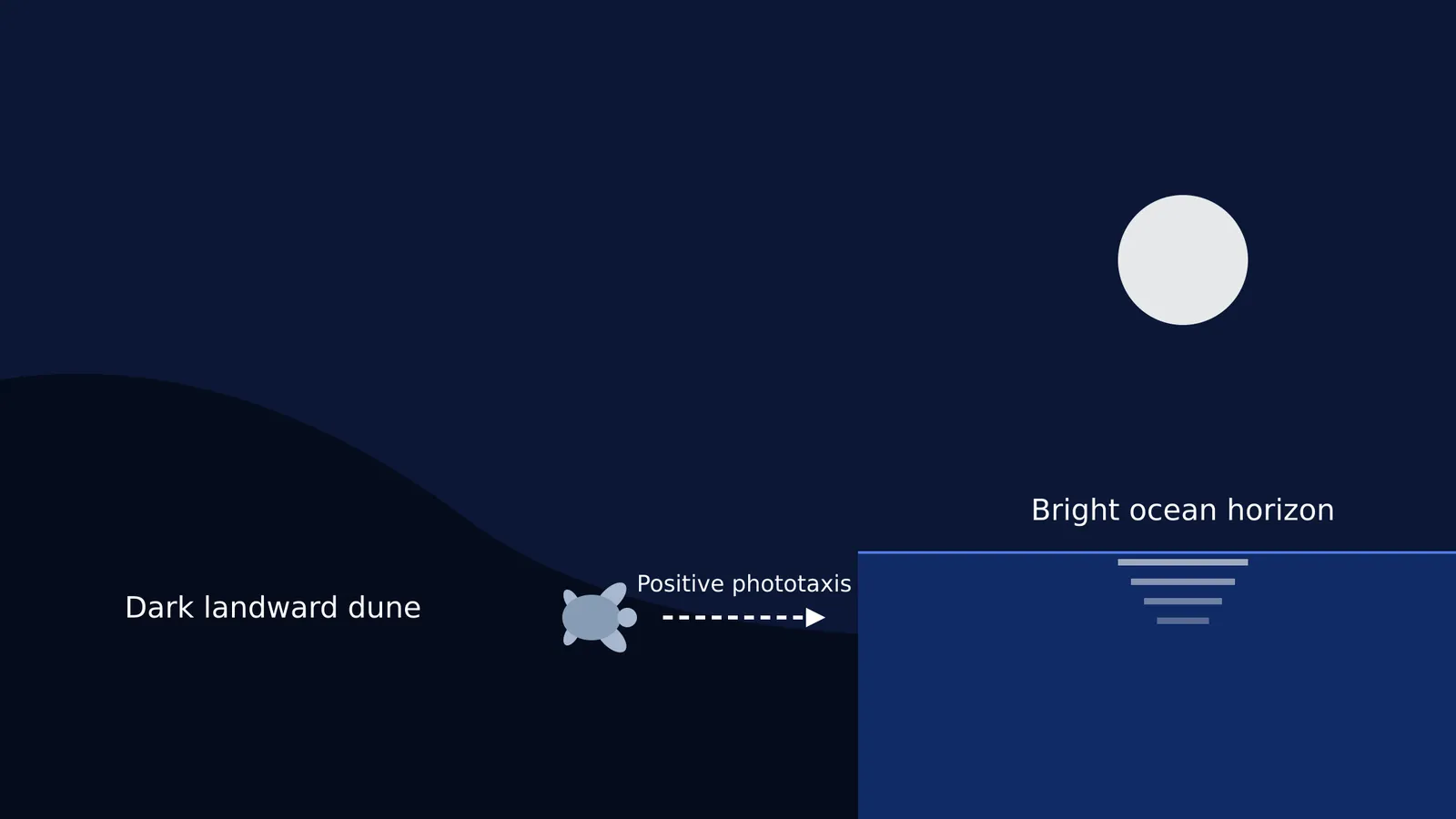
After incubation, millions of hatchlings emerge from the sand. When they hatch in the dark, they do not know where the water is by sight or smell. Instead, they rely on a biological response called positive phototaxis, an innate drive to move towards the brightest light source. They orient seaward by moving away from the darkest silhouette of the landward dune or vegetation to crawl towards the brightest horizon.
On a natural beach at night, the open horizon over the ocean reflects starlight and moonlight, making it significantly brighter than the landward side. The hatchlings scan the horizon, lock onto the brightest area, and crawl towards the surf.
However, this hardwired instinct makes them highly vulnerable to human activity. Artificial lights from coastal roads, ports, and streetlamps are much brighter than the natural night sky. This causes misorientation, leading hatchlings to crawl inland where they face dehydration, exhaustion, or predation by stray dogs.
What threats do olive ridley turtles face at sea?
Despite the millions of hatchlings born in Odisha, the olive ridley is classified as Vulnerable on the IUCN Red List. You can read more about how species are categorised in our guide to Endemic vs endangered species: the IUCN Red List explained.
The primary threat to adult turtles is bycatch in fishing gear. Turtles must surface to breathe, and if they become entangled in mechanized fishing trawls or gillnets, they drown. Historic overexploitation is a major reason why did the dodo, quagga, thylacine and Steller's sea cow go extinct? — and while direct harvesting of turtles is now largely banned worldwide, incidental deaths remain high in coastal waters.
Climate change adds another layer of threat. Rising global temperatures lead to warmer nesting beaches, which can lethally overheat eggs or dangerously skew the sex ratio towards an entirely female population. Extreme weather events also erode the beaches, washing away nests before they can hatch.
How does the Turtle Excluder Device (TED) work?
To combat the threat of bycatch, conservation laws in many regions require fishing trawlers to use Turtle Excluder Devices (TEDs). A TED is a specialized grid of bars fitted into the neck of a trawl net. Small animals like fish and shrimp pass through the bars and are caught in the end of the net. However, when a large sea turtle enters the net, it hits the grid and is guided towards an escape flap, allowing it to swim free unharmed.
Alongside TEDs, local governments often enforce seasonal bans on mechanized fishing near major nesting sites to further protect the turtles.
A framework for tackling conservation questions
If you are studying for a biology exam, conservation case studies like the olive ridley turtle frequently appear in long-answer questions. Use this three-step framework to structure your answers:
Identify the biological principle: What natural mechanism is at work? (For example, temperature-dependent sex determination or positive phototaxis).
State the human impact: What specific human activity is disrupting this mechanism? (For example, climate change raising sand temperatures, or coastal development creating light pollution).
Link to population survival: How does this disruption affect the species' numbers? (For example, a skewed sex ratio means fewer mating pairs in the future; misorientation means hatchlings die before reaching the water).
By protecting the nesting beaches of Odisha and enforcing fishing regulations, conservationists hope to keep the arribada arriving for generations to come.


