

On this page
A jet engine has one job: push air backwards so the aircraft is pushed forwards. You can get the same push by throwing a small amount of air backwards very fast, or a large amount of air backwards slowly. Momentum says both give the same thrust. Energy says they cost very different amounts of fuel. That difference is why airliner engines have such huge fans.
How does a jet engine make thrust?
Air enters the engine at the flight speed v₀ (seen from the aircraft) and leaves at a higher jet speed v_j. If ṁ kilograms of air pass through each second, the momentum given to the air each second is ṁ(v_j − v₀). By Newton's second and third laws, that is the forward force on the engine:
F = ṁ(v_j − v₀) = ṁΔv
How Frank Whittle turned this into the first working turbojet, and how to apply the formula to one, is covered in Frank Whittle's turbojet and the physics of jet thrust. Here we ask a different question: for a fixed thrust, which mix of ṁ and Δv wastes the least energy?
Where does the wasted energy go?
Look at it from the ground. Before the aircraft arrives, the air is still. After the engine passes, a stream of air is moving backwards at Δv = v_j − v₀. That moving air carries kinetic energy, and nothing on the aircraft gets it back. The kinetic energy left behind each second is:
wasted power = ½ṁΔv²
The useful part is the work done on the aircraft each second, the thrust times the flight speed:
useful power = Fv₀
The engine must supply both. You can check that their sum equals the gain in the air's kinetic energy measured from the aircraft, ½ṁ(v_j² − v₀²), which is the jet power.
Now hold F = ṁΔv fixed. Multiply ṁ by 10 and Δv drops to a tenth. The wasted power ½ṁΔv² = ½FΔv then also drops to a tenth. Thrust depends on ṁΔv, but waste depends on ṁΔv². That squared term is the whole story.
What is propulsive efficiency?
Propulsive efficiency is the fraction of the jet power that ends up as useful work on the aircraft:
η = Fv₀ ÷ (Fv₀ + ½ṁΔv²)
Put F = ṁΔv and cancel ṁ:
η = v₀ ÷ (v₀ + ½Δv) = 2v₀ ÷ (v₀ + v_j) = 2 ÷ (1 + v_j/v₀)
The closer the jet speed is to the flight speed, the closer η gets to 1. A fast, narrow jet behind a slow aircraft gives a low η.
Worked example: turbojet versus turbofan
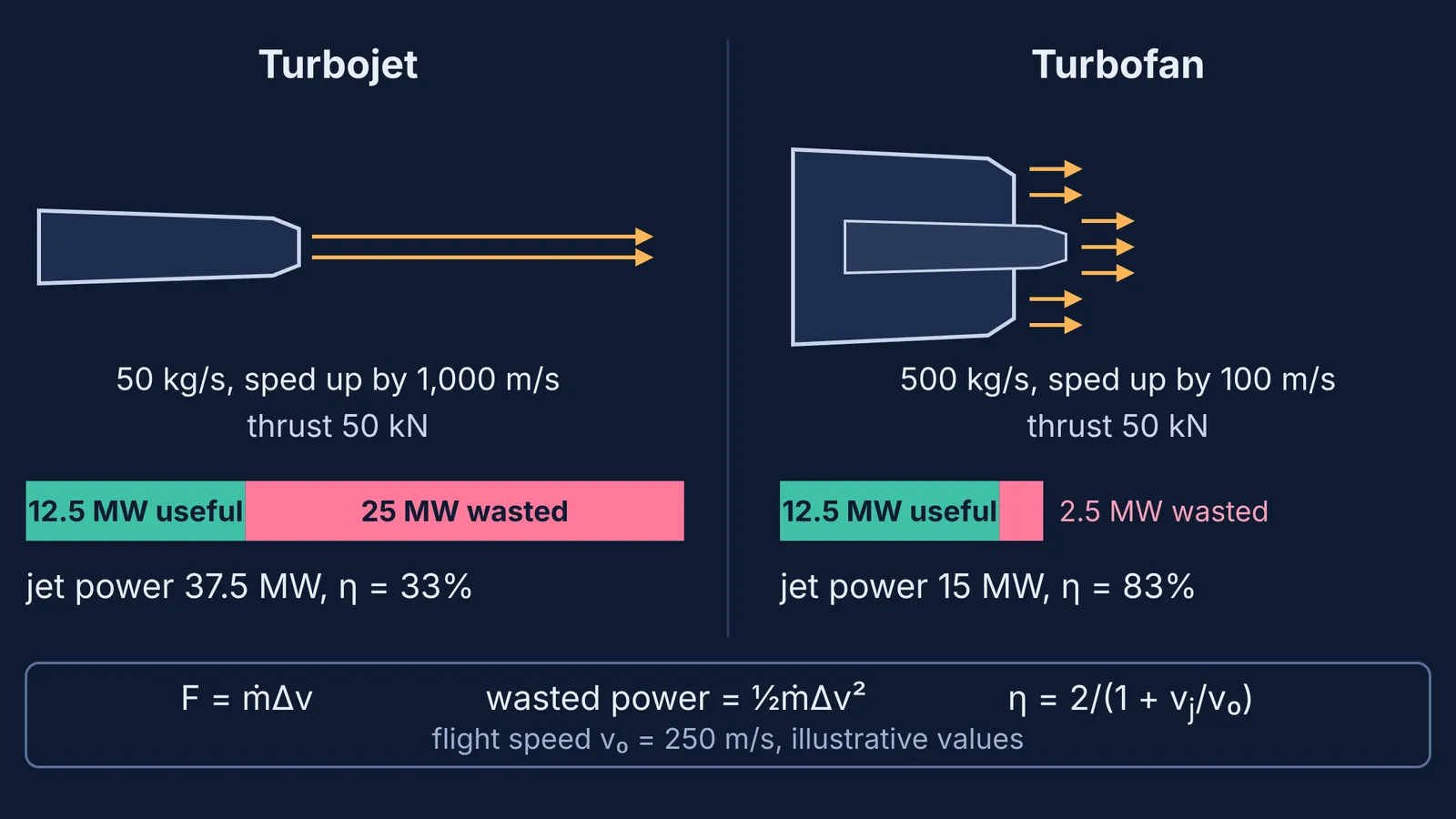
Take an airliner cruising at v₀ = 250 m/s that needs F = 50 kN from one engine. These are round illustrative values, not the figures for a named engine.
Useful power. Fv₀ = 50,000 N × 250 m/s = 12.5 MW. This is the same for any engine making this thrust at this speed.
Turbojet, ṁ = 50 kg/s. Δv = F/ṁ = 50,000 ÷ 50 = 1,000 m/s, so the jet leaves at v_j = 1,250 m/s.
Turbojet waste. ½ × 50 × 1,000² = 25 MW. The jet power is 12.5 + 25 = 37.5 MW, and η = 2 ÷ (1 + 1,250/250) = 2/6 = 33%.
Turbofan, ṁ = 500 kg/s. Δv = 50,000 ÷ 500 = 100 m/s, so v_j = 350 m/s.
Turbofan waste. ½ × 500 × 100² = 2.5 MW. The jet power is 12.5 + 2.5 = 15 MW, and η = 2 ÷ (1 + 350/250) = 2/2.4 = 83%.
Compare. Same thrust, same speed. The turbofan wastes 2.5 MW instead of 25 MW, a tenth as much, and needs 15 MW of jet power instead of 37.5 MW.
Check the units: N × m/s = W, and kg/s × (m/s)² = kg m²/s³ = W. Useful ÷ total and 2/(1 + v_j/v₀) give the same answers.
How big does the fan need to be?
A turbofan gets its large ṁ from a big fan at the front. Most of the air it moves goes around the hot core in a bypass duct, and only a small part passes through the core where fuel is burnt. The bypass ratio is the mass of air going around the core for each kilogram going through it. It is a ratio of mass flows, not of thrusts.
To swallow 500 kg/s, the intake must catch that much air every second. At 11 km the air is thin. NASA Glenn's standard atmosphere model gives about −56 °C, 22.7 kPa and a density of about 0.365 kg/m³ there. The mass flow is ṁ = ρAv₀, so:
A = ṁ ÷ (ρv₀) = 500 ÷ (0.365 × 250) ≈ 5.5 m²
A circle of 5.5 m² has a diameter of about 2.6 m. That is the size of a large modern fan. For a real engine, GE Aerospace lists the GE9X, built for the Boeing 777X, with a 134-inch (about 3.4 m) fan and a bypass ratio of about 10:1. Early turbojets had no bypass: all the air went through the core.
For a hovering helicopter the same "move more air more slowly" idea sets the rotor size, as worked in the air-momentum method for helicopter hover power. The difference here is that the aircraft is moving, so the useful power is Fv₀ rather than the induced power of a rotor at rest.
Why not make the fan even bigger?
If η = 2/(1 + v_j/v₀), why not push v_j all the way down to v₀ and get η = 100%? Because then Δv = 0 and the thrust F = ṁΔv is zero. To keep the thrust, ṁ would have to grow without limit.
In practice, a bigger fan means a heavier engine, a larger nacelle with more drag, and more ground clearance under the wing. At some size these losses cancel the gain in η. Engine makers pick the size where the total fuel burn is lowest, which is why bypass ratios have grown from zero to around 10:1, as on the GE9X, rather than to 100:1. Thin air at cruise height helps keep drag low, which is part of why passenger planes cruise at 35,000 feet.
Two simplifications sit inside the formula. It ignores the small mass of fuel added to the jet, and any pressure thrust at the nozzle. Neither changes the conclusion.
If you want to try more thrust and power problems with each step checked, the Fermi Problem Library has a step-by-step solver that explains the reasoning.
Quick checklist
Thrust: F = ṁ(v_j − v₀) = ṁΔv.
Useful power: Fv₀. Wasted power: ½ṁΔv² = ½FΔv.
Propulsive efficiency: η = 2/(1 + v_j/v₀).
Same thrust with 10 times the air flow means a tenth of the Δv and a tenth of the wasted power.
Bypass ratio is a ratio of mass flows around and through the core.
Overall efficiency = thermal efficiency × propulsive efficiency.
η = 100% would mean zero thrust, so the fan size has a practical limit.


