

On this page
Two compounds share the formula [PtCl₂(NH₃)₂]. In the cis isomer the two chlorides sit next to each other; in the trans isomer they sit opposite. The cis isomer is cisplatin, an anticancer drug, and the trans isomer is not useful as a drug. Chemists make whichever one they want by choosing the starting complex and the order in which they add the ligands. The rule that tells them what will happen is the trans effect.
What is the trans effect in square planar complexes?
The trans effect is the ability of a ligand to make the ligand opposite it (trans to it) easier to replace in a substitution reaction of a square planar complex. A ligand with a strong trans effect is said to labilise the trans position: whatever sits across from it leaves faster.
Square planar Pt(II) complexes are the classic case, because Pt²⁺ is a d⁸ ion and almost always square planar. If you are not sure why, see why d⁸ ions like Pt²⁺ form square planar complexes. Substitution in these complexes is associative: the incoming ligand attacks first, a five-coordinate species forms, and then the leaving ligand departs. The square planar shape is kept, so the new ligand takes exactly the position the old one left.
The key word is kinetic. The trans effect is about how fast a ligand is replaced, not about which product is more stable. The product you get is the one that forms fastest.
How is the trans effect different from trans influence?
Trans influence is a ground-state property. It describes how much a ligand weakens the bond opposite it in the stable, unreacting complex, which you can see as a longer metal–ligand bond in an X-ray structure or a lower stretching frequency in the IR spectrum. It is thermodynamic. The trans effect is measured from reaction rates. Strong σ donors such as H⁻ and PR₃ show both. Ligands such as C₂H₄ and CO have a large trans effect but a smaller trans influence, which is the clue that a second explanation is needed.
What is the trans effect series?
The commonly quoted textbook order, from strongest to weakest trans director, is:
CN⁻ ≈ CO ≈ C₂H₄ > PR₃ ≈ H⁻ > CH₃⁻ > SCN⁻ > NO₂⁻ > I⁻ > Br⁻ > Cl⁻ > NH₃ > py > OH⁻ > H₂O
Different books place a few neighbours slightly differently, but the broad pattern is the same everywhere, and it is easier to remember in groups:
π acceptors at the top: CN⁻, CO, C₂H₄.
Strong σ donors next: PR₃, H⁻, CH₃⁻.
Soft anions and halides in the middle, with I⁻ > Br⁻ > Cl⁻.
Nitrogen and oxygen donors at the bottom: NH₃, pyridine, OH⁻, H₂O.
For most exam questions you only need two comparisons: Cl⁻ > NH₃ and C₂H₄ > Cl⁻.
Why do some ligands have a strong trans effect?
Two explanations are taught, and each fits one part of the series.
σ-trans influence. The two ligands on opposite ends of one axis use the same metal orbital for bonding. A strong σ donor such as H⁻ or PR₃ takes a larger share of that orbital, so the bond to the trans ligand is weakened before the reaction even starts. A weaker bond breaks more easily. This explains the high position of H⁻, CH₃⁻ and PR₃.
π-acceptor stabilisation of the transition state. In the five-coordinate trigonal bipyramidal transition state, the entering ligand, the leaving ligand and the trans-directing ligand all lie in the same trigonal plane. The incoming ligand pushes extra electron density onto Pt. A π acceptor such as CO or C₂H₄ draws that density back into its own empty π* orbitals, which lowers the energy of the transition state. A lower activation energy means a faster reaction at the position trans to it.
The first explanation works on the starting complex, the second on the transition state, and both lead to the same prediction.
How do you make cisplatin using the trans effect?
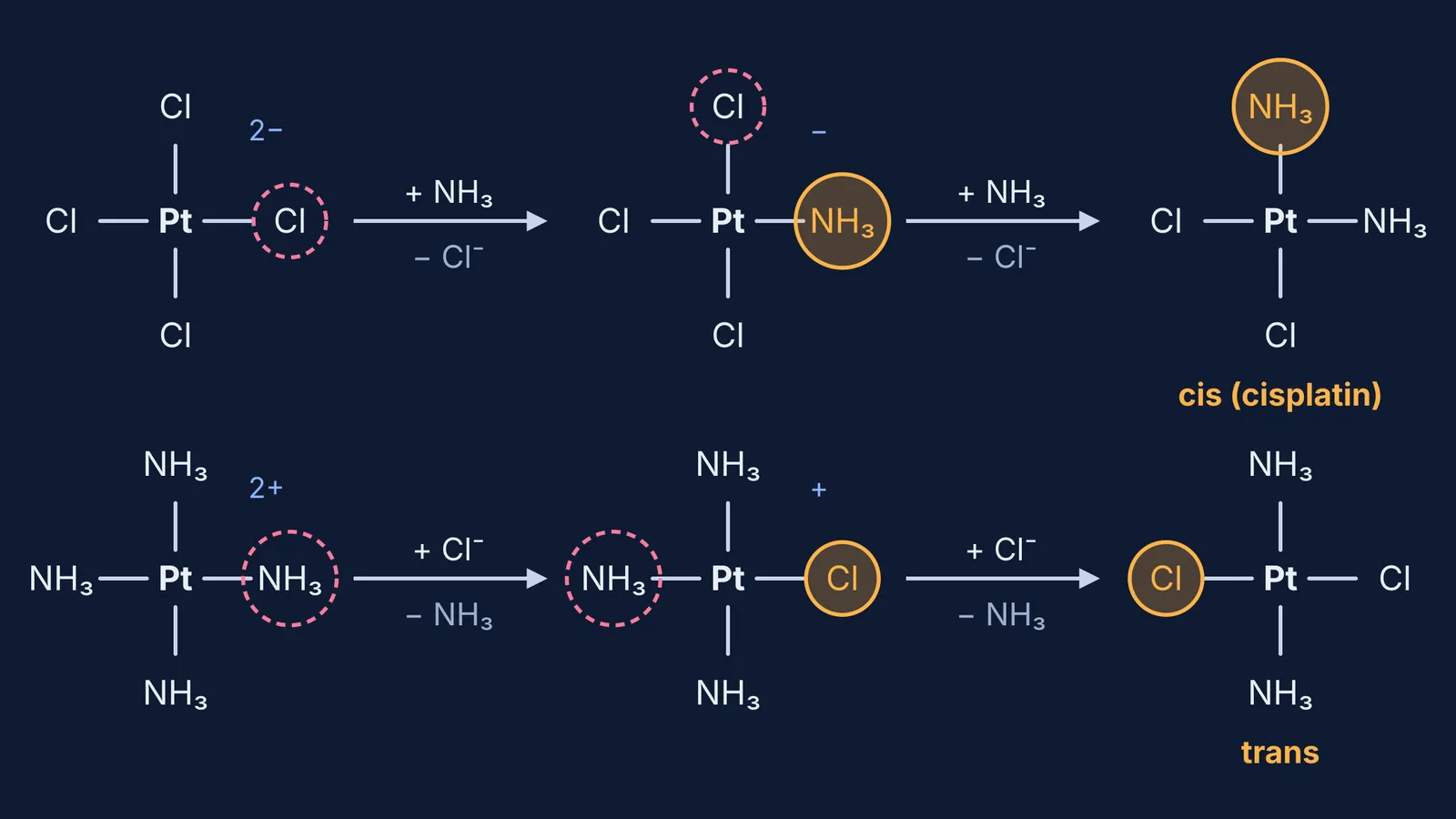
Start from [PtCl₄]²⁻ and add two NH₃, one at a time.
First NH₃. All four Cl⁻ in [PtCl₄]²⁻ are equivalent, since each one has a Cl⁻ opposite it. NH₃ replaces any one of them: [PtCl₄]²⁻ + NH₃ → [PtCl₃(NH₃)]⁻ + Cl⁻.
List what is opposite each Cl. In [PtCl₃(NH₃)]⁻, one Cl is trans to NH₃. The other two Cl are trans to each other.
Compare the trans directors. Cl⁻ has a stronger trans effect than NH₃. So the two Cl that sit opposite another Cl are labilised; the Cl opposite NH₃ is not.
Second NH₃. NH₃ replaces one of the two mutually trans Cl. That position is next to the first NH₃, not across from it.
Product. [PtCl₃(NH₃)]⁻ + NH₃ → cis-[PtCl₂(NH₃)₂] + Cl⁻. This is cisplatin.
Now reverse the roles. Start from [Pt(NH₃)₄]²⁺ and add two Cl⁻.
First Cl⁻. All four NH₃ are equivalent. Cl⁻ replaces one: [Pt(NH₃)₄]²⁺ + Cl⁻ → [PtCl(NH₃)₃]⁺ + NH₃.
List what is opposite each NH₃. One NH₃ is trans to Cl. The other two are trans to each other.
Compare. Cl⁻ is the stronger trans director, so the NH₃ opposite Cl is labilised.
Product. [PtCl(NH₃)₃]⁺ + Cl⁻ → trans-[PtCl₂(NH₃)₂] + NH₃.
Same formula, two different isomers, decided entirely by the order of the ligands. How cisplatin then acts on DNA in cancer cells is covered in applications of coordination compounds in medicine and analysis, so it is not repeated here.
What happens when Zeise's anion reacts with ammonia?
Zeise's anion is [PtCl₃(C₂H₄)]⁻: Pt²⁺ with three Cl⁻ and one ethene bonded side-on. The bonding is explained in how ethene bonds to platinum in Zeise's salt.
What is opposite each Cl? One Cl is trans to C₂H₄. The other two are trans to each other.
Compare. C₂H₄ is near the top of the series, far above Cl⁻.
Which Cl goes? The one trans to C₂H₄.
Product. [PtCl₃(C₂H₄)]⁻ + NH₃ → trans-[PtCl₂(NH₃)(C₂H₄)] + Cl⁻. NH₃ ends up opposite ethene, and the two remaining Cl are trans to each other.
If you want more substitution and isomer problems like these, the Fermi Problem Library has a step-by-step solver that explains the reasoning at each stage.
What mistakes cost marks on trans effect questions?
Thinking the trans effect decides which product is more stable. It decides which ligand leaves fastest.
Assuming the ligand opposite the group that just entered always leaves next. That is only true when the new group is the stronger trans director, as Cl⁻ is in the trans route but NH₃ is not in the cisplatin route.
Forgetting that Cl⁻ is above NH₃ in the series, which flips cis and trans answers.
Applying the series outside square planar substitution. In JEE and NEET it is used for square planar complexes such as those of Pt(II).
Quick checklist
Trans effect: a ligand speeds up replacement of the ligand opposite it in square planar complexes.
It is kinetic; trans influence is the ground-state bond weakening.
Learn the series in groups: π acceptors > strong σ donors > halides > N and O donors.
[PtCl₄]²⁻ + 2NH₃ gives cis-[PtCl₂(NH₃)₂]; [Pt(NH₃)₄]²⁺ + 2Cl⁻ gives the trans isomer.
Zeise's anion + NH₃ puts NH₃ trans to ethene.
Redraw the square after every substitution step.


