

On this page
How does cisplatin target cancer cells in chemotherapy?
Cisplatin, chemically cis-diamminedichloroplatinum(II) or cis-[Pt(NH3)2Cl2], is a square planar platinum(II) complex used in cancer chemotherapy. Discovered in 1969 by Barnett Rosenberg and colleagues at Michigan State University (Nature), it coordinates selectively with cellular DNA. Unlike double salts that dissociate completely into simple ions in water, coordination complexes retain their coordination sphere in solution, a distinction central to distinguishing double salts from coordination complexes.
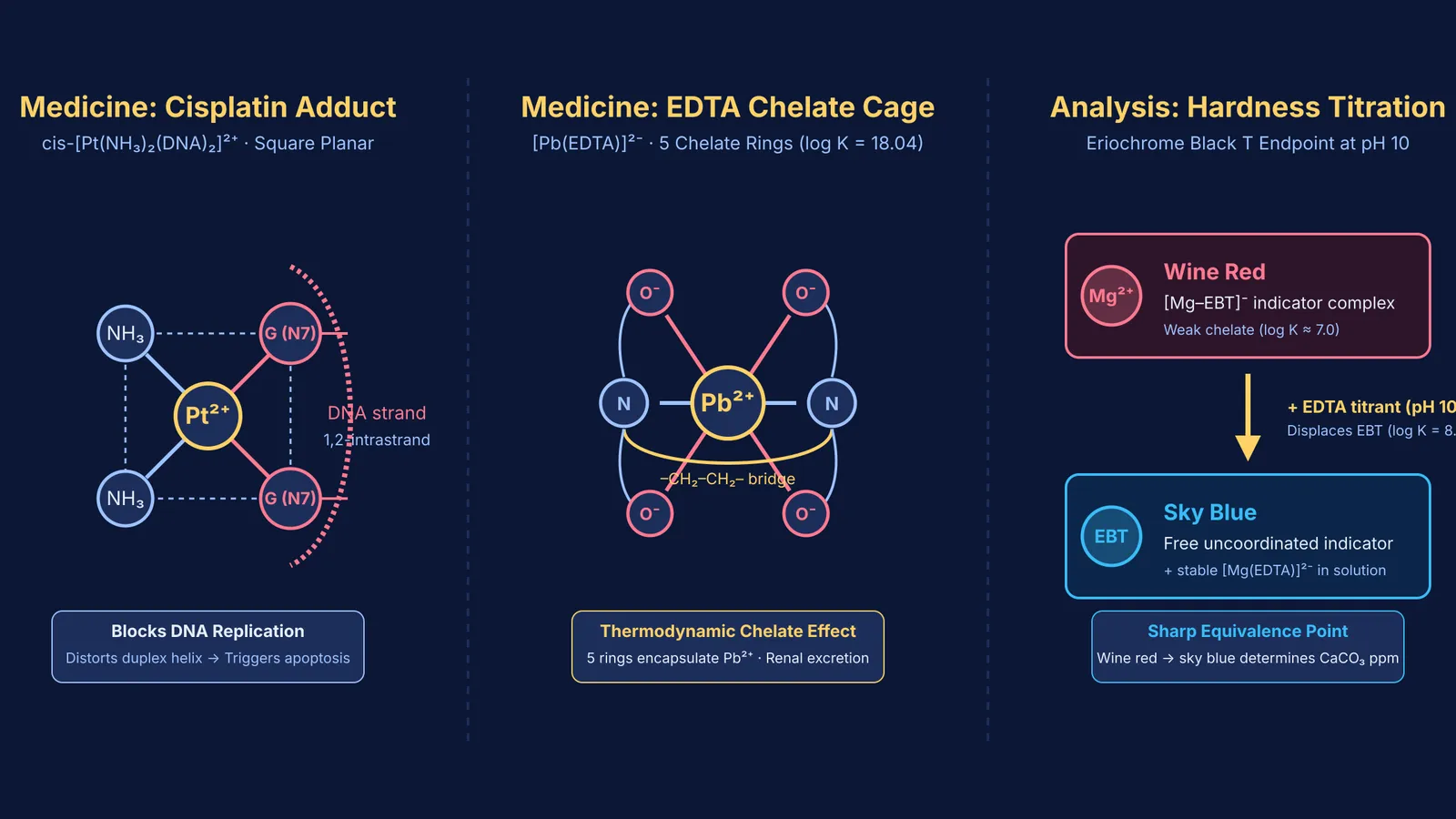
In blood plasma, high extracellular chloride suppresses ligand substitution, preserving the neutral complex. Inside a cancer cell where chloride is lower, water molecules displace chloride ligands through aquation to form reactive aqua species like cis-[Pt(NH3)2(H2O)Cl]⁺. These electrophiles coordinate with the N7 nitrogen atoms of adjacent guanine bases on genomic DNA, creating 1,2-intrastrand cross-links. This coordination kinks the DNA double helix, stalling replication forks and transcription to trigger programmed cell death. The geometric isomer transplatin is clinically inactive because its trans geometry cannot form this specific 1,2-intrastrand cross-link.
Why is calcium disodium EDTA used for lead poisoning chelation?
Chelation therapy uses polydentate ligands to sequester toxic heavy metals from tissue. Ethylenediaminetetraacetic acid (EDTA) is a hexadentate chelating agent with two tertiary amine nitrogens and four carboxylate oxygen donors. When coordinating a metal cation, EDTA forms five distinct five-membered chelate rings, conferring enormous thermodynamic stability.
According to the NIST Critically Selected Stability Constants Database, the stability constant of [Pb(EDTA)]²⁻ is log K = 18.04, compared to log K = 10.65 for [Ca(EDTA)]²⁻. Because their formation constants differ by 7.39 log units, EDTA binds lead 24 million times more strongly than calcium. When calcium disodium EDTA (CaNa2EDTA) is administered, lead displaces calcium via ligand exchange:
[Ca(EDTA)]²⁻ + Pb²⁺ ⇌ [Pb(EDTA)]²⁻ + Ca²⁺
The resulting lead chelate is water-soluble and excreted unchanged by the kidneys. Clinical protocols use the calcium-saturated salt because free disodium EDTA (Na2EDTA) strips ionized calcium from serum, causing fatal hypocalcemia and cardiac arrest as reported by the U.S. Centers for Disease Control and Prevention. In medical guidelines, chelation is indicated when venous blood lead levels exceed 45 µg/dL. The thermodynamics governing this displacement are detailed in our guide to understanding stability constants of complexes.
How does EDTA titration estimate the hardness of water?
Total water hardness measures dissolved multivalent cations, primarily Ca²⁺ and Mg²⁺. In testing governed by the Bureau of Indian Standards (IS 3025 (Part 21): 2009), water hardness is determined by complexometric titration with disodium EDTA, established by Gerold Schwarzenbach (Helvetica Chimica Acta).
The titration operates under strict equilibrium control:
The sample is buffered to pH 10.0 ± 0.1 with ammonium chloride and ammonium hydroxide (NH4Cl + NH4OH).
Eriochrome Black T (EBT) indicator is added. Free EBT is sky blue at pH 10, but forms an unstable wine-red complex with magnesium ions, [Mg-EBT]⁻.
Titrated Na2EDTA preferentially chelates free Ca²⁺ (log K = 10.65) and free Mg²⁺ (log K = 8.69).
Once free cations are consumed, EDTA extracts Mg²⁺ from [Mg-EBT]⁻ because Mg-EDTA is roughly 50 times more stable than Mg-EBT.
This displacement releases free EBT, turning the solution from wine red to steel blue at the equivalence point.
Students can review practical laboratory setups in our guide on performing an EDTA complexometric titration.
How can you calculate water hardness from titration data?
Under IS 3025 (Part 21): 2009, water hardness is reported in milligrams of equivalent CaCO3 per litre (mg/L or ppm). Consider a representative titration:
Problem: A 50.0 mL sample of hard tap water requires 14.50 mL of 0.010 M standard Na2EDTA solution to reach the blue Eriochrome Black T endpoint at pH 10. Calculate total water hardness in ppm (mg/L) as CaCO3 equivalent.
Calculate moles of EDTA: Moles = 0.01450 L × 0.010 mol/L = 1.450 × 10⁻⁴ mol.
Relate to CaCO3: EDTA forms a 1:1 complex with divalent cations, giving 1.450 × 10⁻⁴ mol of CaCO3 equivalent.
Convert to mass: Mass = 1.450 × 10⁻⁴ mol × 100.09 g/mol = 0.014513 g = 14.51 mg.
Calculate concentration: Hardness = 14.51 mg / 0.050 L = 290.2 mg/L (ppm).
Water between 150 and 300 mg/L is classified as hard, suitable for drinking but requiring softening in boilers to avoid scale.
When practicing multi-step complexation calculations or redox equilibria, the Fermi Problem Library provides worked problems with a step-by-step solver that explains the reasoning rather than printing an answer. To explore how ligand field theory, chelation thermodynamics, and stereochemistry connect across inorganic chemistry, the Fermi Concept Library maps every concept in chemistry with its place in the curriculum.


