

On this page
Water hardness is defined by the concentration of dissolved multivalent cations, predominantly calcium (Ca²⁺) and magnesium (Mg²⁺). Because these alkaline-earth metals have similar chemical properties, standard acid-base titrations cannot quantify them. Analytical chemists instead use complexometric titration with ethylenediaminetetraacetic acid (EDTA), combining coordination chemistry with selective precipitation to measure each ion.
Why is EDTA a hexadentate ligand?
EDTA (ethylenediaminetetraacetic acid), commonly prepared as its disodium salt (Na₂H₂Y), is a chelating agent that binds metal ions. Its structure contains six electron-donating donor atoms: two tertiary amine nitrogens and four carboxylate oxygens (Complexometric titration).
When coordinating with a divalent cation such as Ca²⁺ or Mg²⁺, EDTA donates these six lone pairs to form coordinate covalent bonds directed toward the vertices of an octahedron. Because it attaches to the metal ion using six donor atoms, EDTA is classified as a hexadentate ligand. This binding wraps entirely around the metal cation, forming a cage-like chelate. The resulting chelate rings provide exceptional thermodynamic stability known as the chelate effect, driving the complexation reaction to completion.
Why does EDTA bind calcium and magnesium in a 1:1 ratio?
A key strength of complexometric titrations with EDTA is stoichiometric simplicity. Unlike monodentate ligands that bind in stepwise equilibria with poorly defined endpoints, a single hexadentate EDTA molecule satisfies the coordination sphere of a Ca²⁺ or Mg²⁺ cation in one step (Complexometric titration).
The reaction follows a strict 1:1 molar stoichiometry:
M²⁺ + [H₂Y]²⁻ → [MY]²⁻ + 2H⁺
Here, M²⁺ denotes either Ca²⁺ or Mg²⁺, and [H₂Y]²⁻ is the disodium EDTA anion. Because one mole of EDTA binds one mole of metal cation, the moles of EDTA dispensed from the burette equal the moles of divalent cations in the flask. For samples requiring indirect methods, chemists use back titration calculations or standard rules for calculating molarity after dilution.
How do you estimate calcium and magnesium separately?
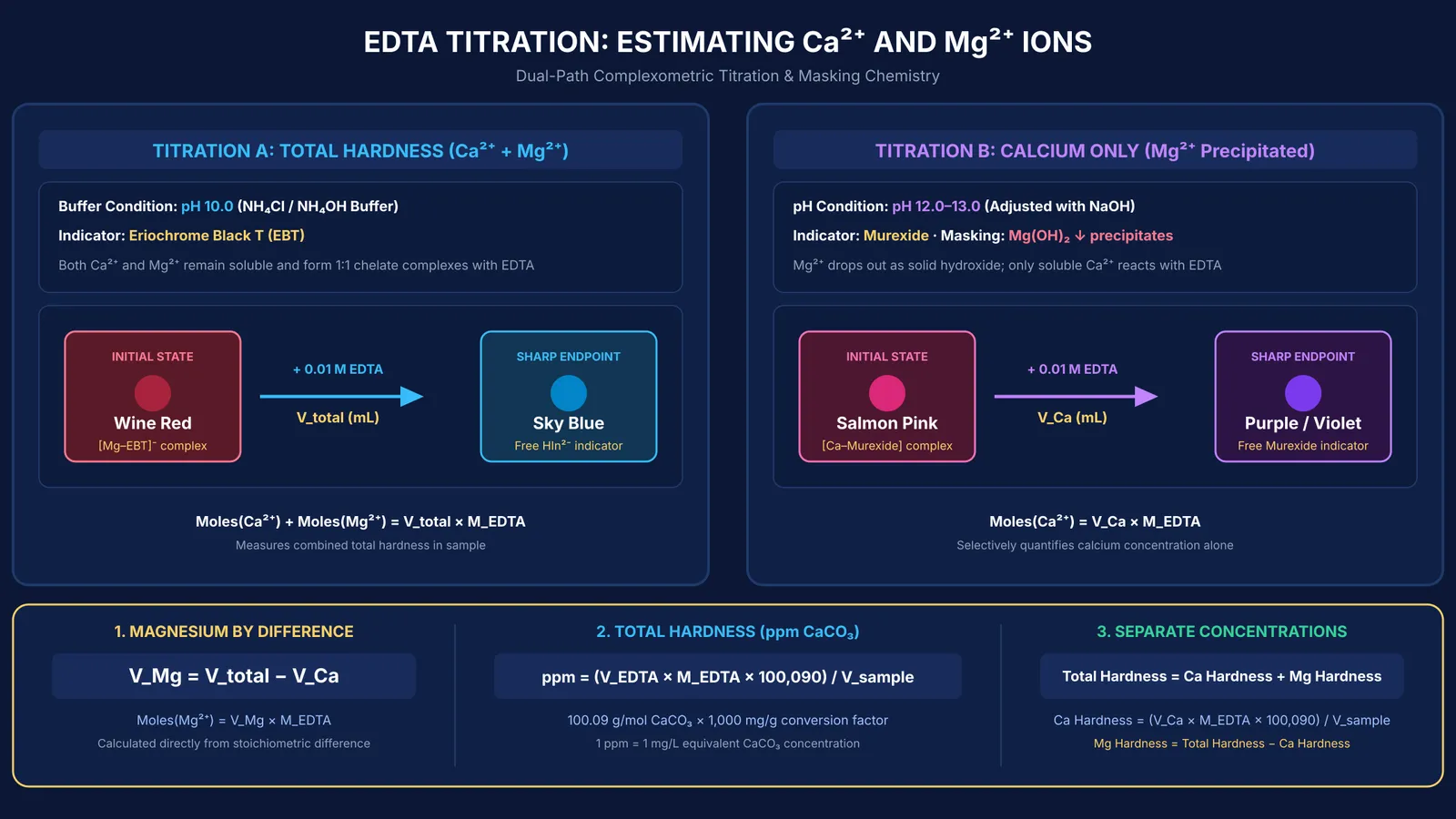
Because both Ca²⁺ and Mg²⁺ form 1:1 complexes with EDTA, determining their individual concentrations requires two separate titrations with different pH levels and indicators.
To find total hardness (Ca²⁺ + Mg²⁺), you buffer the water sample to pH 10 using an ammonium chloride and ammonia (NH₄Cl / NH₄OH) buffer. Adding Eriochrome Black T (EBT) indicator forms a wine-red [M–EBT]⁻ complex with the metal ions. As you titrate with standard EDTA, EDTA displaces the metal from the weaker indicator complex due to its higher stability constant. When all metal ions are chelated by EDTA, free EBT is released, turning the solution sky blue. This burette volume gives the total hardness (V_total).
To find calcium alone, you take a fresh sample and add sodium hydroxide (NaOH) to reach pH 12 to 13. At this basic pH, magnesium precipitates as solid magnesium hydroxide (Mg(OH)₂ ↓). This precipitation masks magnesium, removing it from solution. Calcium remains dissolved and is titrated using murexide as the indicator, changing from pink to violet at the endpoint (V_Ca). You can compare this with our guide on choosing indicators for titration curves.
The volume for magnesium is determined by difference: V_Mg = V_total − V_Ca.
How do you calculate water hardness in ppm from titration volume?
Hardness is reported in parts per million (ppm), which represents milligrams of equivalent calcium carbonate (CaCO₃) per litre of water (Hard water).
Because one mole of EDTA reacts with one mole of metal ion, and CaCO₃ has a molar mass of 100.09 g/mol, the formula is:
Hardness (ppm) = (V_EDTA × M_EDTA × 100,090) / V_sample
Where:
V_EDTA is the volume of EDTA consumed (in mL).
M_EDTA is the molarity of the EDTA solution (typically 0.01 M).
100,090 is the molar mass of CaCO₃ (100.09 g/mol) multiplied by 1,000 to convert grams to milligrams.
V_sample is the volume of the water sample pipetted (in mL).
For example, if a 50 mL sample requires 12.5 mL of 0.01 M EDTA to reach the EBT endpoint at pH 10, total hardness is (12.5 × 0.01 × 100,090) / 50 = 250.2 ppm. If a second 50 mL sample at pH 12 requires 8.0 mL of EDTA, calcium hardness is (8.0 × 0.01 × 100,090) / 50 = 160.1 ppm. Magnesium hardness is 250.2 − 160.1 = 90.1 ppm.
To explore coordination complexes, stability constants, and multidentate ligands, the Fermi Concept Library covers every concept in physics, chemistry, biology, mathematics and computing, each with its own lesson and its place in the map. For worked practice problems, the Fermi Problem Library provides worked problems with a step-by-step solver that explains the reasoning rather than printing an answer.


