

On this page
When transition metal ions dissolve in water, they form hydrated aqua complexes such as [Cu(H₂O)₆]²⁺ rather than floating as bare cations. Introducing ligands like ammonia or ethylenediamine displaces these coordinated water molecules in succession. The quantitative measure of how completely this substitution occurs at equilibrium is the stability constant of the coordination complex.
What does the stability constant of a complex measure?
The stability constant, also called the formation constant, is the equilibrium constant for a complex forming from a metal ion and ligands in solution. According to the official NCERT Class XII Chemistry curriculum, stability refers to the degree of association between the metal cation and ligands at chemical equilibrium.
For the overall formation reaction:
M + nL ⇌ MLₙ
The overall stability constant, denoted by βₙ, is:
βₙ = [MLₙ] / ([M][L]ⁿ)
A larger β value means equilibrium lies heavily toward the coordinated complex, leaving negligible uncomplexed metal cation. Conversely, the reciprocal of the stability constant is the instability or dissociation constant (K_d = 1 / βₙ). A low dissociation constant confirms that the complex resists dissociation into free ions. To explore how thermodynamic equilibria govern complex formation, the Fermi Concept Library maps every concept in chemistry with its own lesson and its place in the map.
How do stepwise and overall formation constants relate?
In solution, complex formation proceeds through consecutive reversible steps, each with its own stepwise formation constant (K₁, K₂, ..., Kₙ).
For a metal ion binding four monodentate ligands L:
M + L ⇌ ML ; K₁ = [ML] / ([M][L])
ML + L ⇌ ML₂ ; K₂ = [ML₂] / ([ML][L])
ML₂ + L ⇌ ML₃ ; K₃ = [ML₃] / ([ML₂][L])
ML₃ + L ⇌ ML₄ ; K₄ = [ML₄] / ([ML₃][L])
Multiplying these expressions cancels intermediate species, yielding the overall constant:
K₁ × K₂ × K₃ × K₄ = [ML₄] / ([M][L]⁴) = β₄
Taking the logarithm converts the product into an exact sum:
log β₄ = log K₁ + log K₂ + log K₃ + log K₄
Standard reference compilations, such as the IUPAC Stability Constants Database, document these values across thousands of coordination systems. Just as in general equilibrium calculations covered in our guide to reaction quotient Q vs K, comparing an actual concentration quotient to the stability constant indicates whether more complex forms.
Why do stepwise stability constants decrease at each step?
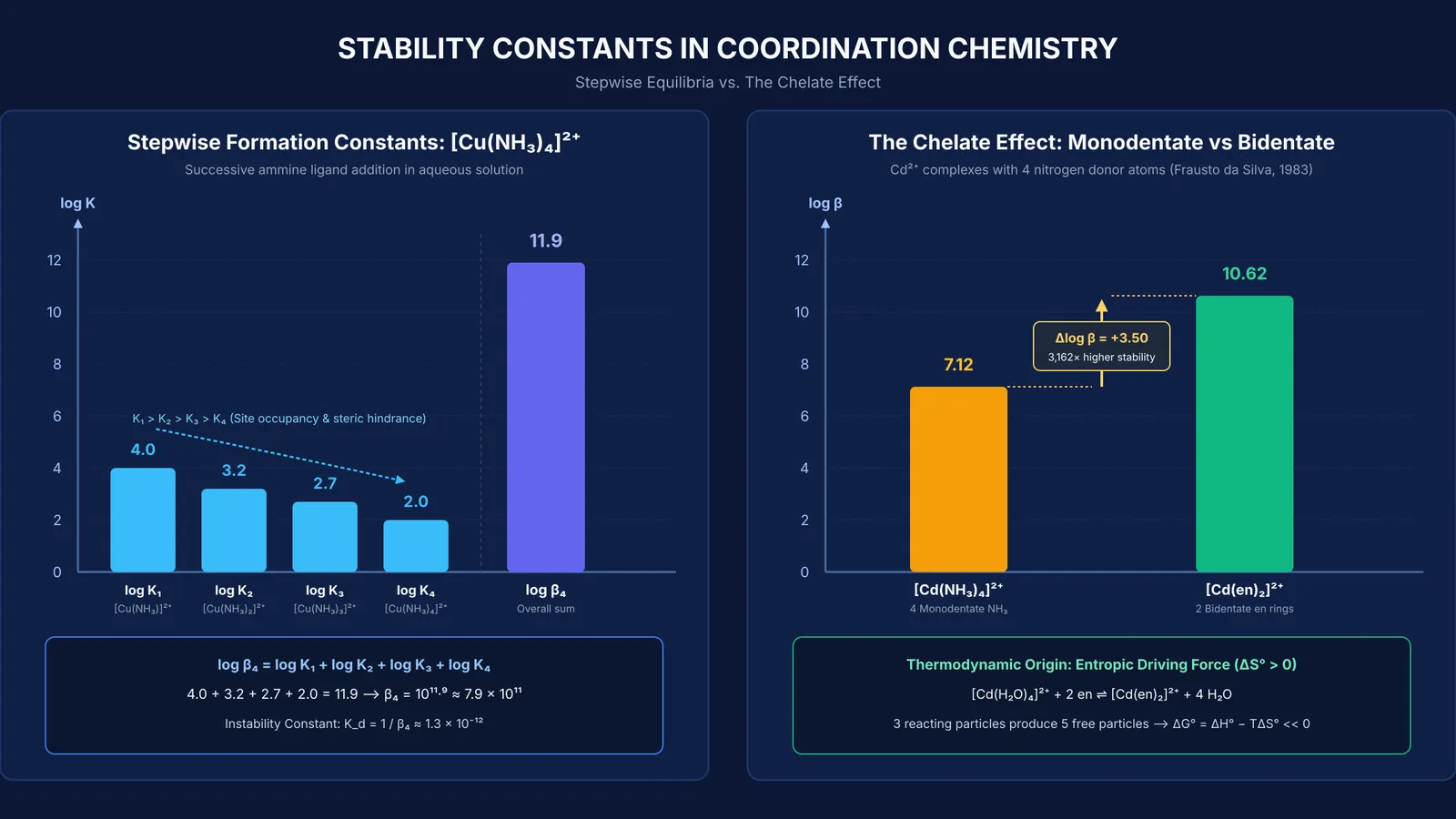
For complexes with monodentate ligands, experimental measurements show a regular decrease: K₁ > K₂ > K₃ > K₄.
Three factors cause this drop:
Statistical factor: As ligands bind, fewer vacant coordination sites remain on the metal ion, while more attached ligands can detach.
Steric hindrance: Adding bulky ligands crowds the coordination sphere, making successive additions geometrically more difficult.
Electrostatic repulsion: When anionic ligands bind to a cation, each addition decreases the net positive charge, weakening electrostatic attraction for the next ligand.
Danish chemist Jannik Bjerrum established this stepwise progression in his 1941 work on metal ammines. Later, Harry Irving and Robert J. P. Williams showed in their 1953 study on the stability of transition-metal complexes that divalent transition metal complexes follow the universal stability sequence Mn²⁺ < Fe²⁺ < Co²⁺ < Ni²⁺ < Cu²⁺ > Zn²⁺. When students struggle to see why stability constants vary across metals, the Fermi Problem Library offers worked problems with a step-by-step solver that explains the underlying reasoning rather than just printing an answer.
How does the chelate effect increase complex stability?
Chelating ligands—polydentate molecules forming five- or six-membered rings with the central metal ion—produce far more stable complexes than comparable monodentate ligands. In 1952, Gerold Schwarzenbach termed this stabilization the chelate effect.
Comparing cadmium complexes illustrates the magnitude:
[Cd(NH₃)₄]²⁺ has an overall stability constant of log β₄ = 7.12.
[Cd(en)₂]²⁺ has an overall stability constant of log β₂ = 10.62.
As analyzed by J. J. R. Frausto da Silva in his 1983 study on the chelate effect, this 3.50 log unit increase makes the chelate complex over 3,100 times more stable in solution, despite both having four cadmium-nitrogen bonds.
This stabilization is predominantly entropic. As Robert D. Hancock demonstrated in chelate ring size analyses, replacing four coordinated water molecules with two bidentate ligands turns three reacting species into five free particles. This net increase in particles yields a positive entropy change (ΔS° > 0), making the standard free energy change (ΔG° = ΔH° − TΔS°) significantly more negative.
How do you solve stability constant problems step by step?
Examinations frequently test conversions between stepwise constants, overall constants, and dissociation constants:
Identify given constants: Check whether the problem states stepwise constants (K₁, K₂, ...) or the cumulative constant (βₙ).
Sum the logarithms: Calculate overall log βₙ by adding stepwise logarithms: log βₙ = Σ log Kᵢ.
Find βₙ: Convert from logarithmic form: βₙ = 10^(log βₙ).
Compute dissociation constant: Determine the instability constant via the reciprocal: K_d = 1 / βₙ.
Worked numerical example:
Problem: For the tetraamminecopper(II) ion, [Cu(NH₃)₄]²⁺, the stepwise constants reported in the NCERT chemistry text are log K₁ = 4.0, log K₂ = 3.2, log K₃ = 2.7, and log K₄ = 2.0. Calculate the overall stability constant (β₄) and the instability constant (K_d).
Step 1: Add the stepwise logarithms: log β₄ = 4.0 + 3.2 + 2.7 + 2.0 = 11.9.
Step 2: Convert to β₄: β₄ = 10¹¹·⁹ ≈ 7.9 × 10¹¹.
Step 3: Calculate K_d: K_d = 1 / β₄ = 1 / (7.9 × 10¹¹) ≈ 1.3 × 10⁻¹².
Step 4: Interpret stability: Because β₄ is on the order of 10¹², copper(II) exists overwhelmingly as the tetraammine complex at equilibrium in aqueous ammonia, leaving negligible uncomplexed Cu²⁺. In companion textbook problems where β₄ is directly specified as 2.1 × 10¹³, the corresponding dissociation constant evaluates to K_d = 1 / (2.1 × 10¹³) ≈ 4.8 × 10⁻¹⁴.
Just as counting ionisable ions clarifies precipitation in Werner complexes and ionisable chlorides, stability constants govern how strongly inner-sphere ligands remain bound.


