

On this page
If an exam asks which class Torpedo belongs to, the answer is Chondrichthyes, the cartilaginous fishes. The electric eel is a different story, and the two are easy to mix up. Both fish make electricity from modified muscle, but they sit on different branches of the fish family tree, carry their organs in different places and fire them in different directions.
Which class do Torpedo and the electric eel belong to?
The NCERT Class 11 Animal Kingdom chapter places Torpedo in class Chondrichthyes and gives it as the example of a fish with electric organs. The same chapter describes Chondrichthyes as having a cartilaginous endoskeleton, gill slits without an operculum and no air bladder.
The electric eel (genus *Electrophorus*) is a bony fish: the Smithsonian's National Zoo lists it in class Actinopterygii, the ray-finned fishes, order Gymnotiformes. In NCERT's scheme that puts it with the Osteichthyes, the bony fishes with an operculum over the gills. Despite the name, it is not a true eel; the zoo notes it is more closely related to catfish and carp.
Misleading names are a favourite trap; see the other common mistakes in the Animal Kingdom chapter.
Where are the electric organs in Torpedo and the electric eel?
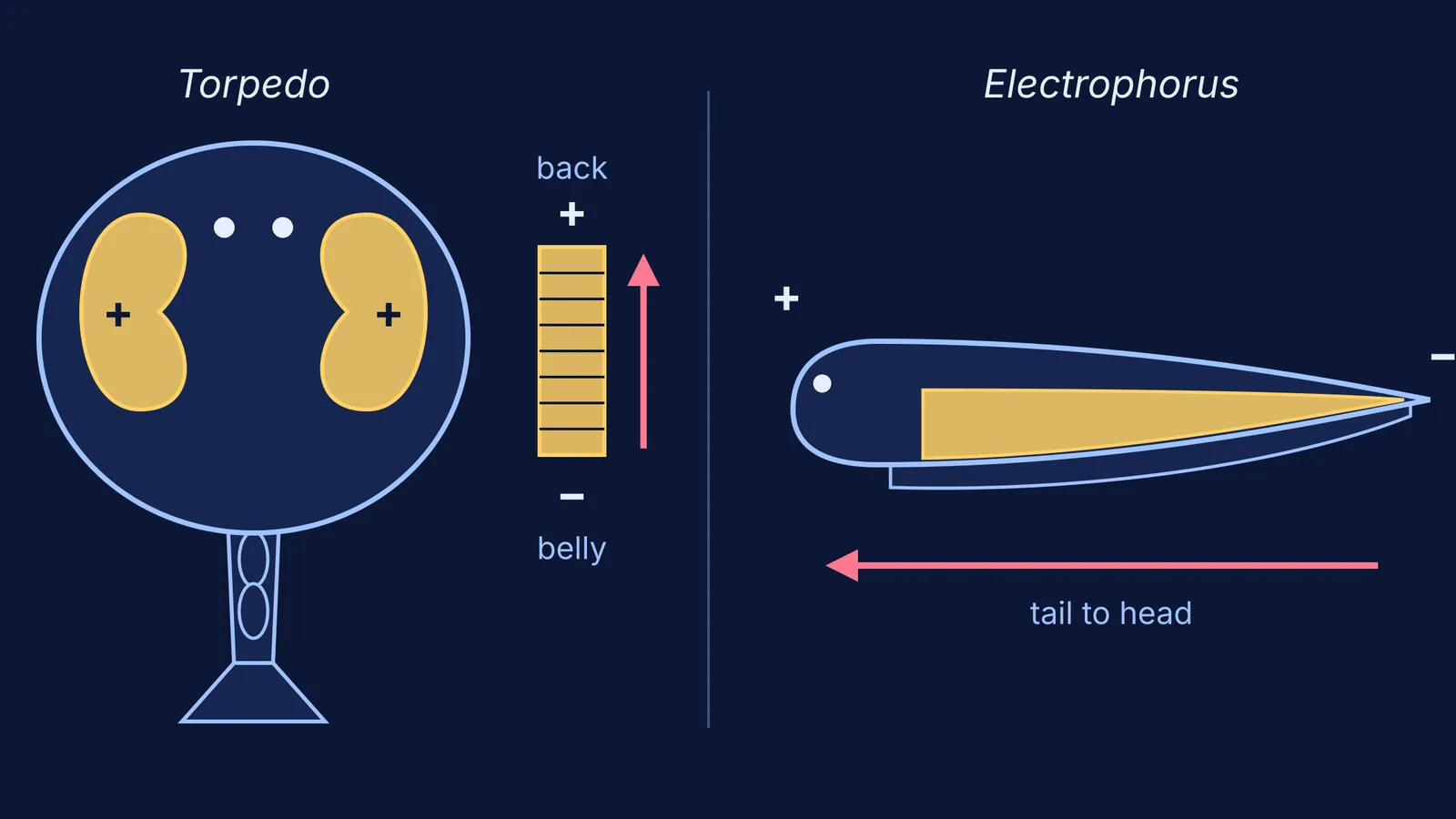
In the Atlantic torpedo, two kidney-shaped electric organs sit in the pectoral fins on either side of the head, according to the Florida Museum of Natural History. Each organ is built of honeycomb-like columns, and each column holds 500 to more than 1,000 plates of modified gill-arch muscle, as summarised in this overview of electric rays. Current passes from the lower to the upper surface of the body, so the back is the positive end and the belly the negative end.
The electric eel has three paired organs, the main organ, Hunter's organ and Sachs' organ, arranged lengthwise along the body (overview of the electric eel). The Smithsonian's National Zoo says these organs make up about 80 percent of the fish's body. Kenneth Catania's PNAS (2016) paper describes its high-voltage volleys as head-positive pulses, so the eel works like a long battery with the head as the + end. Our post on how the electric eel stacks its cells in series explains how that length turns into high voltage.
What does each fish use its shock for?
Torpedo is an ambush hunter. The Florida Museum says the Atlantic torpedo wraps a fish in its pectoral fins and delivers a 170-220 volt shock that stuns or kills it before eating. The shock also deters predators: sharks and other large fishes seldom confront electric rays. Across electric ray species the discharge ranges from 8 to 220 volts (electric ray overview).
The electric eel uses two kinds of discharge. A weak pulse of nearly 10 volts from Sachs' organ is thought to be used for electrolocation, sensing objects around it in murky water (electric eel overview). The strong pulses hunt and defend:
Hunting: Catania reported in Science (2014) that high-voltage volleys activate the prey's own motor neurons, locking its muscles in a whole-body contraction so it cannot escape, and that volleys of two or three pulses make hidden prey twitch and give away its position. Later work has questioned part of this account.
Defence: in PNAS (2016) Catania showed that eels leap out of the water to shock a threat directly.
Record: a 2019 study in Nature Communications split the electric eel into three species and recorded 860 volts from one of the two new species, which the authors call the strongest living bioelectricity generator.
Torpedo's cartilaginous relatives work with electricity too: sharks sense tiny electric fields with their ampullae of Lorenzini.
Torpedo vs electric eel: a one-minute checklist
Skeleton: Torpedo is cartilaginous (Chondrichthyes); the electric eel is bony (Actinopterygii, a bony fish).
Habitat: Torpedo is a marine ray; the electric eel lives in slow-moving fresh water of the Amazon and Orinoco basins, per the National Zoo.
Organ position: Torpedo's two kidney-shaped organs sit beside the head in the pectoral fins; the eel's three organs run along its body.
Direction: Torpedo fires belly to back; the eel fires tail to head.
Uses: both stun prey and deter predators; only the eel adds a low-voltage pulse for electrolocation.
How might an exam test Torpedo and the electric eel?
Torpedo belongs to which class? Answer: Chondrichthyes.
Which of these has an operculum: Torpedo or *Electrophorus*? Answer: *Electrophorus*, because it is a bony fish; Chondrichthyes have no operculum.
Assertion: the electric eel is a true eel. Answer: false; it belongs to the knifefish order Gymnotiformes.
If question 2 tripped you up, the gap is usually the Chondrichthyes-Osteichthyes split rather than electric fish. The Fermi Concept Library covers every concept in biology, each with its own lesson and its place in the map.
Next time you revise Pisces, add one line to your notes: Torpedo, cartilage, head, belly to back; eel, bone, body, tail to head.


