

On this page
In 2006, a team led by Edward Daeschler, Neil Shubin and Farish Jenkins described a fossil fish from Arctic Canada that had a neck, ribs and wrist-like bones. They named it Tiktaalik roseae. It is now one of the textbook examples of a transitional fossil, and the way it was found matters as much as what it is.
Why is Tiktaalik called a transitional fossil?
A transitional fossil is one that shows a mix of features from an older group and a later group that came from it. The original paper in Nature describes Tiktaalik as "an intermediate between fish with fins and tetrapods with limbs" (Daeschler, Shubin and Jenkins, Nature 2006). Tetrapods are vertebrates with limbs rather than paired fins, and their descendants: amphibians, reptiles, birds and mammals, including you.
The same paper lists the fish side: body scales, fin rays, lower jaw and palate like those of older lobe-finned fish. It also lists the tetrapod side: a shortened skull roof, a modified ear region, a mobile neck and a functional wrist joint.
Tiktaalik lived about 375 million years ago, and the fossils come from Ellesmere Island in Canada's Nunavut Territory (University of Chicago Medicine, 2006).
How did scientists predict where to dig for Tiktaalik?
The team did not stumble on Tiktaalik. They reasoned their way to it.
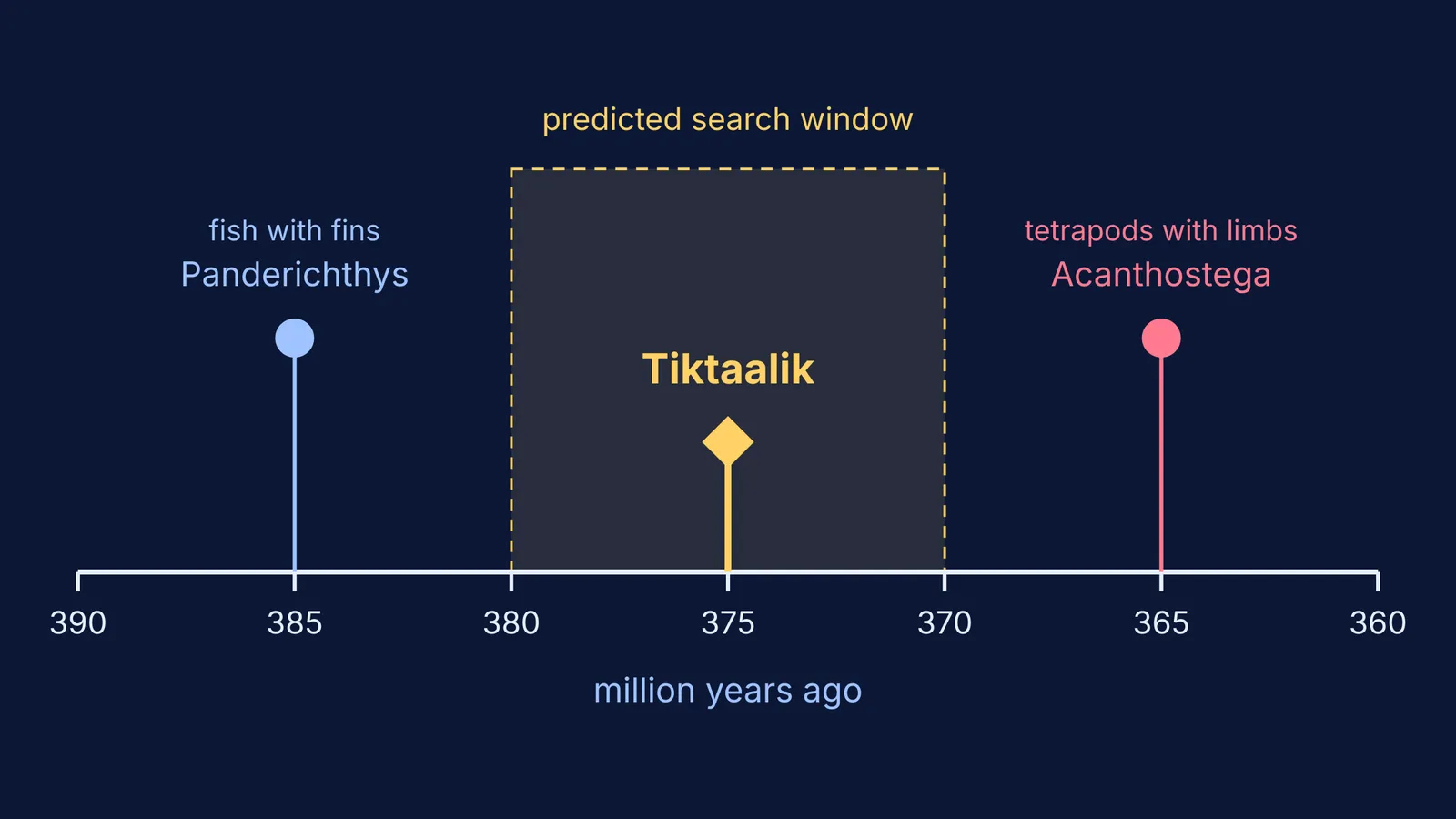
Tetrapod-like fish such as Panderichthys lived about 385 million years ago, and the earliest tetrapods, Ichthyostega and Acanthostega, lived about 365 million years ago (Scientific American, 2006). If fish became four-limbed animals, the in-between forms should sit in rocks from the gap between those dates. They also needed rocks laid down in shallow streams and coasts, where such animals would have lived.
According to the Harvard Gazette, Shubin found a map in a geology textbook showing three major outcrops of Devonian rock: Pennsylvania, where he was already working, east Greenland, which had been well explored, and the Canadian Arctic, which was largely unexplored. Fieldwork in the Arctic began the following summer, in 1999. The University of Chicago release says the fossils came out of four summers of exploration in Nunavut.
What do Tiktaalik's neck, wrist bones and gills show?
Neck. A neck is "seen for the first time in the fossil record in Tiktaalik" and helps an animal whose body is held fairly still against the ground, as in shallow water and on land (University of Chicago, 2008).
Wrist and fin bones. The front fin has an expanded set of bones with synovial joints, similar to the limbs of early tetrapods, and could hold a limb-like stance with the shoulder and elbow bent (Shubin, Daeschler and Jenkins, Nature 2006). The fin still has fin rays, so it is not a foot.
Gills and lungs. Tiktaalik had scales, fins and gills, but also lungs (Harvard Gazette, 2009). A gill-related bone, the hyomandibula, is greatly reduced, which suggests these animals were starting to rely less on gills for breathing (University of Chicago, 2008, linked above).
Hips. A 2014 study found that its pelvic girdle and hind fin kept a primitive layout but were enlarged and sturdy, much like those of tetrapods (Shubin, Daeschler and Jenkins, PNAS 2014).
Why does Tiktaalik count as a test of evolution?
A test is a prediction that could fail. Evolution predicted that fish-tetrapod intermediates should appear in rocks of a certain age and type. The team could have spent years in the Arctic and found only ordinary fish. They found Tiktaalik instead, which is why it is often described as a successful prediction rather than a lucky find.
The story kept moving. In 2010, tetrapod footprints from Poland were dated to about 18 million years before the earliest tetrapod body fossils and about 10 million years before the oldest Tiktaalik-like fish (Niedźwiedzki and colleagues, Nature 2010). So in an answer, call Tiktaalik a close relative that shows the in-between stage, not the direct ancestor of land animals. Revising the picture with new evidence is how science works. Our explainer on what "theory" means in science goes further.
How do you write Tiktaalik into an exam answer?
For a question on fossil evidence, use this four-step frame (dates from Scientific American, 2006):
Define: a transitional fossil shows features of an older group and a later group descended from it.
Prediction: fish at about 385 million years and tetrapods at about 365 million years, so intermediates expected near 375 million years.
Evidence: Tiktaalik, Ellesmere Island, Canada; fish features (scales, fin rays, gills) and tetrapod features (mobile neck, wrist joint, lungs).
Meaning: the fossil was found in rocks of the age and type the theory pointed to, so it is a successful test.
The same frame works for Archaeopteryx, the link between reptiles and birds, and for the fossil series of horse evolution.
If terms like synovial joint or lobe-finned fish are fuzzy, the Fermi Concept Library has a lesson for every concept in biology, each with its place in the map, so you can fill the gap before you write.


