

On this page
When a classmate, a relative or a forwarded message says evolution is "just a theory", they are using the word the way we use it at the dinner table. Scientists use it very differently, and once you see the difference, the argument loses its force.
What does theory mean in science?
In everyday speech, a theory is a hunch. The US National Academy of Sciences says as much in its evolution resources: in everyday usage, "theory" often refers to a hunch or a speculation.
In science, a theory is "a comprehensive explanation of some aspect of nature that is supported by a vast body of evidence", according to the National Academy of Sciences.
The Academy's definitions keep three words apart:
Fact: an observation, measurement or other evidence that can be expected to occur the same way under similar circumstances.
Hypothesis: a tentative explanation for an observation or problem that can be tested by further investigation.
Theory: a well-substantiated explanation of some aspect of the natural world, one that can be used to predict things not yet observed.
So a theory is not a step below a fact: facts are what theories explain.
Is gravity just a theory too?
Yes, in the same sense. An apple falling is a fact. The theory of gravitation explains why it falls and how fast, and its strength lies in its predictions. The Academy notes that the theory of gravitation "predicted the behavior of objects on the moon and other planets long before the activities of spacecraft and astronauts confirmed them" (National Academy of Sciences).
Germ theory, the idea that specific microbes cause specific diseases, is the other useful comparison. According to his Nobel Prize biography, Robert Koch grew anthrax bacilli in pure culture and showed they could still cause the disease, work published in 1876; he published his work on the tubercle bacillus in 1882, and in Egypt in 1883 he found the vibrio that causes cholera. Nobody washing their hands before dinner thinks germs are "just a theory". Evolution has the same scientific standing as both.
What is the evidence for evolution?
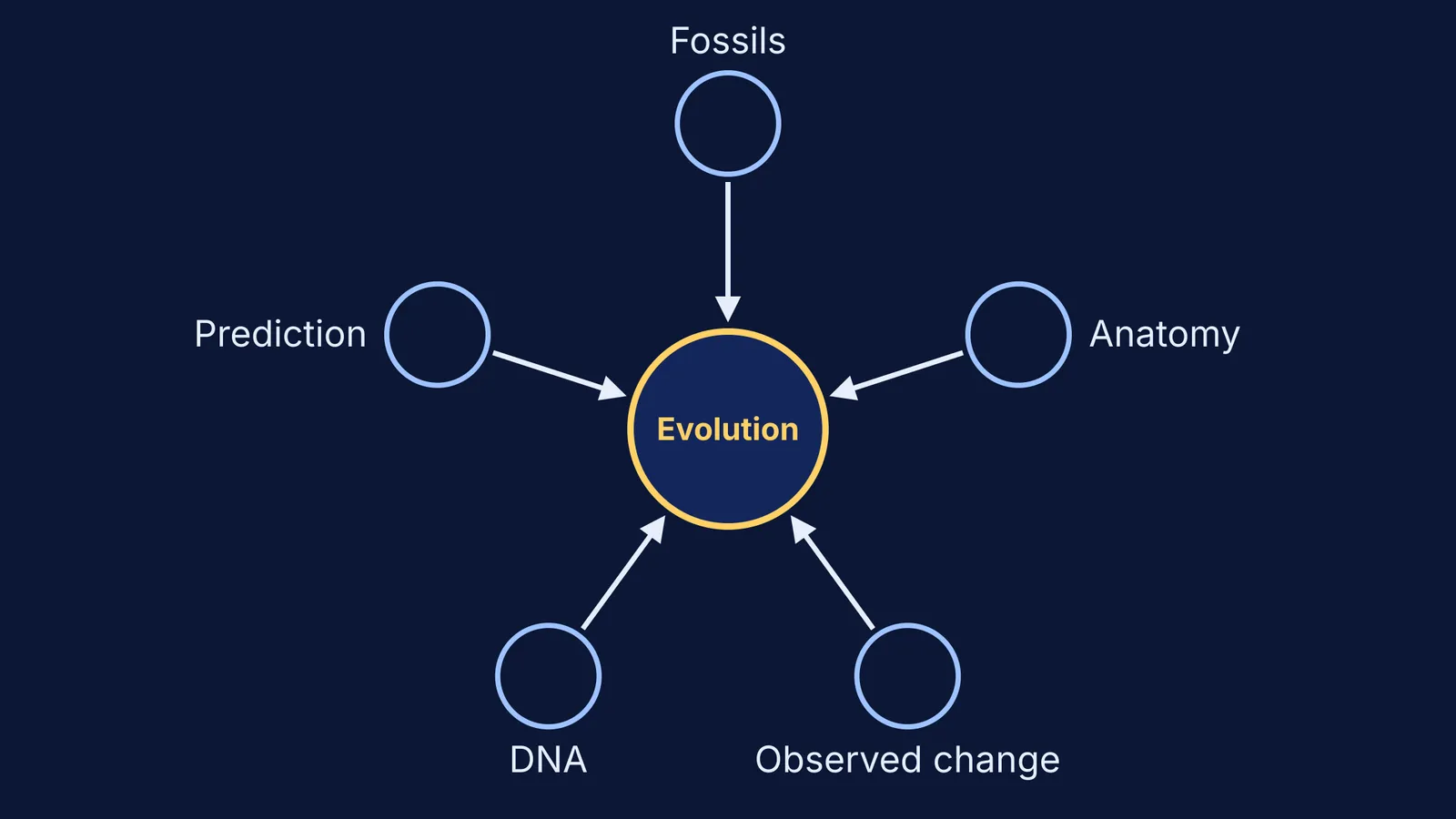
Several independent kinds of evidence, gathered by different scientists with different tools, point to the same answer.
Fossils in order. The Academy notes that nowhere on Earth are dinosaur fossils found together with human fossils (National Academy of Sciences). See how fossils and radioactive dating show evolution.
A prediction that came true. Biologists predicted they would find fossils intermediate between fish and limbed land animals in rocks about 375 million years old, and *Tiktaalik* confirmed it (National Academy of Sciences). Described in Nature in 2006, this fish from Arctic Canada had scales and fin rays, but also a mobile neck and a functional wrist joint.
Shared body plans. Organs with the same underlying structure but different jobs point to a shared ancestor; see our guide to homologous versus analogous organs.
DNA. Comparing the chimpanzee genome with the human genome, researchers catalogued the changes since the two species split from a common ancestor: about 35 million single-nucleotide changes and five million insertions or deletions (Chimpanzee Sequencing and Analysis Consortium, 2005).
Evolution you can watch. The yearly changes in flu viruses and the rise of antibiotic-resistant bacteria are products of evolution (National Academy of Sciences). In a laboratory study, 12 populations of *E. coli* were started in 1988; after more than 30,000 generations, one had evolved the ability to use citrate as a carbon source (Blount, Borland and Lenski, 2008).
Any of these could, in principle, have contradicted evolution. None has. That is why the Academy says the past and continuing occurrence of evolution is also a scientific fact: scientists continue to study the mechanisms of how it operates, not whether it happened.
If homology or natural selection still feels shaky, the Fermi Concept Library has a lesson for every concept in biology.
How do you answer "it's just a theory"?
A calm three-question check works better than a lecture.
Which meaning? "Do you mean theory as in a guess, or theory as in germ theory?"
What does it predict? A good theory sticks its neck out. Evolution said what age of rock should hold a fish partway to a land animal, and *Tiktaalik* turned up.
How many independent lines agree? Fossils, anatomy, DNA and lab experiments were gathered separately. A guess does not get confirmed five different ways.
Worked example: run the same check on "My theory is that our team lost because of the new jersey." It means a guess, it predicts nothing you could test, and it rests on one match. It fails all three; evolution passes all three.
A common follow-up mistake is picturing evolution as aiming at a goal; see why evolution is not goal-directed. If you are unsure where to start revising the chapter, Fermi's AI tutor can work out what you already know and build a plan for the session.


