

On this page
Your Class 11 NCERT biology chapter says thyroid hormones "play an important role in the regulation of the basal metabolic rate" (NCERT Biology, Chapter 19), but not how. In short, thyroxine makes cells spend energy faster, and spent energy ends up as heat. Biologists call this the calorigenic effect: more oxygen used, more heat made.
What is basal metabolic rate?
Basal metabolic rate (BMR) is the minimum energy needed to keep a person alive while awake and resting in a steady state, says a 2019 review that treats it as the same as resting energy expenditure, REE (Yavuz, Salgado Nunez del Prado and Celi, 2019).
BMR is measured by indirect calorimetry, which records oxygen taken in and carbon dioxide breathed out. The Weir equation turns those flows into energy: kcal per minute = 3.941 x litres of O2 per minute + 1.106 x litres of CO2 per minute, minus a small urinary-nitrogen term (Mtaweh and colleagues, 2018). So "more oxygen used" and "more energy spent" are two ways of saying the same thing.
How does thyroxine increase basal metabolic rate?
The thyroid releases thyroxine (T4), and tissues convert it to the more active triiodothyronine (T3) with enzymes called deiodinases. A 2014 review in Physiological Reviews calls one of them, type 2 deiodinase, essential for heat production in brown fat (Mullur, Liu and Brent, 2014). From there, follow the chain:
T3 acts on receptors inside the cell and changes which genes are switched on.
Ions leak across cell membranes faster, so the Na+/K+-ATPase and the calcium pump of muscle (SERCA) must spend extra ATP to keep their gradients (Yavuz and colleagues, 2019).
To replace that ATP, mitochondria oxidise more glucose and fat, which uses more oxygen.
In skeletal muscle, more protons also leak back across the inner mitochondrial membrane, so more fuel is burned for the same ATP and the difference is released as heat.
Mullur and colleagues call thyroid hormone's effects on fat, glucose and protein cycles "minor contributions to BMR".
Thyroxine works slowly because it acts through genes; our post on why adrenaline acts in seconds but thyroxine takes days follows that timing.
Why does too much or too little thyroid hormone change how warm you feel?
"Cold and heat intolerance are hallmark clinical features of patients with hypothyroidism and hyperthyroidism, respectively," write Mullur, Liu and Brent (Physiological Reviews, 2014). The NHS lists "feeling cold more than usual" among the symptoms of an underactive thyroid, and "sensitivity to heat" and "warm skin and excessive sweating" for an overactive thyroid.
In six women with Graves' disease, REE was 140% of the predicted value before treatment and fell to 113% after 52 weeks on the drug methimazole. In nine people treated for hypothyroidism, REE changed by 15% as their thyroxine dose was adjusted to move their TSH level from 0.1 to 10 μIU/mL, even though their free T4 stayed in the normal range (Yavuz and colleagues, 2019). NCERT lists increased basal metabolic rate and weight loss as signs of exophthalmic goitre; see simple goitre vs exophthalmic goitre for how the two differ.
How much extra heat is that? A worked example
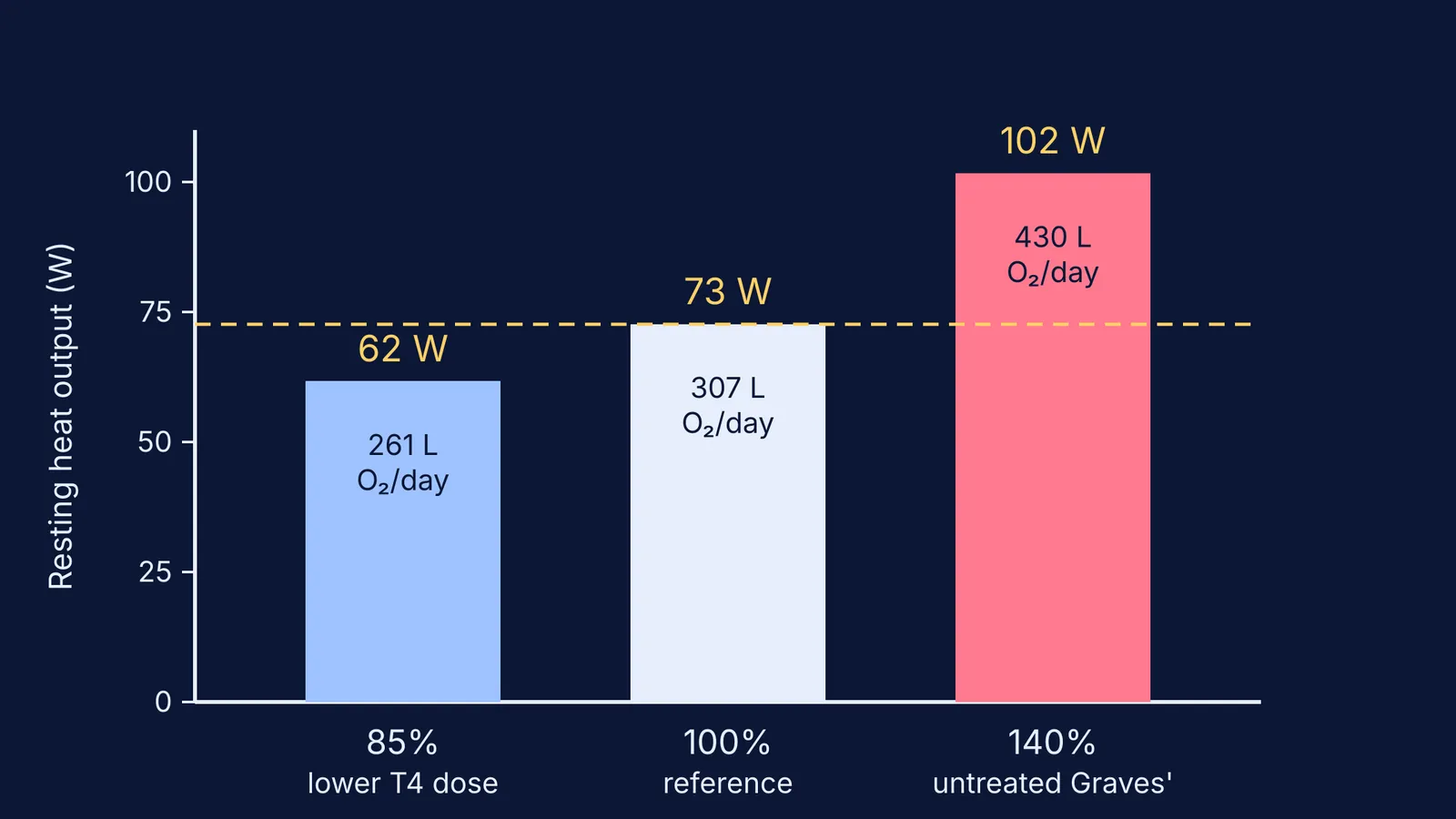
Take a made-up resting energy use of 1,500 kcal per day (an illustration, not a target) and apply the 140% and 15% figures reported by Yavuz and colleagues (2019).
Normal: 1,500 x 4,184 J / 86,400 s = about 73 W of heat.
Raised to 140%, like the Graves' patients before treatment: 2,100 kcal per day, about 102 W. That is 29 extra joules every second.
Lowered by 15%: 1,275 kcal per day, about 62 W, or 11 W less.
For oxygen, assume 0.85 litres of CO2 breathed out per litre of O2 taken in (a respiratory quotient of 0.85) and ignore the small nitrogen term. The Weir equation then gives 3.941 + 1.106 x 0.85 = about 4.88 kcal per litre of oxygen. So 1,500 kcal needs about 307 litres of oxygen a day, and 2,100 kcal needs about 430 litres.
The extra 29 W leaves through the skin, fitting the warm skin and sweating the NHS lists. With 11 W less, the body must save heat instead; see why we shiver and how the body's thermostat works.
How should you revise this for an exam?
Without notes, can you:
Define BMR and say that T4 becomes T3 in tissues?
Name the two pumps: Na+/K+-ATPase and SERCA?
Contrast high BMR, heat intolerance and weight loss with low BMR, feeling cold and weight gain?
If one link feels shaky, the Fermi Concept Library has a lesson for every concept in biology, physics and chemistry, each placed in its map. For calculations like the watts example, the Fermi Problem Library has worked problems with a step-by-step solver that explains the reasoning rather than printing an answer.
Next time your textbook says "regulates BMR", follow it down to a pump, a litre of oxygen and a few watts of heat.


