

On this page
A dog barks behind you and your heart is pounding before you have turned round. Someone starting thyroid hormone tablets, by contrast, does not feel different the same afternoon. Both signals travel in the same blood. The difference comes down to one question: where does the hormone meet its receptor, and what has to happen after that? If receptors are new to you, start with our explainer on how hormones act through receptors.
Why does adrenaline act in seconds?
Adrenaline (epinephrine) is an amine hormone from the adrenal medulla, and it works from outside the cell. OpenStax Anatomy and Physiology explains that water-soluble hormones cannot cross the lipid bilayer, so they pass their message to a receptor on the cell surface. That receptor is linked to a G protein, which switches on an enzyme that makes cyclic AMP (cAMP), the second messenger.
Nothing new has to be built. The enzymes are already in the cell, waiting to be switched on by phosphorylation. OpenStax notes that this cascade increases the speed and efficiency of the response, because a very low concentration of hormone can start thousands of signalling events.
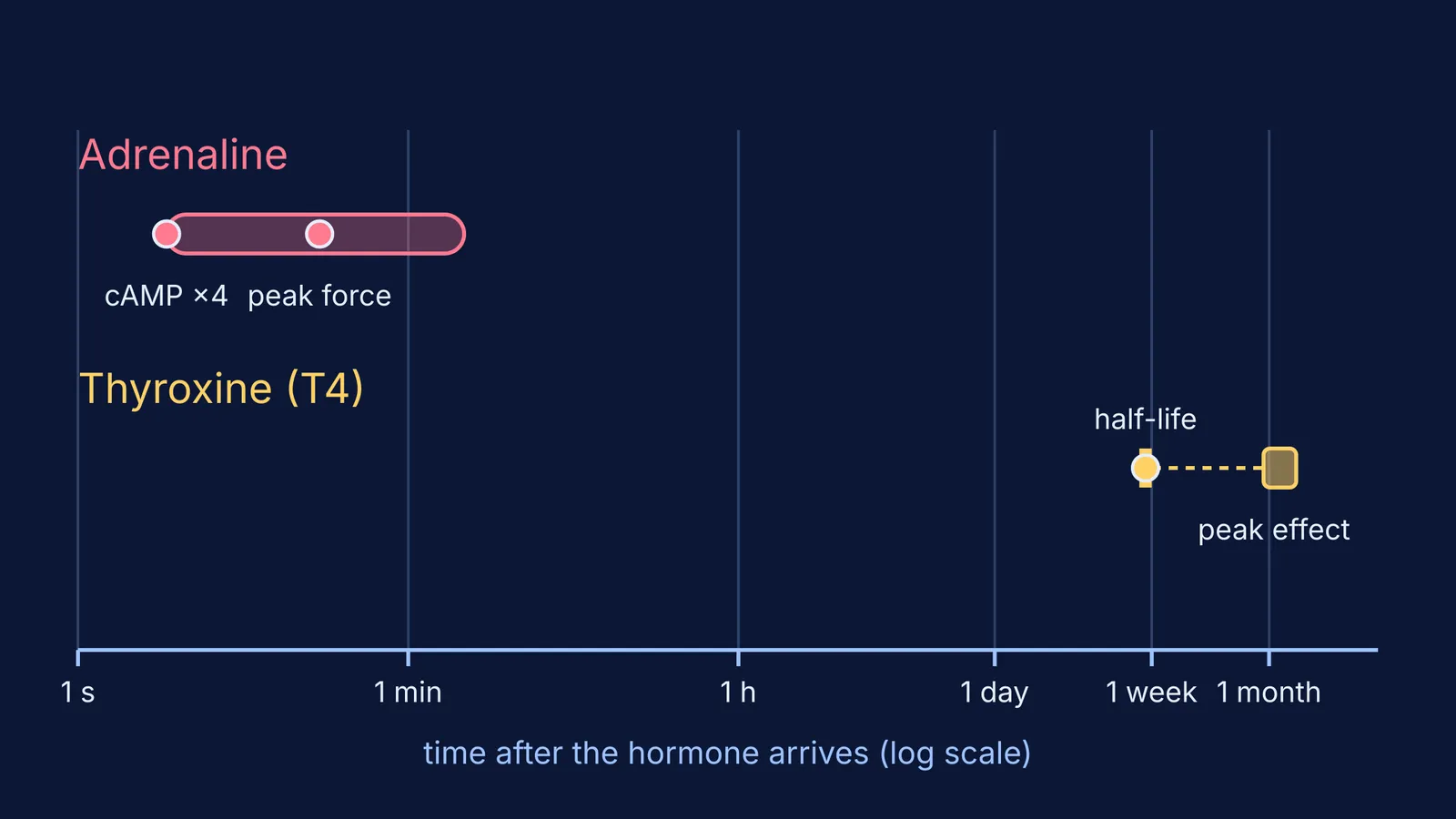
The numbers come from the scientist who discovered cAMP. In his 1971 Nobel lecture, Earl Sutherland reported that, in his group's experiments, a single injection of epinephrine into an isolated, working rat heart raised cAMP four-fold within 3 seconds. In the same figure, the heart's force of contraction peaked about 20 seconds after the injection and was almost back to normal within two minutes.
The off switch is just as quick. An enzyme called phosphodiesterase breaks cAMP down, so the signal is short (OpenStax). Fast on, fast off is what an emergency hormone needs; our guide to adrenaline's emergency effects covers what it does to the heart, lungs and liver.
Why does thyroxine take days to work?
Thyroxine (T4) works from inside the nucleus. Thyroid hormones bind thyroid hormone receptors, which belong to the nuclear receptor family and act as transcription factors on target genes, according to the Endotext chapter by Rohit Sinha and Paul Yen. The US FDA label for levothyroxine says the hormone-receptor complex activates gene transcription and the synthesis of messenger RNA and proteins.
So the chain is longer: switch genes on, make mRNA, make new proteins, and only then does the cell's metabolism change. Three more things stretch the clock:
T4 is largely a prohormone. Sinha and Yen describe T4 as a prohormone for the more potent T3, which binds the receptor with about 10-fold higher affinity (Endotext).
Most T3 is made from T4 in the tissues: approximately 80% of circulating T3 comes from T4 this way (FDA label).
T4 lingers. More than 99% of circulating thyroid hormone is bound to plasma proteins, and T4's half-life is 6 to 7 days in people with normal thyroid function, against 2 days or less for T3 (FDA label).
The result is a slow build. The 2024 Synthroid label states that the peak therapeutic effect of a dose may not be reached for 4 to 6 weeks. The same gene-driven control runs development too, as in how thyroxine drives frog metamorphosis.
How can you predict a hormone's speed?
Use this three-question check on any hormone in your syllabus:
Can it cross the cell membrane? If not (peptides, and amines such as adrenaline), expect a surface receptor and a second messenger. If it gets in (steroids, and thyroid hormones, which use their own carriers), expect an intracellular receptor (OpenStax).
Does the response need new proteins? Switching on enzymes the cell already has takes seconds. Reading genes and building proteins takes much longer.
How long does the signal last? A messenger broken down quickly gives a brief effect; a long half-life gives a steady one.
One honest caveat: the split is not perfectly clean. Sinha and Yen note evidence that thyroid hormones can also bind membrane proteins and trigger cell signalling, but their main effects run through nuclear receptors and gene expression (Endotext).
How does this show up in exam questions?
Here is a worked assertion-reason example.
Assertion: The effect of adrenaline on the heart appears within seconds.
Reason: Adrenaline binds a receptor in the nucleus and changes gene expression.
Step 1: The assertion is true; in the rat heart experiment described in Sutherland's Nobel lecture, cAMP rose four-fold within 3 seconds. Step 2: The reason is false; adrenaline acts at the cell surface through a second messenger. Answer: assertion true, reason false. Now swap in thyroxine: the nuclear receptor and gene expression make the reason true, and the within-seconds assertion false.
To see second messengers and nuclear receptors side by side, the Fermi Concept Library gives every biology concept its own lesson and its place in the map. If you keep picking the wrong mechanism in assertion-reason questions, the Fermi Problem Library has worked problems with a step-by-step solver that explains the reasoning rather than printing an answer.


