

On this page
Put your hand flat on a desk and move only the thumb. It slides sideways, lifts off the desk, and can swing across the palm to touch your little finger. No other finger can make that last move, and the reason is a joint near your wrist.
What is a saddle joint?
A saddle joint is a synovial joint in which the opposing surfaces are reciprocally concave and convex, according to the Wikipedia entry on saddle joints. Each surface curves up in one direction and down in the direction at right angles, like a horse's saddle, which dips from front to back and arches from side to side. The same page lists the thumb, the sternoclavicular joint at the top of the chest, a joint in the middle ear and one in the heel as examples. It says saddle joints allow flexion, extension, abduction, adduction and circumduction, but not axial rotation. The thumb bends that rule a little.
Why is the thumb joint called a saddle joint?
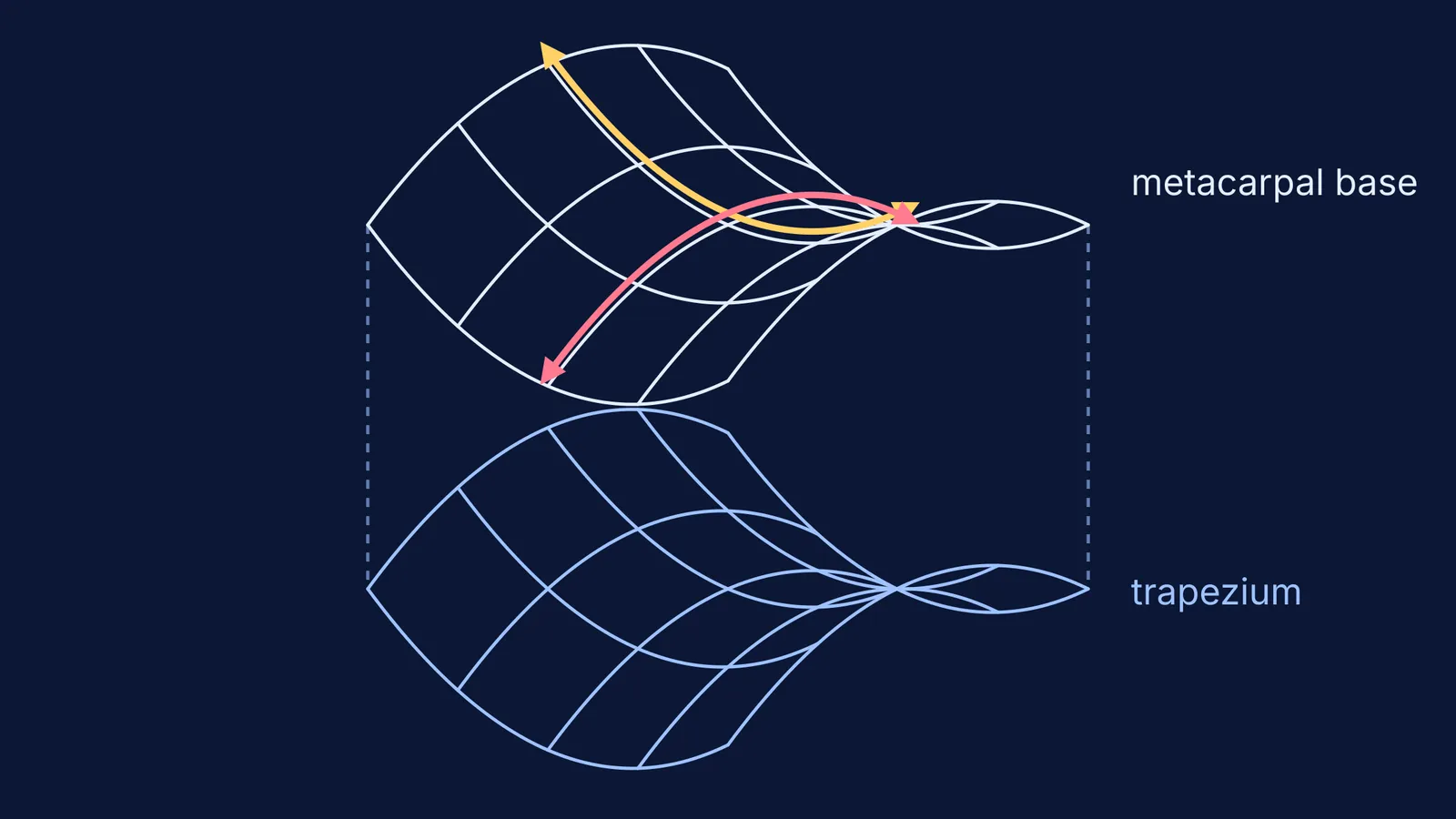
The thumb's carpometacarpal (CMC) joint is where the trapezium, one of the small wrist bones, meets the base of the first metacarpal, the long bone inside the fleshy part of your thumb. Kenhub's anatomy guide also calls it the trapeziometacarpal joint, or the basal joint of the thumb, and classifies it as a synovial saddle joint.
Hand surgeon Amy Ladd describes the shape in a 2018 review in the Journal of Hand Surgery. The trapezium's surface is largely convex in the volar-dorsal direction (palm side to back of hand) and concave in the radial-ulnar direction (thumb side to little-finger side). The metacarpal's surface has matching curves, so the two nest like a rider on a saddle, with the curves crossing at right angles. Ladd notes that the metacarpal matches the trapezium only loosely.
That loose fit matters. Kenhub lists flexion-extension with a total range of 40 to 50 degrees, abduction-adduction of about 80 degrees, and axial rotation of 70 to 110 degrees. A textbook saddle joint has two axes; the real thumb also twists, helped by the loose fit of its surfaces and by its ligaments and muscles.
How does the saddle shape let the thumb oppose?
Kenhub defines opposition as bringing the tip of the thumb into contact with the tip of any of the other four fingers, and describes it as flexion with abduction, then internal rotation, then adduction. Each part maps onto the shape:
Rocking along the dip of the saddle swings the thumb in one plane.
Rocking across the arch swings it in the plane at right angles.
Combining the two lets the thumb trace a cone (circumduction).
The loose fit lets the metacarpal turn on its long axis, so the thumb pad ends up facing the finger pads instead of their sides.
Kenhub also points out that the thumb sits rotated about 90 degrees to the plane of the hand. That is why the thumb's "flexion" looks like a sideways sweep next to your fingers.
For the full set of joint types, from hinge to ball-and-socket, see our Locomotion and Movement notes for Class 11. If the crosswise fit is hard to picture from a flat textbook figure, the Fermi Simulation Lab has interactive simulations for ideas that are easier to see than to read.
What happens when you tape your thumb?
In a 2017 study in the Journal of Wrist Surgery, 50 healthy volunteers each spent 24 hours in a thumb spica cast, which held the thumb still, followed by a short arm cast, which left the thumb free. On a standard self-reported arm-function score, they averaged 68.7 in the thumb cast, against 93 in the free-thumb cast. Their typing speed averaged 38.84 words per minute in the thumb cast, against 49.38. The authors caution that 24 hours in healthy people cannot tell us much about longer immobilisation.
You can run a gentler version in ten minutes:
Choose five tasks: write your name, button a shirt, open a water bottle, pick a coin up from a table, tie a shoelace.
Predict which task will suffer most, and write it down.
Time each task with your hand free.
Tape your thumb loosely along your index finger with paper or masking tape, so it cannot swing across the palm.
Repeat the tasks in the same order, stopping any task at 60 seconds.
Divide each taped time by the free time. The biggest ratio shows where opposition was doing the most work.
The workarounds your hand invents, such as clamping things between two fingers, show what opposition normally does. Remove the tape at once if your fingers tingle, go pale or hurt. Skip the test if your hand is injured, and see a doctor or physiotherapist about any thumb pain.
Next, read why a pen and a bucket need different grips, or our explainer on double-jointedness. The Fermi Concept Library gives every biology concept its own lesson and its place in the map, so you can see where joints sit beside bones and muscles.


