

On this page
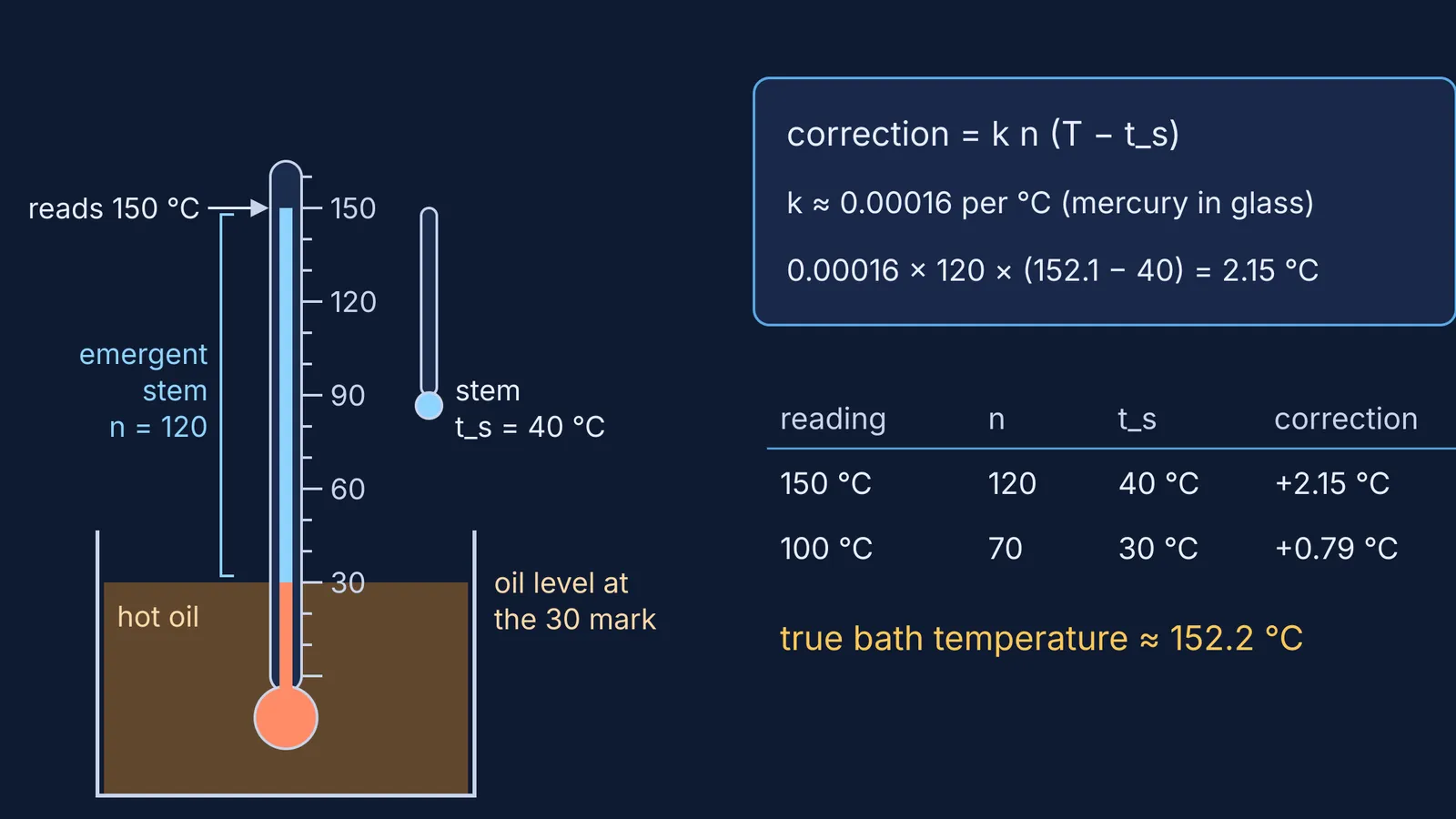
You heat an oil bath for a melting-point practical, dip a mercury laboratory thermometer in until the oil reaches its 30 °C mark, and read 150 °C. The bath is really at about 152 °C. The thermometer is not faulty. Most of its mercury column is sticking out into room air, and that cooler mercury has not expanded as much as the scale assumed. The fix is called the emergent stem correction, and it is a neat use of apparent expansion of a liquid in glass.
What is the difference between total and partial immersion thermometers?
A thermometer's scale is marked for a particular way of using it. The US National Bureau of Standards guide NBS Monograph 150, Liquid-in-Glass Thermometry defines three kinds:
Total immersion: reads correctly when the bulb and the whole mercury column are at the temperature being measured.
Partial immersion: reads correctly when the bulb and a stated length of stem are immersed. It is generally marked with an immersion line, and the rest of the stem is expected to be in room air.
Complete immersion: reads correctly only when the entire thermometer, including the expansion chamber at the top, is at the measured temperature.
A partial-immersion thermometer used at its marked depth needs no stem correction. The trouble starts when a total-immersion thermometer is used in a shallow bath or a test tube, with much of its column outside. The part outside is called the emergent stem.
Why does a thermometer read low when its stem sticks out?
The scale on a total-immersion thermometer assumes every bit of mercury is at the reading temperature T. If n degrees of the column are outside the liquid at an average temperature t_s, that mercury is cooler than the scale assumed by (T − t_s). It has expanded less, so the column is shorter and the reading is low.
How much shorter? The same Monograph gives a useful number. For mercury in "normal" glass, the bulb holds about 6,222 times the volume of one degree of the capillary. Warming the mercury by 1 °C pushes out a volume equal to one degree of capillary, so the apparent expansion of mercury in that glass is 1/6,222 = 1.61 × 10⁻⁴ per °C. This is the apparent coefficient, real expansion of mercury minus the expansion of the glass, explained in real and apparent expansion of liquids.
The emergent mercury is n degrees' worth of column. Heating it by (T − t_s) would lengthen it by a fraction k(T − t_s). So the missing length, in degrees, is
stem correction = k n (T − t_s)
This is the formula in NBS Monograph 150, which says that if the kind of glass is unknown you can take k = 0.00016 per °C for Celsius mercury thermometers. Its table gives k from 0.000158 to 0.000164 for normal glass between 0 and 300 °C, and from 0.000164 to 0.000188 for borosilicate glass between 0 and 450 °C. The correction is added to the reading.
How do you measure the stem temperature?
You cannot just use room temperature. Air just above a hot bath is warm, and the stem near the liquid is warmer than the stem near the top. The usual method is to tie a second, small thermometer beside the stem, with its bulb about halfway up the emergent column, and take its reading as t_s. The Monograph describes a more careful tool for this, a long-bulb "faden" thermometer that averages along the stem.
Because t_s is an estimate, the correction itself carries some uncertainty. A 5 °C error in t_s at n = 120 changes the correction by 0.00016 × 120 × 5 = 0.10 °C.
Worked example: an oil bath reading 150 °C
A total-immersion mercury thermometer reads 150 °C. The oil surface is at the 30 °C mark. A small thermometer beside the stem reads 40 °C.
Count the emergent degrees. n = 150 − 30 = 120 degrees.
First estimate. Use the reading for T: correction = 0.00016 × 120 × (150 − 40) = 0.00016 × 13,200 = 2.11 °C.
Improve it. The true bulb temperature is about 152.1 °C, not 150 °C. Use that: correction = 0.00016 × 120 × (152.1 − 40) = 2.15 °C. One more round changes nothing at this precision.
Answer. True temperature ≈ 150 + 2.15 = 152.2 °C.
Check the size. The fractional error is 2.15 / 152 = 1.4%. The Monograph's own example (90 °C reading, n = 30, stem at 80 °C) gives only 0.00016 × 30 × 10 = 0.048 °C. The correction is large here because both n and (T − t_s) are large.
A second case: a reading of 100 °C with the liquid at the 30 °C mark (n = 70) and the stem at 30 °C. Correction = 0.00016 × 70 × 70 = 0.78 °C, or 0.79 °C after one improvement round. So a "boiling point" taken with a long dry stem can be nearly a degree low.
Does the same correction work for alcohol thermometers?
The formula is the same, but k is very different. Organic liquids such as alcohol and toluene expand far more than mercury, and their expansion changes quickly with temperature. NBS Monograph 150 suggests an approximate k = 0.001 per °C for Celsius thermometers filled with such liquids, about six times the mercury value. With the same n = 70 and a 70 °C stem difference as above, that would be roughly 0.001 × 70 × 70 = 4.9 °C, so stem corrections matter even more for red-liquid thermometers.
Why is this like the metal scale correction?
Both are corrections for a measuring instrument sitting at a different temperature from the one it was calibrated at. A steel scale read at the wrong temperature gives lengths that are slightly off, worked in metal scale reading error at different temperatures. Here, part of a liquid column sits at the wrong temperature. In both cases the error is (expansion coefficient) × (amount being measured) × (temperature difference). The design of the laboratory thermometer itself is in clinical vs laboratory thermometer.
Many labs now use digital probes, and mercury thermometers are being phased out under the Minamata Convention on Mercury because mercury is toxic. Never handle spilled mercury yourself; tell your teacher. The physics of the correction still appears in exam questions and still applies to any liquid-in-glass thermometer.
If thermal expansion still feels slippery, the Concept Library covers real and apparent expansion concept by concept.
Quick checklist
Total-immersion thermometers assume all the mercury is at the reading temperature.
Partial-immersion thermometers used at their immersion line need no stem correction.
Stem correction = k n (T − t_s), added to the reading.
k ≈ 0.00016 per °C for mercury in glass, which is 1/6,222, the apparent expansion of mercury in the glass.
n is the number of scale degrees out of the liquid; t_s is measured with a second thermometer beside the stem.
Use the corrected temperature for T and recompute once.
For alcohol-filled thermometers, k ≈ 0.001 per °C.


