

On this page
This set follows our first Thermodynamics NEET practice set with eight new single-correct questions, easy to hard, each with a worked answer and a trap line.
Which Thermodynamics topics does set 2 cover?
The NMC syllabus for NEET (UG)-2026 lists Thermodynamics as Physics Unit 8: the zeroth law and temperature, heat, work and internal energy, the first law, isothermal and adiabatic processes, and the second law with reversible and irreversible processes. Set 1 tested signs, heating at fixed volume and pressure, an adiabatic temperature, a Carnot engine and a cycle. Set 2 adds the zeroth law, solids' specific heat, Cp − Cv = R, adiabatic pressure and slope, reversibility, process heat capacity and second-law limits.
All of it is in Chapter 11 of NCERT Class 11 Physics Part II (Reprint 2026-27), which gives C = 3R for a solid, Cp − Cv = R and PV^γ = constant. We use ΔQ = ΔU + ΔW (W done by the gas) and R = 8.3 J mol⁻¹ K⁻¹. New to the chapter? Read how to prepare Thermodynamics for NEET.
How should you use this practice set?
The NTA information bulletin for NEET (UG)-2026 gave +4 for a correct answer and −1 for a wrong one, so guesses cost marks.
Allow one minute each for Q1 to Q3 and two for the rest.
Write which of Q, W and ΔU is zero before any formula.
Mark every guess and read every trap.
Easy: zeroth law, solids and Cp − Cv
Q1 (easy). Blocks P and Q never touch, but each is in thermal equilibrium with the same thermometer. What must P and Q share?
(A) The same internal energy (B) The same temperature (C) The same heat content (D) Nothing, until they touch each other
Answer: (B). By the zeroth law, P and Q are in thermal equilibrium with each other, which means equal temperatures.
Trap: (A) forgets that internal energy also depends on the amount of material.
Q2 (easy). Taking C = 3R for a solid, how much heat raises 1.5 mol of a metal by 60 K?
(A) 1.12 kJ (B) 1.87 kJ (C) 2.24 kJ (D) 2.61 kJ
Answer: (C). ΔQ = nCΔT = 1.5 × 3 × 8.3 × 60 = 2241 J ≈ 2.24 kJ.
Trap: (A) uses 3R/2, a monatomic gas's Cv.
Q3 (easy). An ideal diatomic gas needs 830 J more heat to warm by 25 K at constant pressure than at constant volume. How many moles?
(A) 1.1 mol (B) 1.6 mol (C) 2.0 mol (D) 4.0 mol
Answer: (D). The extra heat is n(Cp − Cv)ΔT = nRΔT, so n = 830/(8.3 × 25) = 4.0 mol.
Trap: (A) and (B) divide by Cp = 7R/2 or Cv = 5R/2 instead of their difference.
Medium: adiabats, slopes and reversibility
Q4 (medium). A monatomic ideal gas (γ = 5/3) at 2.43 × 10⁶ Pa expands adiabatically to 27 times its volume. Find the final pressure.
(A) 9.0 × 10⁴ Pa (B) 2.7 × 10⁵ Pa (C) 1.0 × 10⁴ Pa (D) 3.3 × 10³ Pa
Answer: (C). PV^γ is constant, so P₂ = P₁ ÷ 27^(5/3) = 2.43 × 10⁶ ÷ 243 = 1.0 × 10⁴ Pa.
Trap: (A) assumes isothermal; (B) uses the exponent γ − 1.
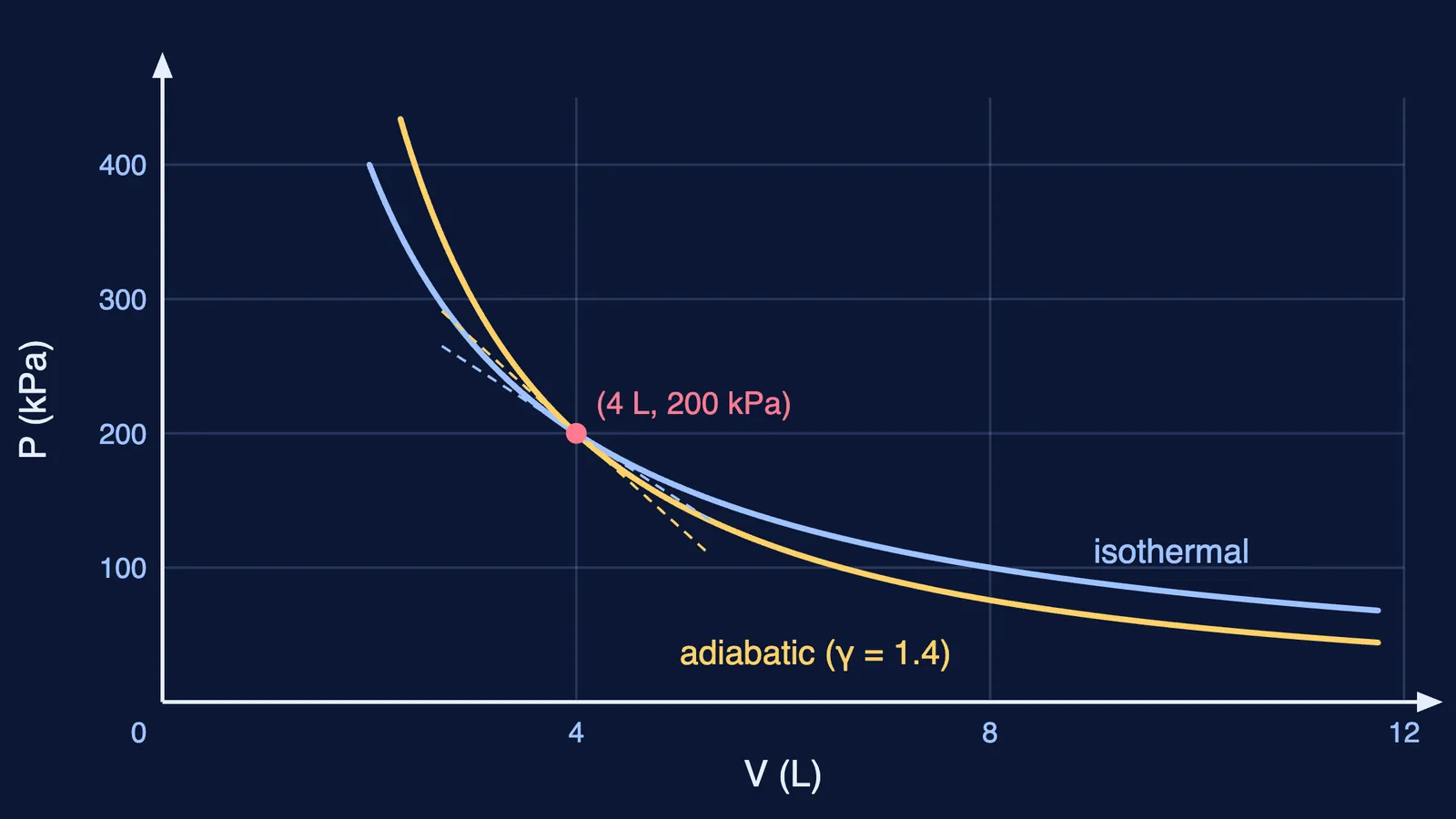
Q5 (medium). An ideal diatomic gas (γ = 7/5) is at 200 kPa and 4.0 L (the marked point in the diagram above). What is the magnitude of the adiabat's slope dP/dV there?
(A) 3.6 × 10⁷ Pa m⁻³ (B) 5.0 × 10⁷ Pa m⁻³ (C) 7.0 × 10⁷ Pa m⁻³ (D) 8.3 × 10⁷ Pa m⁻³
Answer: (C). PV^γ = constant gives dP/dV = −γP/V, so the magnitude is 1.4 × (2.0 × 10⁵)/(4.0 × 10⁻³) = 7.0 × 10⁷ Pa m⁻³.
Trap: (B) is the isotherm's slope, P/V; (D) uses γ = 5/3.
Q6 (medium). Which process can be treated as reversible?
(A) Hot tea cooling in a 25 °C room (B) A gas compressed very slowly at constant temperature by a frictionless piston (C) Water warmed by a paddle stirred inside it (D) A gas compressed suddenly by a piston that rubs on the cylinder wall
Answer: (B). A process is reversible only if it is quasi-static and has no dissipation. (A) moves heat across a finite temperature difference, (C) turns work into heat by stirring, and (D) is both sudden and has friction.
Trap: (A) looks slow, but heat still crosses a finite temperature gap, so it never runs back by itself.
Hard: process heat capacity and engine claims
Q7 (hard). Two moles of a monatomic ideal gas absorb 1660 J of heat in some process and do 415 J of work. What is the molar heat capacity of the gas for this process?
(A) 12.45 J mol⁻¹ K⁻¹ (B) 16.6 J mol⁻¹ K⁻¹ (C) 20.75 J mol⁻¹ K⁻¹ (D) 33.2 J mol⁻¹ K⁻¹
Answer: (B). ΔU = 1660 − 415 = 1245 J = 2 × (3/2) × 8.3 × ΔT, so ΔT = 50 K. C = ΔQ/(nΔT) = 1660/100 = 16.6 J mol⁻¹ K⁻¹ = 2R.
Trap: (A) and (C) are Cv and Cp, but this process is neither. (D) forgets n.
Q8 (hard). An engine takes 1200 J per cycle from a reservoir at 600 K and rejects heat to a sink at 360 K. What is the least heat it must reject per cycle?
(A) 0 J (B) 480 J (C) 720 J (D) 1200 J
Answer: (C). No engine beats the Carnot efficiency 1 − 360/600 = 40%, so the work is at most 480 J and at least 1200 − 480 = 720 J must go to the sink.
Trap: (B) is the largest possible work, not the heat rejected. (A) is the perfect engine Kelvin-Planck forbids.
What should you do after checking your answers?
Sort misses by cause: a law misread (Q1, Q6, Q8), the wrong heat capacity (Q2, Q3, Q7) or the wrong exponent (Q4, Q5). Redo your weakest group, then retry both sets in three days. For the formulas in one place, see our heat and thermodynamics formula sheet.
For more practice, the Fermi Problem Library has worked problems with a step-by-step solver that explains the reasoning rather than printing an answer.


