

On this page
Your sex was set at fertilisation by the X or Y chromosome in the sperm. In turtles and crocodiles, the warmth of the nest decides instead. It is the main exception to the XO, XY and ZW systems in our guide.
What is temperature-dependent sex determination?
Temperature-dependent sex determination (TSD) means the incubation temperature of an egg, not its chromosomes, decides whether the embryo develops testes or ovaries. In all sea turtles, warmer eggs produce mainly females and cooler eggs mainly males, as Godfrey and colleagues explain in the Canadian Journal of Zoology (1999).
Temperature does not act all the way through incubation. A 2024 review of crocodilian sex determination in Animals says this thermosensitive period lasts about 15 days in crocodilians; in the American alligator and the spectacled caiman it falls between days 30 and 45.
How does heat reach a gene? In the red-eared slider turtle, Ge and colleagues reported in Science (2018) that an enzyme called KDM6B switches on the dominant male gene. When they knocked KDM6B down, embryos that should have become male developed as females.
What is the pivotal temperature?
The pivotal temperature is the constant incubation temperature that produces 50% of each sex, and the range of temperatures that produces both sexes is called the transitional range (Godfrey et al., 1999).
How do you find the pivotal temperature from data?
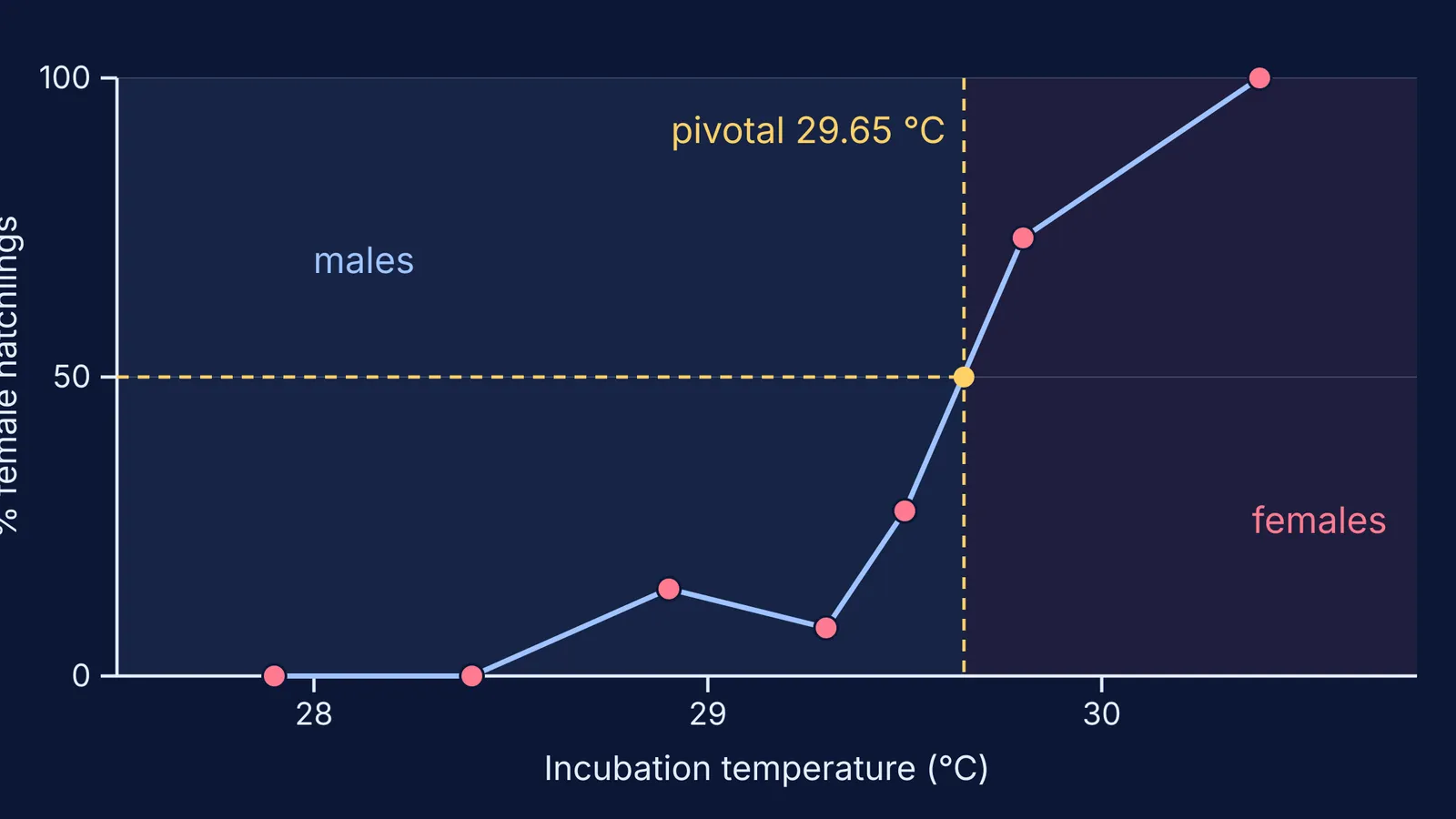
In the same 1999 study, hawksbill turtle eggs from Bahia, Brazil were incubated at constant temperatures in Toronto. Table 1 gives the share of female hatchlings:
27.9 °C: 0% female
28.4 °C: 0% female
28.9 °C: 14.6% female
29.3 °C: 8.0% female
29.5 °C: 27.6% female
29.8 °C: 73.3% female
30.4 °C: 100% female
Find the two temperatures on either side of 50%: 29.5 °C (27.6%) and 29.8 °C (73.3%).
Work out how far 50% sits between them: (50 − 27.6) ÷ (73.3 − 27.6) = 22.4 ÷ 45.7 ≈ 0.49.
Apply that fraction to the 0.3 °C gap: 29.5 + 0.49 × 0.3 ≈ 29.65 °C.
That matches the 29.65 °C the authors report. The whole swing from all-male to all-female happens within about 2 °C. The dip from 14.6% to 8.0% is not a mistake: small samples of real eggs are noisy.
Do crocodiles follow the same rule as turtles?
Not quite. The 2024 crocodilian review describes a female-male-female pattern: females form at low and high temperatures, and males at moderate ones.
American alligator: below 30 to 31 °C only females hatch, temperatures above 33 °C favour males, and there are two pivotal temperatures, 31.7 °C and 35.9 °C.
Estuarine (saltwater) crocodile: below 30 °C and above 34 °C, only female embryos develop.
Mugger, or marsh crocodile, found in India: both sexes can emerge across a window of almost 2 °C.
So "hot makes females" is only half true for crocodilians. For another Indian crocodilian, see our post on the gharial, the endangered river crocodile.
Why might warming beaches skew hatchling sex ratios?
If sand gets warmer, more nests sit above the pivotal temperature, and more hatchlings are female. A 2018 Current Biology study led by Michael Jensen combined hormone tests and genetics to find the sex and home nesting beaches of hundreds of green turtles at a shared feeding ground. As NOAA Fisheries summarised, turtles from the warmer northern Great Barrier Reef beaches were 99.1% female among juveniles, 99.8% among sub-adults and 86.8% among adults, against about 65 to 69% female from cooler southern beaches.
More females is not automatically a crisis. Across 75 nesting sites for seven sea turtle species, Hays and colleagues (2017) found that female-biased hatchling ratios are the norm and have not reduced population size, because adult breeding ratios are more balanced than hatchling ratios. The risk they flag is strong future warming, when high egg deaths combine with all-female hatchlings.
Crocodilians can swing the other way first. The 2024 review cites a forecast by Bock and colleagues (2020) that American alligator nests along the US East Coast will warm by 1.1 to 1.4 °C by 2050, pushing hatchlings to around 90% male, and that a 4.6 °C rise by 2100 could then cut males to no more than 2%.
This matters on Indian coasts too, where olive ridleys nest in huge numbers (our post on arribada mass nesting).
How do you answer TSD questions in an exam?
Use this five-step check:
Name the system: sex is set by the environment, not by sex chromosomes.
Sea turtles: warm gives females, cool gives males.
Crocodilians: female at both extremes, male in the middle (two pivotal temperatures).
Pivotal temperature gives 50:50; the transitional range gives both sexes.
Given a data table, interpolate between the two points either side of 50%.
If TSD feels disconnected from the XY and ZW systems, the Fermi Concept Library gives every biology concept its own lesson and its place in the map. To practise data questions like the interpolation above, the Fermi Problem Library has worked problems with a step-by-step solver that explains the reasoning rather than printing an answer.
Next time you see a turtle nest, remember: the sand's temperature is deciding who hatches.


