On this page
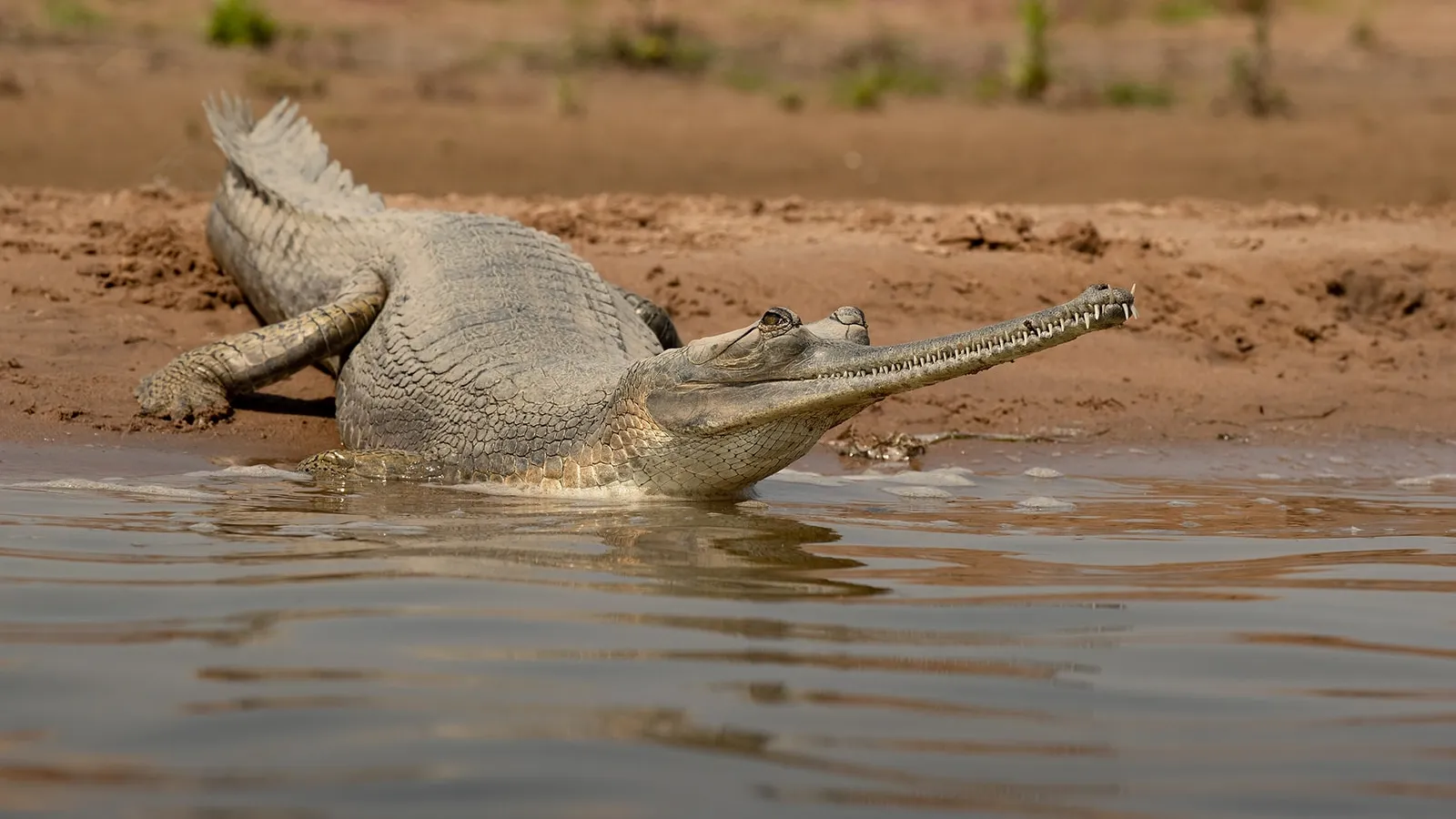
The gharial (*Gavialis gangeticus*) is the crocodile with a snout so thin it looks like a stick with teeth. For a biology answer on adaptation or conservation, connect three things: what its body looks like, what each feature does, and why those features make it easy to hurt.
What are the main features of a gharial?
According to the IUCN Crocodile Specialist Group's gharial account, males mature at about 3 metres long, at around 13 years old (females at about 16), and some grow past 6 metres. Fish appear to be the main food, though gharials also eat insects, frogs and other small animals.
Adult males carry a bulbous knob at the tip of the snout. The name "gharial" comes from "ghara", meaning "pot", after this knob, according to the same account.
A Survival Blueprint for the gharial, written by Ashish Bashyal, Ranjana Bhatta and A. Jailabdeen for the Zoological Society of London's EDGE programme, says the ghara acts like a sound resonator for a loud underwater "POP" that males make to attract females and to communicate.
Why does a gharial have such a long thin snout?
A 2013 study in PLoS ONE by Andrew Cuff and Emily Rayfield compared the skulls of spinosaur dinosaurs and living crocodilians (Cuff and Rayfield, 2013). It describes the gharial as almost exclusively a fish-eater with a narrow, tubular snout that catches prey with rapid, swiping sideways strikes of the head.
The paper gives two reasons this shape suits fishing: a narrow tubular snout reduces surface drag in water, and a long snout gives greater angular acceleration, so its tip moves faster.
Where and how do gharials nest?
Females lay an average of 40 eggs (range 6 to 95) in a hole nest dug into sandbars in the middle of the river and on river banks, the Crocodile Specialist Group reports.
The Survival Blueprint says nesting and egg laying run from mid-March to early April, on sandbanks exposed in the dry season along slow-moving stretches of river. Incubation takes 2 to 2.5 months, and hatching runs from late May to early July. Females, often with one large male, guard groups of hatchlings for 1 to 2 months. The incubation temperature also decides whether an egg becomes a male or a female.
Why is the gharial critically endangered?
The gharial was listed as Critically Endangered on the IUCN Red List in 2007, and the global wild population is estimated at fewer than 2,000 adults, according to the Crocodile Specialist Group. Gharials now survive in only 14 widely spaced subpopulations: 10 in India, 3 in Nepal and 1 in Bangladesh, the Survival Blueprint reports. Citing the 2019 IUCN assessment, it says the National Chambal Sanctuary holds 77% of the world's adult gharials. Its tables count 126 adult males against 777 adult females in India.
The same document rates the main threats:
Sand mining. Sand and boulder removal on the Chambal is rated critical: it strips the riverside sand gharials nest in and alters the river's flow.
Fishing nets. Monofilament gill nets trap and drown gharials. Young ones are especially likely to be caught, while older ones seem to avoid nets. In Chitwan, Nepal, eight radio-tagged gharials died in gill nets in 2019 and 2020.
Dams and barrages. The Gandak barrage changes water levels on the Narayani. In 2020, every gharial nest on the Narayani was flooded before it hatched.
Less water and fewer fish. Irrigation lift stations cut the Chambal's dry-season flow, and locals and park staff report sharply falling fish stocks in the Narayani.
See how the threats line up with the features? A fish specialist suffers when fish run out, a sand nester loses its future when the sand is dug away, and a long, toothy snout tangles easily in a net.
How do you write a gharial answer in a biology exam?
Use a feature, function, threat chain: one line each on what the feature looks like, what it does and what threatens it.
Feature: long, narrow, tubular snout. Function: less drag and a fast sideways strike to catch fish. Threat: falling fish stocks remove its food, and gill nets entangle it.
Feature: nests in holes on river sandbanks, about 40 eggs per clutch (IUCN Crocodile Specialist Group). Function: the sand incubates the eggs, and its temperature sets their sex. Threat: sand mining removes nesting banks, and barrages flood nests.
Feature: ghara on adult males. Function: amplifies the underwater courtship call. Threat: adult males are scarce, and the Survival Blueprint describes a weir on Nepal's Babai River that cuts females off from males.
End with the status line: Critically Endangered, fewer than 2,000 adults, most in the Chambal. The chain works for any adaptation question.
If adaptation still feels fuzzy, the Fermi Concept Library has a lesson for every concept in biology and shows its place in the map, so you can check how adaptation links to ecology before you write. To test yourself, the Fermi Problem Library has worked problems with a step-by-step solver that explains the reasoning rather than printing an answer.