

On this page
Before electronic distance meters, survey baselines were measured with chains and steel tapes, and site engineers still use tapes. A tape is exact only under the conditions it was calibrated in: lying flat, at its standard pull and temperature. Lift it between two supports and it sags, so it reads more than the straight distance. Pull it harder and the sag shrinks, but the tape stretches. Two pieces of Class 11 physics, the statics of a hanging line and Young's modulus, tell you how big each error is and the one pull at which they cancel.
Why does a tape hanging between two supports read too long?
A tape held at both ends cannot be straight: a horizontal tape has no vertical component of tension to hold up its weight. So it hangs in a shallow curve. The reading along the curve is longer than the straight chord between the two ends.
For a light tape pulled hard, the curve is very nearly a parabola. Take moments about one end for the left half of the tape, with weight per metre w, span L and pull P. The half weighs wL/2 and acts at L/4 from the end, and the horizontal pull P at mid-span acts at a lever arm equal to the sag D. So P·D = (wL/2)(L/4), which gives:
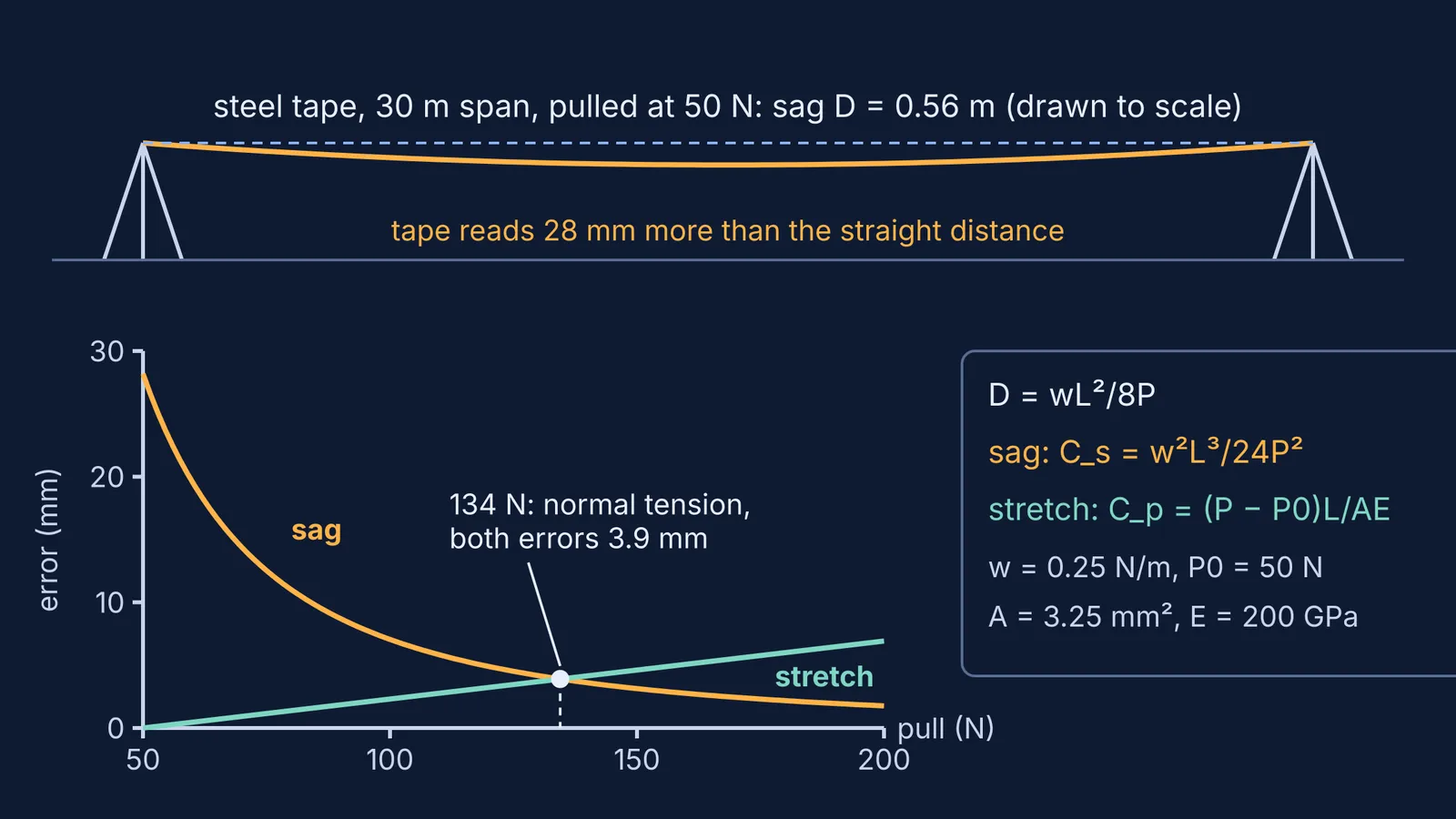
Sag at mid-span: D = wL²/8P.
Our post on why electric wires sag more in summer shows that a shallow parabola is longer than its chord by 8D²/3L. Put D = wL²/8P into that and you get the sag correction:
Sag correction: C_s = w²L³/24P², always subtracted from the reading.
Check the units: (N/m)² × m³ ÷ N² = m. The same formula appears in surveying texts as W²L/24P², with W = wL the weight of the span; see the NPTEL surveying notes on sag correction. It assumes both ends are at the same level and the curve is shallow.
How much does pulling harder stretch the tape?
A steel tape obeys Hooke's law. If it was calibrated at a standard pull P₀ and you pull with P, the extra force stretches it by:
Pull correction: C_p = (P − P₀)L/AE, where A is the cross-section and E is Young's modulus. See the NPTEL notes on correction for tension.
A stretched tape has its marks spread apart, so it reads short. C_p is added when P > P₀. Sag makes the reading too long and stretch makes it too short. That opposite sign is what lets them cancel.
What pull makes the two errors cancel?
Here is a worked example with illustrative numbers. A steel tape is 13 mm wide and 0.25 mm thick, calibrated flat at P₀ = 50 N. Take steel density 7850 kg/m³, E = 200 GPa and g = 9.81 m/s². It is held between two supports 30 m apart at the same level.
Cross-section. A = 13 mm × 0.25 mm = 3.25 mm² = 3.25 × 10⁻⁶ m².
Weight per metre. w = ρgA = 7850 × 9.81 × 3.25 × 10⁻⁶ = 0.250 N/m. The whole 30 m span weighs 7.5 N.
Sag at 50 N. D = 0.250 × 30² ÷ (8 × 50) = 0.563 m. The middle of the tape hangs more than half a metre low.
Sag correction at 50 N. C_s = 0.250² × 30³ ÷ (24 × 50²) = 0.0282 m = 28.2 mm. There is no stretch correction at the standard pull, so a reading of 30.000 m means 29.972 m.
Pull at 100 N. Sag correction = 28.2 × (50/100)² = 7.0 mm. Stretch = 50 × 30 ÷ (3.25 × 10⁻⁶ × 2 × 10¹¹) = 2.3 mm. Net error 4.7 mm too long.
Normal tension. Set (P − P₀)L/AE = w²L³/24P² and solve. Solving numerically gives P = 134 N.
Check at 134 N. Sag = 0.209 m, sag correction = 3.90 mm, stretch = 84 × 30 ÷ 650 000 = 3.90 mm. They cancel, so the tape reads the true horizontal distance.
The pull that makes the errors cancel is called the normal tension. Here it is 134 N, about the weight of a 13.7 kg mass, which a surveyor applies with a spring balance at the tape's end. The stress in the tape is 134 ÷ 3.25 × 10⁻⁶ ≈ 41 MPa, far below the yield strength of steel. As a cross-check, solving the exact catenary instead of the parabola gives 28.1 mm at 50 N and 3.90 mm at 134 N, so the parabola is accurate here.
Does the normal tension work for any span?
No. Setting the two corrections equal gives (P − P₀)/AE = w²L²/24P². The span L is still in it, so the normal tension changes with span: it is higher for longer spans. Temperature is a separate error that it does not touch.
Spans matter a lot because sag goes as L³. If the same 30 m is measured with supports every 10 m at 50 N, each span has a sag correction of only 1.04 mm, 3.1 mm in total instead of 28.2 mm. Pull also has to be steady: at 45 N the 30 m sag correction is 34.8 mm, and at 55 N it is 23.3 mm.
What do tape standards and temperature add?
The international recommendation for tape measures, OIML R 35, says long steel tapes (5 to 200 m) carry a tension of about 50 N or more, marked on the tape. Their reference temperature is 20 °C unless another is marked, and they are checked lying on a flat horizontal surface. So the tape's own length is correct only flat, at its marked pull, at 20 °C. Anything else needs a correction.
Temperature is the third correction. With α ≈ 1.2 × 10⁻⁵ per °C for steel, a 30 m tape used 15 °C above its standard temperature is 30 × 15 × 1.2 × 10⁻⁵ = 5.4 mm longer, so it reads 5.4 mm short. That is the same size as the sag and pull errors above. The thermal part is worked in detail in correcting a metal scale at a different temperature, and the way the Great Trigonometrical Survey chained its baselines is told in how William Lambton measured the Great Arc of India.
To practise elasticity and statics problems like this one, the Fermi Problem Library has a step-by-step solver that explains the reasoning.
What mistakes cost marks on tape correction problems?
Adding the sag correction. A sagging tape always reads too long, so the correction is subtracted.
Using mass per metre (kg/m) for w instead of weight per metre (N/m).
Applying a sag correction to a tape lying on the ground. A fully supported tape has only pull and temperature corrections.
Using the total applied pull P in the stretch formula instead of the extra pull, P − P₀.
Thinking normal tension removes all errors. It removes only sag and stretch, for one span.
Quick checklist
Sag: D = wL²/8P; correction C_s = w²L³/24P², subtracted.
Stretch: C_p = (P − P₀)L/AE, added when P > P₀.
Normal tension: the pull where C_s = C_p; 134 N for our 30 m tape.
Shorter spans cut sag sharply, because C_s grows as L³.
Temperature: ΔL = αLΔT, a separate correction.


