

On this page
The short answer is no. Since 25 January 2022, when the Surrogacy (Regulation) Act, 2021 came into force (SCC Online report on the commencement notification), India has allowed only altruistic surrogacy. Here is the Act in one page, from its Gazette text (full text of the Act).
What is the difference between altruistic and commercial surrogacy?
Both definitions are in Section 2 of the Act.
Altruistic surrogacy is surrogacy in which no charges, fees, remuneration or monetary incentive of any kind go to the surrogate mother, her dependents or her representative, except medical expenses, other prescribed expenses and insurance cover (Section 2(1)(b)).
Commercial surrogacy is any payment, reward, benefit, fee or incentive in cash or kind beyond those expenses, and includes buying or selling embryos, gametes or the services of a surrogate mother (Section 2(1)(g)).
The Act also allows only gestational surrogacy: the surrogate carries an implanted embryo, the child is not genetically related to her, and no woman may act as a surrogate by providing her own gametes (Section 4).
Who is eligible for surrogacy in India?
Section 4(iii) of the Surrogacy (Regulation) Act sets the conditions.
The intending couple needs certificates of essentiality and eligibility from the appropriate authority. They must:
be a legally married Indian man and woman (Section 2(1)(h));
have a medical indication for gestational surrogacy, certified by a District Medical Board;
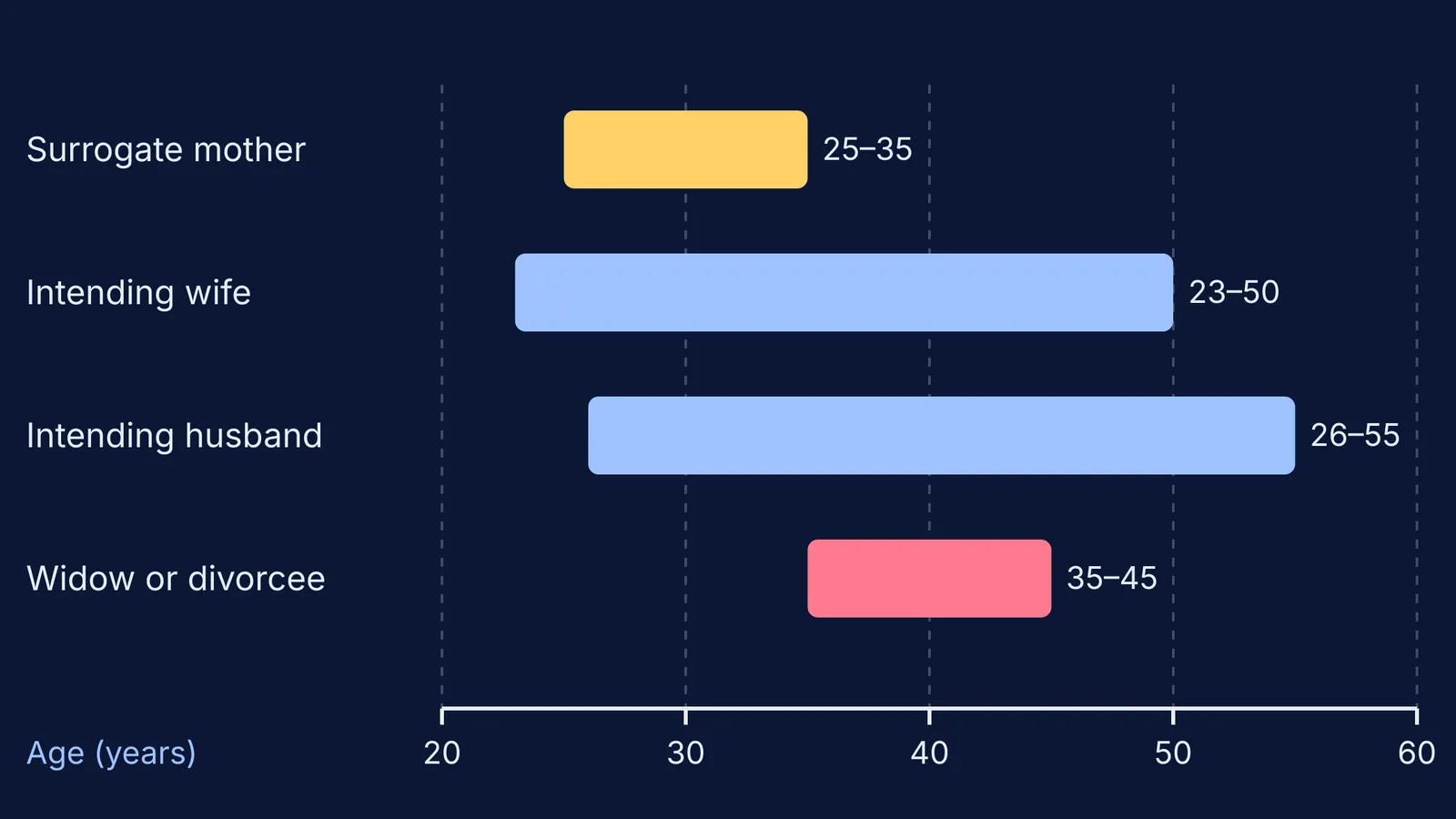
be aged 23 to 50 (wife) and 26 to 55 (husband) on the day of certification;
have no surviving child (biological, adopted or by surrogacy), unless that child is mentally or physically challenged or has a life-threatening illness with no permanent cure.
An intending woman is an Indian widow or divorcee aged 35 to 45 (Section 2(1)(s)).
The surrogate mother needs her own eligibility certificate. She must:
be an ever-married woman with a child of her own, aged 25 to 35 on the day of implantation;
act as a surrogate only once in her lifetime;
hold a certificate of medical and psychological fitness from a registered medical practitioner.
The couple must also insure the surrogate for 36 months, covering postpartum complications, and get a Magistrate's order on parentage and custody (Section 4(iii)(a)). The surrogate may withdraw consent before implantation (Section 6), and the child has all the rights of a natural child of the intending parents (Section 8).
On 9 October 2025, in Vijaya Kumari S. v. Union of India, the Supreme Court held that the age limits do not apply to couples who froze embryos before the Act began, and said it had not ruled on whether the limits themselves are valid (SCC Online report on the judgment).
Can donor eggs or sperm be used?
On 21 February 2024 the Health Ministry amended the Surrogacy (Regulation) Rules so that a couple may use one donor gamete if a District Medical Board certifies a medical condition, but the child must have at least one gamete from the couple (SCC Online summary of the 2024 amendment). The amended rule also says a widow or divorcee must use her own eggs with donor sperm (LiveLaw report on the amendment).
What are the penalties for commercial surrogacy?
Under Section 38 of the Act, undertaking or advertising commercial surrogacy, exploiting a surrogate or child, selling embryos or gametes, or sex selection is punishable with up to 10 years in prison and a fine of up to ₹10 lakh.
Under Section 40, an intending couple or woman who seeks commercial surrogacy faces up to 5 years and a fine of up to ₹5 lakh for a first offence, and up to 10 years and ₹10 lakh for a repeat offence. Section 43 makes every offence under the Act cognizable, non-bailable and non-compoundable.
A worked example: check a case in four questions
Test this made-up case against Section 4 of the Act. Priya, 38, and Arun, 41, are married, have no children, and a District Medical Board has certified that Priya cannot carry a pregnancy. Arun's cousin, 33, married with a son, offers to be their surrogate. They plan to pay her hospital bills and insurance, plus ₹3 lakh as thanks.
Is the couple eligible? Married, inside the 23 to 50 and 26 to 55 bands, no surviving child, certified indication: yes.
Is the surrogate eligible? Ever-married, own child, aged 25 to 35, first time: yes, with a fitness certificate.
Whose gametes? Never the surrogate's eggs; at least one gamete from Priya or Arun.
Any money beyond expenses and insurance? Yes, the ₹3 lakh, which makes it commercial surrogacy.
Drop the ₹3 lakh and the plan fits. For a real case, speak to a registered surrogacy clinic, a gynaecologist and a lawyer: this summary is not legal or medical advice.
How does this connect to your biology syllabus?
Surrogacy sits beside IVF and infertility in reproductive health. Start with our reproductive health key terms for Class 12, read why infertility is not only a women's problem, and check common reproductive health mistakes in biology.
To revise fertilisation, implantation and embryo stages, the Fermi Concept Library has a lesson on every concept in biology, each with its place in the map.


