

On this page
Before anyone knew about nuclear fusion, physicists still had to explain why the Sun stays hot. The strongest candidate they had was gravity. If the Sun slowly shrinks, its gas falls inward, loses gravitational potential energy, and that energy can come out as heat and light. Helmholtz and Kelvin worked this out in the nineteenth century, and you can test it with one formula from your gravitation chapter: U = 3GM²/5R. The answer comes out at about 19 million years, which turned out to be far too short.
How much gravitational energy does it take to build a sphere?
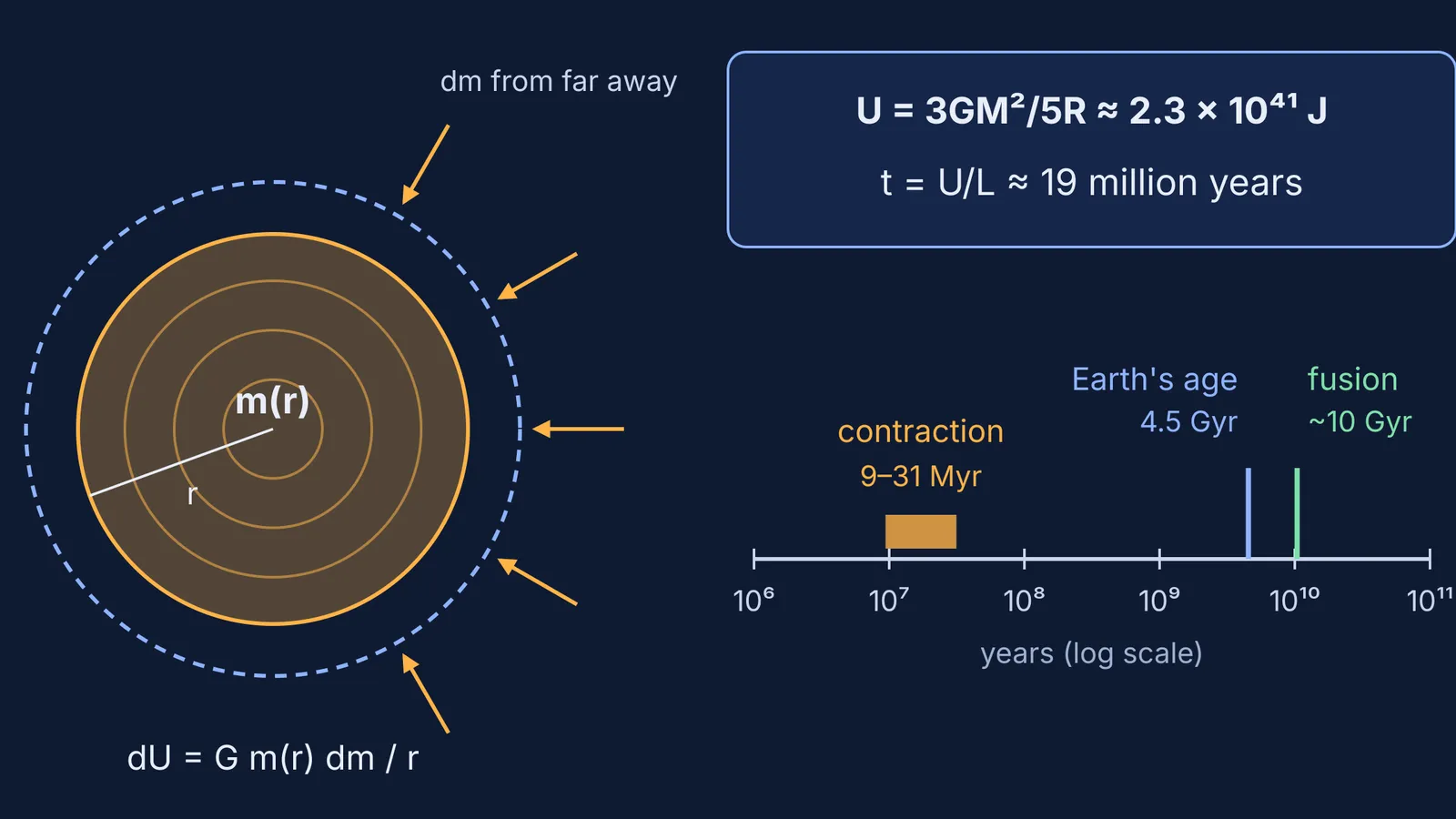
Build the Sun one thin layer at a time, like an onion. At some stage you have a ball of radius r and mass m(r). You bring a thin shell of mass dm from very far away and spread it over the surface.
Outside a uniform ball, gravity acts as if all of m(r) sat at the centre. So the potential energy of the new shell changes from 0 (far away) to −Gm(r)dm/r, and the energy released is
dU = G m(r) dm / r
For a uniform sphere of total mass M and radius R:
m(r) = M r³/R³, since mass grows with volume.
dm = 3M r² dr/R³, the mass of a shell of thickness dr.
So dU = (G/r)(M r³/R³)(3M r²/R³) dr = (3GM²/R⁶) r⁴ dr.
Adding every shell from r = 0 to r = R:
U = (3GM²/R⁶)(R⁵/5) = 3GM²/5R
This is the energy released in assembling the sphere from scattered pieces. The gravitational potential energy of the finished sphere is −3GM²/5R. The electric version, 3kQ²/5R for a uniformly charged ball, follows from the same shell-by-shell steps with kQ² in place of GM².
How long could gravity alone keep the Sun shining?
If the Sun's power came only from this store, the time it could last is roughly the energy divided by the power, t = U/L. This is the Kelvin–Helmholtz timescale. First, one correction.
When a star contracts, not all the released energy leaves as light. Part of it heats the gas, which is what keeps the pressure high enough to hold the star up. For a star made of ideal monatomic gas in equilibrium, the virial theorem says exactly half the released gravitational energy goes into heating the gas and half is radiated away. So the honest estimate is U/2L, not U/L.
Astronomy texts usually quote the timescale in rounded form as GM²/RL, without the 3/5 or the half. The University of Sheffield's stellar timescales notes give about 30 million years and treat the factor of 2 as unimportant. All versions land in the tens of millions of years.
Worked example: the Sun's contraction lifetime
Use NASA's values from the NASA Sun fact sheet: M = 1.988 × 10³⁰ kg, R = 6.957 × 10⁸ m, L = 3.828 × 10²⁶ W. Take G = 6.674 × 10⁻¹¹ N m² kg⁻² and 1 year = 3.156 × 10⁷ s.
Energy store. U = 3GM²/5R = 3 × 6.674 × 10⁻¹¹ × (1.988 × 10³⁰)² / (5 × 6.957 × 10⁸) = 2.28 × 10⁴¹ J. Units: N m² kg⁻² × kg² / m = N m = J.
Time if all of it were radiated. t = U/L = 2.28 × 10⁴¹ / 3.828 × 10²⁶ = 5.94 × 10¹⁴ s. Divide by 3.156 × 10⁷ s per year: t = 1.88 × 10⁷ years, about 19 million years.
With the virial half. Only U/2 is radiated, so t = 9.4 million years.
Textbook form. GM²/RL = (5/3) × 1.88 × 10⁷ = 3.1 × 10⁷ years, about 31 million years.
How fast it would have to shrink. Write U = a/R with a = 3GM²/5. Then dU/dt = −(a/R²) dR/dt. Setting the rate of energy release equal to L gives a shrink rate of LR²/a = 37 m per year. With only half radiated, it doubles to about 74 m per year. That is tiny against a radius of 696,000 km.
A real star is denser at the centre than at the edge, so the uniform-sphere 3/5 factor is an underestimate. A standard stellar model (a polytrope of index 3, used by Eddington) gives U = 3GM²/2R, 2.5 times larger. That stretches 19 million years to about 47 million, and the radiated half to about 24 million. It is still tens of millions of years.
Why didn't Kelvin's answer fit the evidence?
Kelvin took the energy argument seriously. In a lecture on the Sun's heat at the Royal Institution in 1887, he said it was hard to suppose that the Earth had received anything more than about twenty million years of sunlight. His separate argument from the cooling of the Earth, covered in how Kelvin estimated the age of the Earth by cooling, pointed the same way.
Geologists and biologists needed far more time. In On the Origin of Species, Darwin estimated that the sea's slow erosion of the Weald in southern England alone had taken about 300 million years. Today the Earth's age is put at about 4.5 billion years, roughly 240 times the 19-million-year figure.
Kelvin and Helmholtz were not careless. Their calculation was right for the physics of their day; nuclear energy had not been discovered. Arthur Eddington later argued that the Sun must run on something like the conversion of hydrogen to helium, as told in what Eddington discovered about the stars.
How much longer does fusion keep the Sun shining?
Fusion releases about 0.7% of the mass of the hydrogen turned into helium as energy. Only the core is hot enough to burn, so suppose about 10% of the Sun's mass is used before the Sun leaves its present stage.
Energy: E = 0.1 × 0.007 × Mc² = 0.1 × 0.007 × 1.988 × 10³⁰ × (3.00 × 10⁸)² = 1.25 × 10⁴⁴ J.
Time: E/L = 3.27 × 10¹⁷ s = 1.0 × 10¹⁰ years, about 10 billion years.
That is about 550 times longer than the contraction estimate, and comfortably longer than the Earth's age. The rate at which this burns mass, about four million tonnes per second, is worked out in how much mass the Sun loses per second.
Contraction was not wrong, just early: before fusion began, the young Sun was heated by exactly this kind of slow gravitational squeeze, until its core grew hot enough to burn hydrogen. Today the Sun is not shrinking.
To practise more gravitational energy problems with each step explained, try the Fermi Problem Library, a step-by-step solver that explains the reasoning.
What mistakes do students make here?
Using GM²/R or GM²/2R for a solid sphere. The uniform solid sphere gives 3GM²/5R; GM²/2R is for a thin shell.
Dividing U by L and calling it the time the star radiates, without saying that only half is radiated.
Writing that the Sun is shrinking today. It is not.
Quick checklist
U = 3GM²/5R for a uniform sphere, from adding dU = Gm(r)dm/r over shells.
For the Sun, U ≈ 2.3 × 10⁴¹ J.
U/L ≈ 19 million years; virial half ≈ 9 million; GM²/RL ≈ 31 million.
Shrinking about 37 m a year would supply today's power.
Fusion gives about 10 billion years, roughly 550 times longer.
Kelvin's short age was right for known physics; nuclear energy was the missing piece.


