

On this page
In short
Lord Kelvin estimated the Earth's age to be 20 to 400 million years by calculating how long a solid molten sphere would take to cool to the present surface temperature gradient. His estimate was far too young because he missed the heat from radioactive decay and the heat transported by convection in the Earth's mantle.
In the mid-19th century, geology and biology were moving toward the idea that the Earth was incredibly old. Charles Darwin needed vast amounts of time for natural selection to take place, and geologists observed that processes like erosion and sedimentation occur at a painstakingly slow pace. But physics—led by William Thomson, later known as Lord Kelvin—stepped in to argue that the planet could not possibly be that ancient.
By applying the laws of thermodynamics, Kelvin calculated that the Earth was between 24 million and 400 million years old. He later grew more confident in his model, revising his estimate down to a rigid 20 million years. This set off a fierce scientific debate, forcing biologists to scramble for explanations of rapid evolution.
How did Lord Kelvin estimate the age of the Earth?
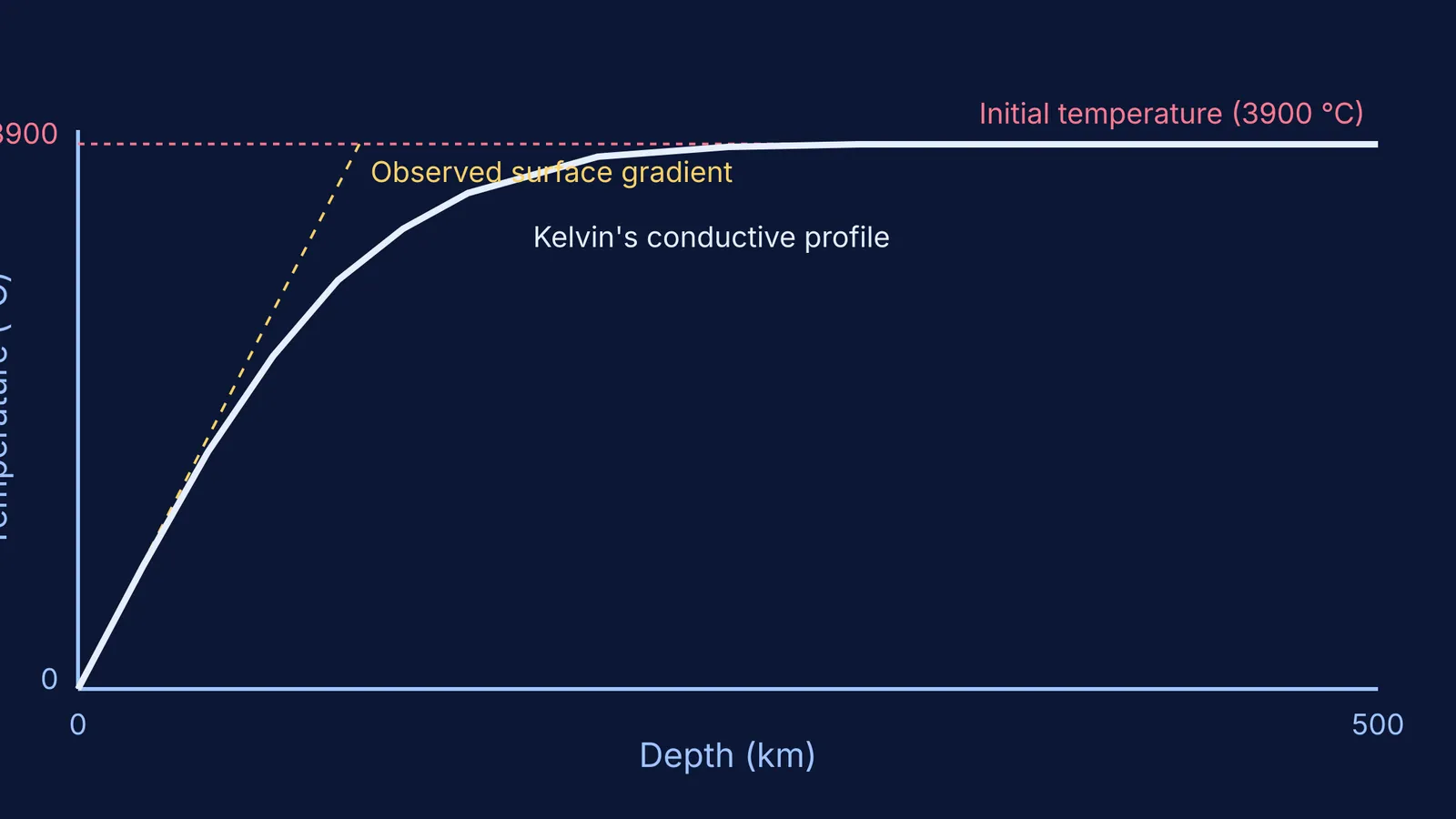
Kelvin treated the Earth as a completely solid sphere that began in a molten state and had been losing heat to space ever since. He knew from deep mining operations that the temperature of the Earth increases as you go further underground.
To set up his mathematical equation, Kelvin used a mean geothermal gradient of 36°C per kilometer, which is roughly 1/50th of a degree Fahrenheit per foot. He also assumed the Earth's initial molten temperature was 3,900°C, based on the known melting points of various rocks.
By applying Joseph Fourier's equations for heat conduction, Kelvin worked backward. He calculated exactly how long it would take a 3,900°C sphere of solid rock to cool down enough to produce the specific 36°C/km temperature gradient we observe at the surface today. From a purely mathematical perspective, his calculus was flawless. However, his physical assumptions were missing key pieces of the puzzle that had not yet been discovered.
Why was Kelvin's estimate so wrong?
For decades, the standard textbook answer has been that Kelvin failed because he did not know about radioactivity. In 1896, French physicist Henri Becquerel discovered spontaneous radioactivity by placing uranium salts near photographic plates in a dark drawer. By 1903, Pierre Curie and Albert Laborde had determined that this radioactive decay actually releases measurable amounts of heat.
In 1904, physicist Ernest Rutherford famously pointed out that radioactive elements in the Earth's interior act as a continuous internal furnace. Because elements like uranium and thorium decay slowly over billions of years—a concept you can practice by counting alpha and beta decays—the Earth was not simply an inert ball of rock losing its initial heat to space. It was constantly generating new heat.
However, modern physicists point out an even deeper flaw in Kelvin's conductive model. In 1895, Kelvin's former assistant John Perry showed that Kelvin's assumption of a solid, rigid Earth was incorrect. Perry mathematically argued that if the Earth's mantle behaves as a highly viscous fluid, it would transport heat via convection. A convecting mantle would continually mix hot material from the deep interior up to the crust, sustaining a high surface temperature gradient for billions of years—even if radioactivity did not exist.
How can you test your physical models?
When you solve complex physics problems, setting up the right assumptions is half the battle. If you miss a crucial variable—like the heat generated by atomic decay or the presence of mantle convection—your final answer will be wildly off, even if your arithmetic is perfect. You must train yourself to look for hidden variables.
If you are trying to master thermodynamics, the Fermi Simulation Lab provides interactive simulations for ideas that are easier to see than to read, such as heat flow and temperature gradients. When you get stuck on the underlying math, the Fermi Problem Library provides worked problems with a step-by-step solver that explains the reasoning rather than printing an answer. Just like John Perry checking Kelvin's work, it helps to have a system that points out your hidden assumptions, such as knowing when you can safely assume the free expansion of an ideal gas.


