

On this page
In the early twentieth century, nobody knew exactly why the Sun did not collapse under its own immense weight, or what kept it burning so brightly for so long. In 1926, the British astrophysicist Arthur Eddington published *The Internal Constitution of the Stars*, a groundbreaking book that completely changed how we understand the physics of stellar bodies. It proved that stars are not just burning balls of liquid or solid rock, as some early astronomers believed, but giant spheres of ideal gas held together in a delicate and dynamic balance.
What keeps a star from collapsing?
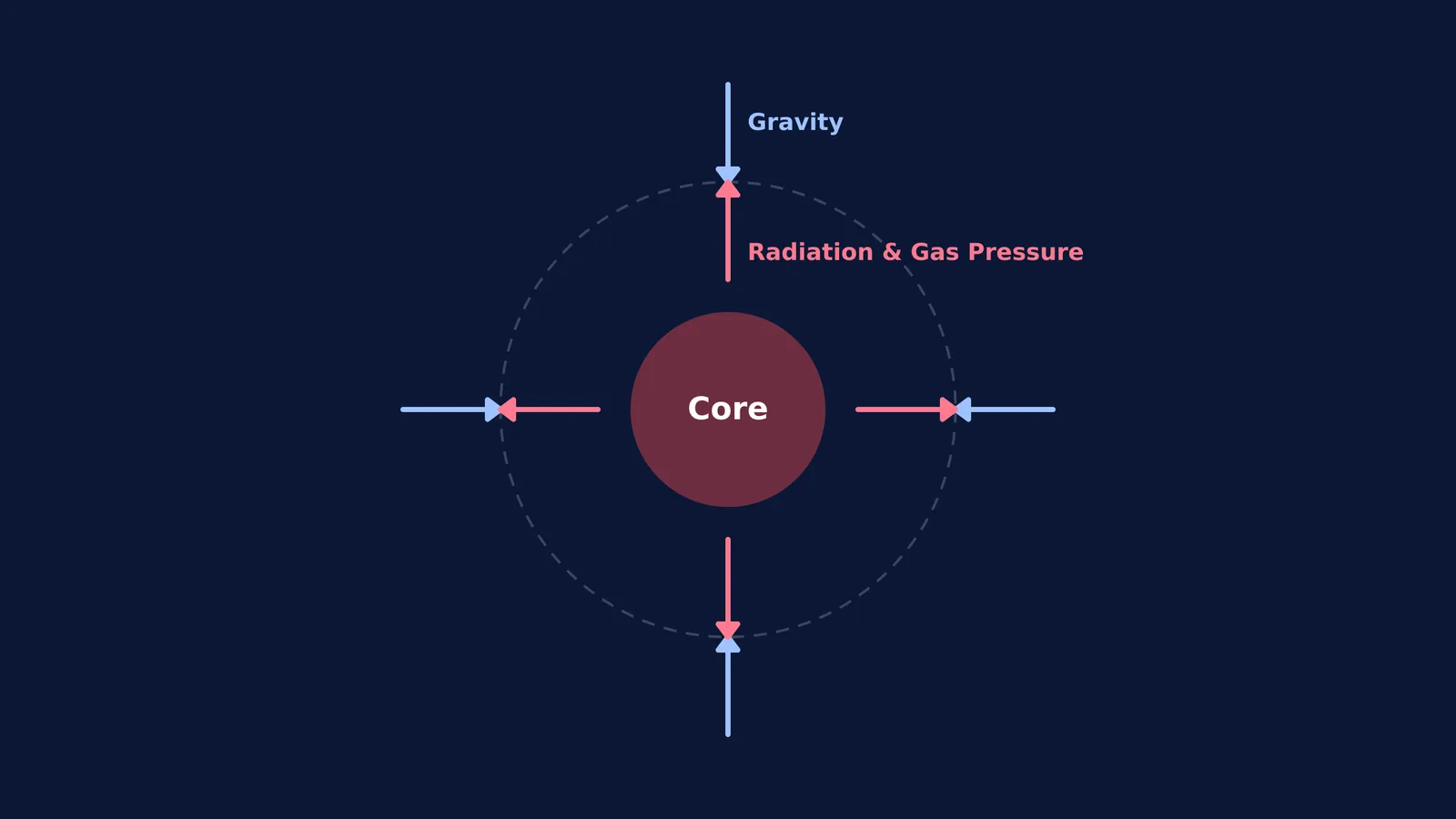
Gravity pulls everything in a star towards its core. Eddington proposed that a star survives by remaining in hydrostatic equilibrium. This means the inward pull of gravity is exactly cancelled out by outward forces.
He was the first to show that this outward push does not just come from hot gas (gas pressure). In massive stars, a huge part of the push comes from the light itself, known as radiation pressure. He demonstrated that as a star becomes heavier, radiation pressure becomes increasingly dominant in preventing its collapse. At a certain extreme point—now called the Eddington limit—the outward force of radiation pressure completely equals the inward force of gravity. If a star becomes more luminous than this limit, the intense radiation blows the star's outer layers away into space, setting a natural maximum mass for stars.
To grasp how multiple forces balance each other, students can use the Fermi Simulation Lab, which contains interactive simulations for the ideas that are easier to see than to read.
What is the Eddington mass-luminosity relation?
In a 1924 paper, Eddington derived a theoretical rule linking a star's mass (M) to its total energy output, or luminosity (L). He found that for most main-sequence stars, luminosity is roughly proportional to the mass raised to the power of 3.5, written as L ∝ M^3.5.
This was a major breakthrough. At the time, astronomers believed that only large, low-density "giant" stars behaved like ideal gases, while dense "dwarf" stars like our Sun did not. Eddington's mathematics proved that even dense stars behave as ideal gases. He reasoned that the extreme heat inside stars strips atoms of their electrons, making the particles small enough to compress heavily without losing their gaseous properties.
If you are studying these derivations, the Fermi Concept Library contains every concept in physics, chemistry, biology, mathematics and computing, each with its own lesson and its place in the map.
What did The Internal Constitution of the Stars predict?
Beyond pressure and mass, Eddington's 1926 book made a bold claim about what powers a star. For decades, the leading idea was the Kelvin-Helmholtz mechanism, which suggested that stars were simply shrinking and releasing gravitational heat as they compressed. However, this contraction theory could not explain why stars like our Sun had been shining for billions of years without fully collapsing.
Instead, Eddington calculated that stellar cores must reach millions of degrees and argued that they are fueled by "subatomic energy". Drawing on Albert Einstein's equation, E = mc², and measurements by Francis Aston showing that a helium atom is slightly lighter than four hydrogen atoms, he proposed the nuclear fusion of hydrogen into helium. He estimated that if a star contained even 5% fusible hydrogen, it would be enough to sustain its massive energy output for a very long time.
Worked example: using the mass-luminosity relation
Because luminosity scales so sharply with mass (M^3.5), small changes in a star's weight cause massive differences in its brightness.
Imagine a star that has exactly 2 times the mass of our Sun. The mass-luminosity relation helps us find how much brighter it is:
The mass ratio is 2.
We raise this to the power of 3.5.
2^3.5 = 8 × √2.
Since √2 is approximately 1.414, the luminosity is 8 × 1.414 = 11.312.
A star 2 times as heavy as the Sun shines more than 11 times brighter. This is why heavy stars consume their fuel very quickly, living far shorter lives than smaller stars. By applying such rules, you can start learning physics from first principles, not formulas.
To understand more about how gravity shapes the universe, explore understanding planetary orbits with a gravity simulation.


