

On this page
Ask five people for the strongest muscle in the body and you may hear the jaw, the bum, the calf, the heart and the tongue. Four have a real case. The catch is that "strongest" can mean different things, each with a different winner.
Why is there no single answer to "the strongest muscle"?
Strength can mean:
Force: how hard a muscle can pull, in newtons.
Force for its size: how much force a small muscle can put where it is needed.
Endurance: how long a muscle can keep working without tiring.
Size is a poor guide to force. What sets force is how many fibres pull side by side, measured as the physiological cross-sectional area, or PCSA.
Which muscle pulls with the most force?
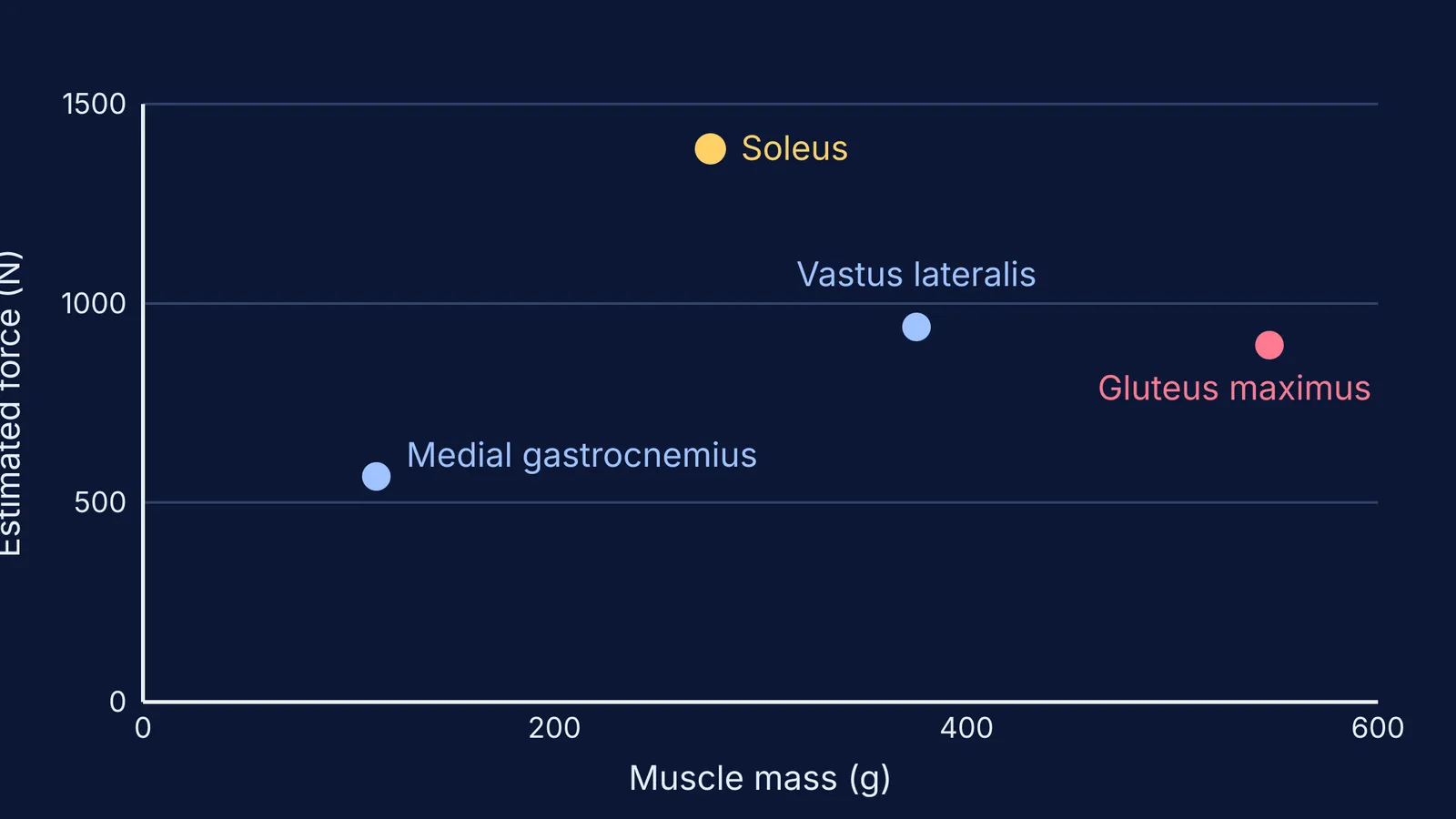
By force, the answer is the soleus, a calf muscle beneath the gastrocnemius. In a 2009 study, Ward and colleagues dissected 27 muscles from 21 human lower limbs and found the soleus had the largest PCSA, 51.8 cm² on average. Their abstract names the soleus, gluteus medius and vastus lateralis as the strongest of these muscles based on their architecture.
The gluteus maximus is the heaviest muscle in the same data set, at 547 g, roughly twice the soleus's 276 g (Ward et al., 2009). But its fibres are long (about 15.7 cm) and its PCSA is only 33.4 cm². The soleus packs many short fibres (about 4.4 cm) at an angle, so more of them pull side by side. Long fibres give range and speed; many short fibres give force.
Worked example: to turn area into force, multiply PCSA by specific tension, the force each square centimetre of fibre can make. A 2024 systematic review in the Journal of Applied Physiology recommends 26.8 N/cm² for human muscle. Using the PCSA values from Ward et al.:
Soleus: 51.8 cm² × 26.8 N/cm² ≈ 1,390 N, about the weight of a 140 kg mass.
Gluteus maximus: 33.4 cm² × 26.8 N/cm² ≈ 895 N.
These are fibre forces, not what you can lift.
Is the jaw the strongest muscle for its size?
The masseter, the main jaw-closing muscle, is often named as the strongest muscle for its size. Scientific American calls it a contender because the jaw is a short lever, so the muscle must pull hard to close it.
In a 1993 University of Helsinki study of 30 dental students, the average maximum bite force at the molars was 847 N for men and 597 N for women. Because it is measured at the teeth, it is not directly comparable with the soleus estimate. Strictly, the bite comes from the masseter working with the other jaw-closing muscles, and a review of bite force research warns that results vary with the device and method.
Source: Scientific American's 2014 fact check.
Why do people say the heart is the strongest muscle?
On endurance, the heart is the usual answer; Scientific American calls it the hardest-working muscle. Using typical resting values from the OpenStax Anatomy and Physiology textbook (75 beats per minute and a cardiac output of 5.25 L per minute), you can work it out:
Beats per day: 75 × 60 × 24 = 108,000.
Blood pumped per day: 5.25 L × 1,440 minutes ≈ 7,560 L.
Beats in 70 years: about 2.8 billion.
Cardiac muscle makes its energy mainly through aerobic metabolism and is packed with mitochondria (OpenStax), which is why it can keep going. Our explainer on estimating the power of the human heart turns these numbers into watts.
The soleus is an endurance muscle too. In a 2019 biopsy study of 20 active men, fast type II fibres covered only about 21% of the soleus's fibre area on average, so most of it is slow-twitch fibre. OpenStax explains that slow oxidative fibres can work for long periods without fatiguing, which suits a muscle that helps keep you upright. See also red and white muscle fibres compared.
How should you answer "strongest muscle" in an exam or quiz?
Use this four-step check:
Ask what is being measured: force, force for size, mass or endurance.
Name the winner for that measure: soleus (force), masseter (force for size), gluteus maximus (mass), heart (endurance).
Give one number with its source, such as the soleus's 51.8 cm² PCSA from Ward et al. (2009).
Say why: fibre arrangement, levers, or fibre type.
A one-line answer that covers all of it: "It depends on the measure; the soleus produces the most force, the masseter the most for its size, and the heart works longest without rest."
If the three muscle types are hazy, start with our guide to striated, smooth and cardiac muscle. The Fermi Concept Library gives each concept in biology and physics its own lesson, so you can fill a gap like PCSA or specific tension before moving on. If you want to practise force estimates like the ones above, the Fermi Problem Library has worked problems with a step-by-step solver that explains the reasoning rather than printing an answer.


