On this page
You can work out the power of your own heart with one line of school physics and four numbers you can look up. The answer is about one watt at rest.
This is a physics exercise, not a health check. If you have a question about your own blood pressure or heart, ask a doctor.
Why is a heart's power pressure times flow rate?
Power is energy per second. When a pump pushes a volume V of fluid against a pressure P, it does work P × V. Pressure is force per area and volume is area times distance, so P × V is force times distance, which is work. Divide by time and you get the one formula this estimate needs:
Power = pressure × volume flow rate
In SI units, pascals times cubic metres per second gives joules per second, which is watts. The heart is really two pumps side by side. The left ventricle pushes blood around the body and the right ventricle pushes blood through the lungs (see our explainer on why your heart runs two loops). So we work out each side and add them.
What numbers do you need?
You need four numbers, all from open sources:
Flow. A resting adult's stroke volume is about 70 mL and their heart rate about 75 beats per minute, giving a mean cardiac output of 5.25 L/min, according to OpenStax Anatomy and Physiology. The same text notes this is the output of each ventricle, not the total for the heart.
Left-side pressure. For a reading of 120/80 mm Hg, mean arterial pressure is about 80 + (120 − 80)/3, or 93 mm Hg, according to OpenStax. Our post on what 120/80 means explains the two numbers.
Right-side pressure. A systematic review of 1,187 healthy people from 47 studies found a mean pulmonary artery pressure at rest of 14.0 ± 3.3 mm Hg (Kovacs et al., European Respiratory Journal, 2009).
Units. One conventional millimetre of mercury equals 133.3224 pascals (NIST Guide to the SI).
How much power does the human heart produce at rest?
The worked example uses the OpenStax flow figure, the OpenStax mean arterial pressure, the NIST conversion and the Kovacs review:
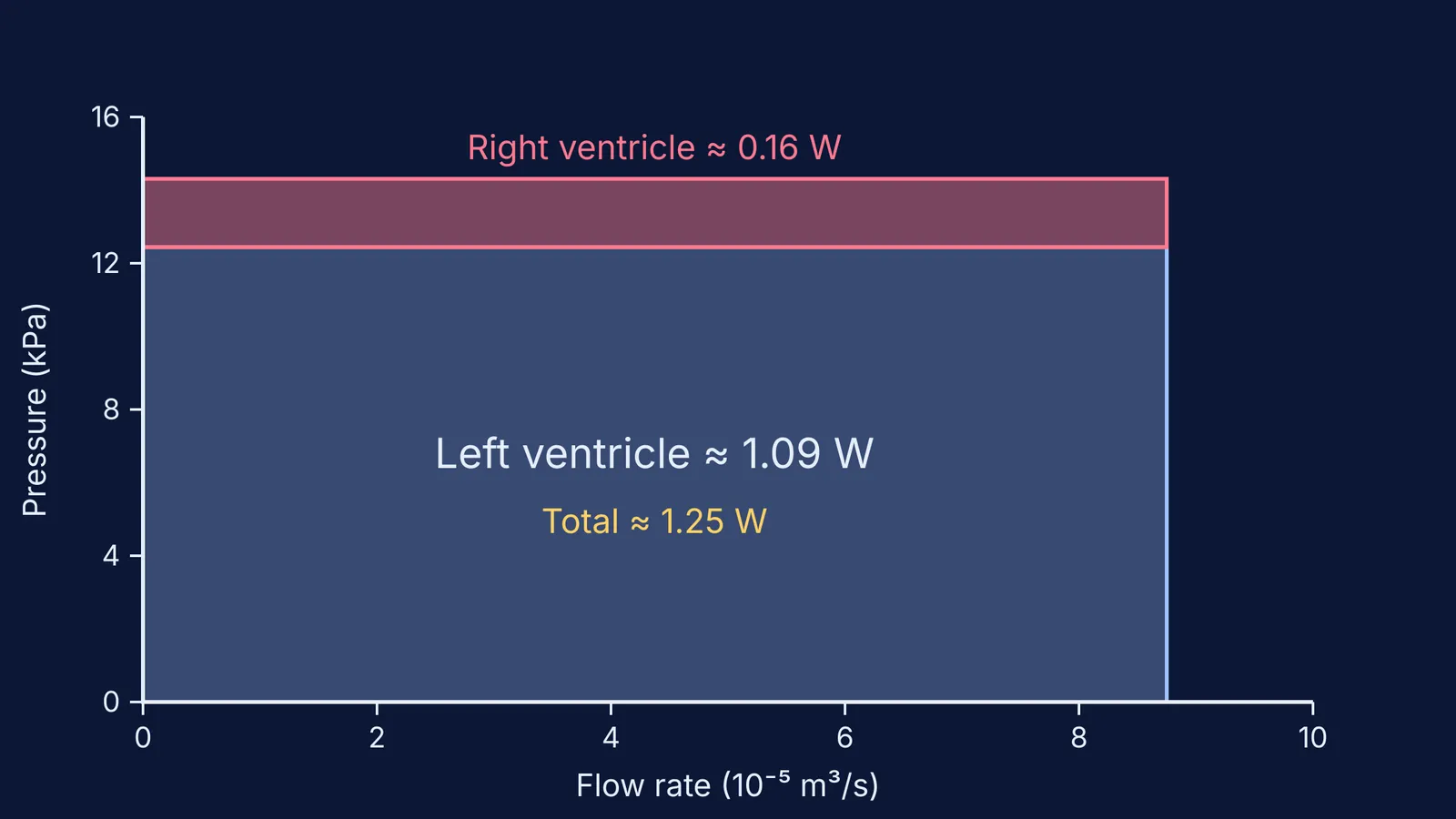
Convert the flow: 5.25 L/min = 5.25 × 10⁻³ m³ ÷ 60 s = 8.75 × 10⁻⁵ m³/s.
Convert the left-side pressure: 93.3 mm Hg × 133.3 Pa per mm Hg ≈ 12,400 Pa.
Left ventricle: 12,400 Pa × 8.75 × 10⁻⁵ m³/s ≈ 1.09 W.
Right ventricle: 14 mm Hg ≈ 1,870 Pa, and 1,870 Pa × 8.75 × 10⁻⁵ m³/s ≈ 0.16 W.
Add them: about 1.25 W.
Now do the Fermi-style check with powers of ten only. The pressure is about 10⁴ Pa and the flow is about 10⁻⁴ m³/s, so the power is about 1 W. The detailed answer and the rough one agree.
What does the estimate leave out?
A good estimate says what it ignored and which way each gap pushes the answer.
Starting pressure. Blood enters the ventricles at a low pressure, not zero, so using the full mean arterial pressure slightly overestimates the work.
Kinetic energy. The heart also speeds the blood up. At rest this is a small extra.
Pulses. Flow and pressure rise and fall with each beat. We used averages.
Exercise. OpenStax gives a cardiac output of about 19.5 L/min during exercise, which it describes as 4–5 times the resting rate. At resting pressures, that flow alone takes the total to about 4.7 W. Pressures rise during exercise too, so the real figure is higher.
Efficiency. Pumping power is not the energy the heart uses. A 2020 review notes that classical human studies put the left ventricle's mechanical efficiency at 20–30%, with the rest lost as heat (Juszczyk et al., Journal of Clinical Medicine). So about 1.25 W of pumping costs roughly 4 to 6 W of chemical energy.
How can you practise estimates like this?
Use the same five steps for any Fermi problem:
Write the physics law in one line (here, P = pressure × flow rate).
List each quantity with its unit and where you got it.
Convert everything to SI units before you multiply.
Check the answer with powers of ten.
Name what you ignored and say whether it makes the answer bigger or smaller.
Try the same method on how many atoms are in a grain of salt. If unit conversions keep tripping you up, the Fermi Problem Library has worked problems with a step-by-step solver that explains the reasoning rather than printing an answer. If pressure or flow rate still feels fuzzy, the Fermi Concept Library gives each concept in physics, chemistry, biology, mathematics and computing its own lesson.
Next time you see a small LED glowing, remember that your heart pumps blood with a power in the same range, every second of your life.