

On this page
A pinch of salt is made of many grains, and each one is a tiny crystal. Counting the atoms in a single grain is one of the cleanest estimation problems in school chemistry. You need only density, molar mass and Avogadro's number.
How many atoms are in a grain of salt?
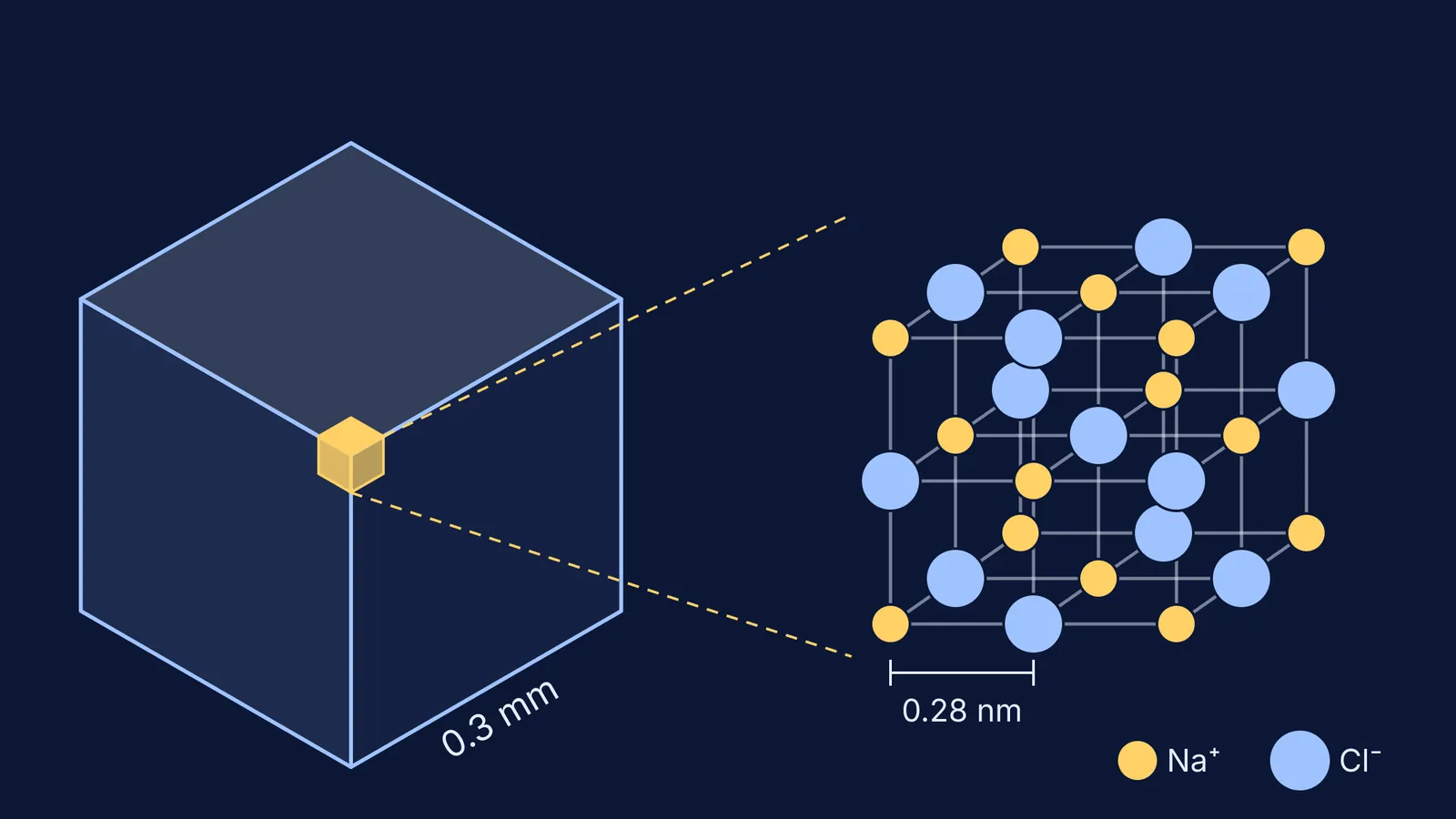
An ordinary grain of table salt holds about 1.2 × 10¹⁸ atoms, or 1.2 billion billion. That figure uses a grain size of about 0.3 mm on a side from Wayne's Word, the density of sodium chloride from PubChem and the Avogadro constant from NIST. Half the atoms are sodium ions (Na⁺) and half are chloride ions (Cl⁻), so there are about 6 × 10¹⁷ of each.
The count depends strongly on the grain. Volume grows with the cube of the side, so a coarser grain 0.5 mm across holds about 5.6 × 10¹⁸ atoms.
How do you estimate the mass of one grain?
Table salt grains are small cubes. The natural-history site Wayne's Word puts a single grain at about 0.3 mm on a side and notes that three average grains stacked together make about 1 mm. Treat the grain as a cube with side 0.3 mm.
First convert to centimetres, because density is given per cubic centimetre: 0.3 mm = 0.03 cm. The volume is 0.03 × 0.03 × 0.03 = 2.7 × 10⁻⁵ cm³.
The density of sodium chloride is 2.17 g/cm³ at 25 °C, according to PubChem. Mass = density × volume = 2.17 × 2.7 × 10⁻⁵ = 5.9 × 10⁻⁵ g. That is about 0.06 milligrams.
How do you turn grams of salt into atoms?
The molar mass of NaCl is 58.44 g/mol in PubChem. That is the sum of the standard atomic weights from the IUPAC Commission on Isotopic Abundances and Atomic Weights: 22.99 for sodium and about 35.45 for chlorine. Textbooks often round chlorine to 35.5 and sodium to 23, which gives 58.5 g/mol; the difference changes the answer by about 0.1%. The Avogadro constant is exactly 6.022 140 76 × 10²³ per mole (NIST).
Here is the whole chain, one line per step:
Volume: (0.03 cm)³ = 2.7 × 10⁻⁵ cm³
Mass: 2.7 × 10⁻⁵ cm³ × 2.17 g/cm³ = 5.9 × 10⁻⁵ g
Moles: 5.9 × 10⁻⁵ g ÷ 58.5 g/mol = 1.0 × 10⁻⁶ mol
Formula units: 1.0 × 10⁻⁶ mol × 6.022 × 10²³ per mol = 6.0 × 10¹⁷
Atoms: 6.0 × 10¹⁷ × 2 = 1.2 × 10¹⁸
Step 3 comes out to almost exactly one micromole. For a feel for how large a mole is, see how big a mole really is, in sand, seconds and paper.
The factor of two in step 5 matters. Sodium chloride is an ionic solid, so it has no separate NaCl molecules. Each formula unit is one Na⁺ ion and one Cl⁻ ion held in a lattice. The same idea scales up to compounds with more ions, as in finding the number of ions in one mole of aluminium sulphate.
Can you check the answer another way?
Yes, by counting ions along the edge of the crystal. A crystal-structure database from Japan's AIST lists rock salt as cubic, with a unit cell 5.640 Å on a side holding 4 formula units, which is 8 ions. Neighbouring ions are half a cell apart, about 0.282 nm.
Along a 0.3 mm edge you therefore have 0.3 mm ÷ 0.282 nm ≈ 1.06 million ions in a row. Cube that and you get (1.06 × 10⁶)³ ≈ 1.2 × 10¹⁸ ions, the same answer as the mole route. The database's calculated density, 2.17 g/cm³, also matches PubChem.
What should you check when you try this yourself?
Use your own salt. Line up grains along 5 mm of a ruler, count them, and divide to get your grain size. Then run the chain and check:
Side length converted to cm before cubing
Mass in grams, not milligrams, before dividing by 58.5
Answer written as formula units first, then doubled for atoms
Final answer close to 10¹⁸ for a grain near 0.3 mm (if you get 10¹⁵ or 10²¹, look for a lost factor of 1,000)
The same chain (volume, mass, moles, Avogadro) answers most "how many particles" questions. Our worked example on how many molecules are in one drop of water follows the same pattern.
If the unit conversion keeps tripping you up, the Fermi Problem Library has worked problems with a step-by-step solver that explains the reasoning rather than printing an answer. If the shaky part is the idea underneath, such as the mole, the formula unit or the ionic lattice, the Fermi Concept Library gives each concept its own lesson and its place in the map.


