

On this page
A mole is a number, like a dozen, only far bigger. The Avogadro constant is exactly 6.02214076 x 10^23 per mole, a defined value with no uncertainty, according to NIST's CODATA value.
That number is so large that most students simply stop picturing it. That is a problem, because mole concept questions in Class 11 chemistry and JEE Main reward the student who can tell when an answer is wildly off. Below, we turn 6.022 x 10^23 into three pictures, then ask you to predict the mass and volume of three everyday moles before you check.
How big is a mole of things you can see?
Each comparison uses one sourced input and one line of arithmetic, so you can redo it yourself.
Counted as seconds: NASA puts the age of the universe at about 13.8 billion years. A year has 365.25 x 86,400 = 31,557,600 seconds. So 6.022 x 10^23 seconds is about 1.9 x 10^16 years, roughly 1.4 million times the age of the universe.
Stacked as paper: one maker's technical data sheet for 80 gsm copy paper gives a thickness of 106 micrometres per sheet. A mole of those sheets would make a stack 6.4 x 10^19 metres tall. NASA gives one light-year as about 9.461 trillion kilometres, so the stack would reach about 6,700 light-years into the galaxy.
Poured out as sand: the USGS defines sand grains as between 62.5 micrometres and 2 mm across. Take a grain half a millimetre wide and give it its own little 0.5 mm box. A mole of grains then fills about 75,000 cubic kilometres. India's area is 3,287,263 square kilometres, so that sand would cover the whole country about 23 metres deep.
How much does one mole of water, salt and sugar weigh?
Before you scroll, write down three guesses for each substance: the mass in grams, the volume, and whether it would fit in your palm. Committing to a number first is what makes the check stick.
Now the method. The mass of one mole in grams equals the molar mass. Volume is mass divided by density.
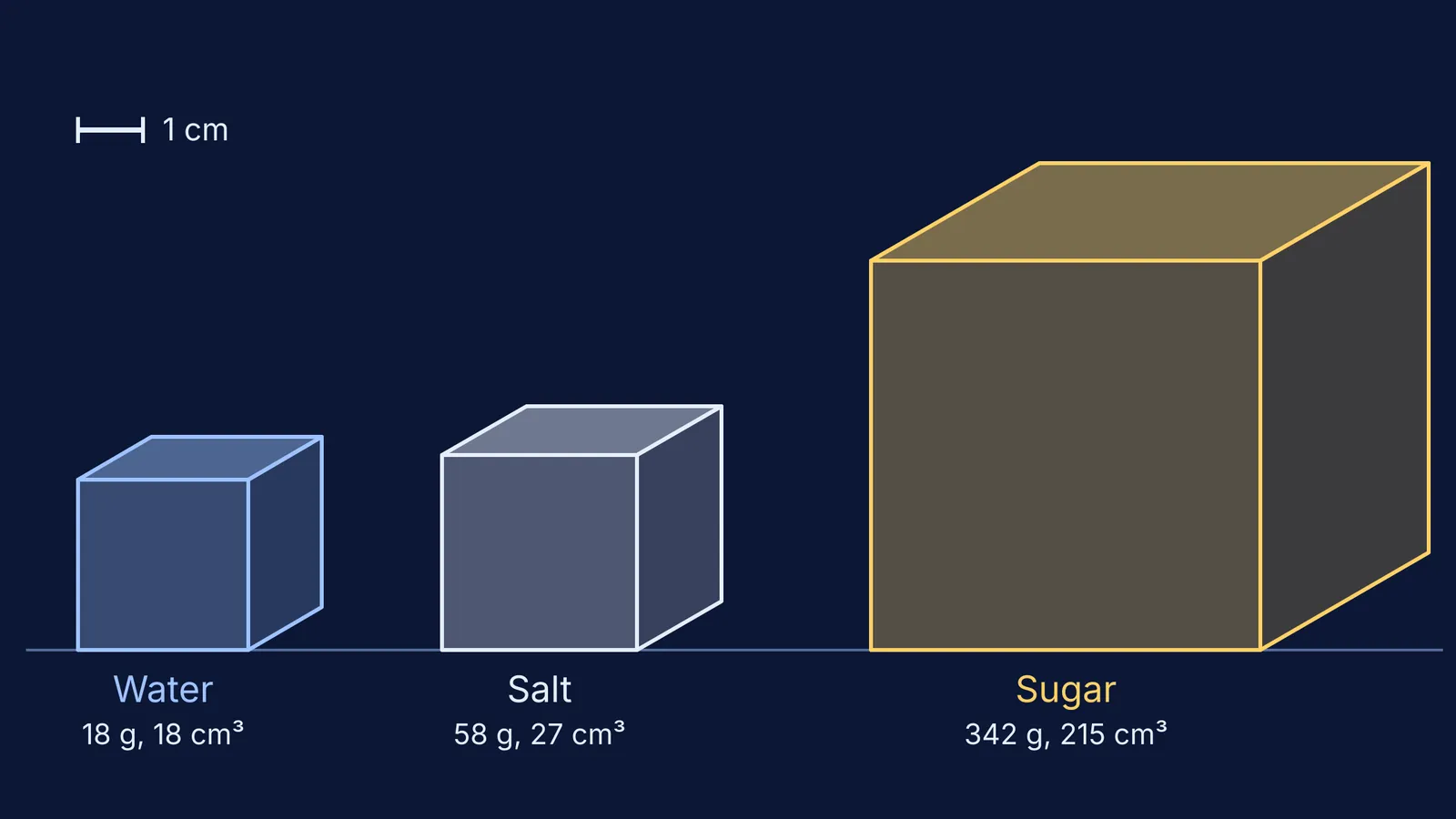
Water. PubChem lists a molar mass of 18.015 g/mol. The USGS table gives water's density near room temperature as about 0.998 g/cm³. So one mole is 18 g and about 18 mL, a single gulp.
Salt (sodium chloride). PubChem gives 58.44 g/mol and a density of 2.17 g/cm³ from the CRC Handbook. That is 58.44 / 2.17 = 27 cm³, a solid crystal cube 3.0 cm on each side.
Sugar (sucrose, C12H22O11). PubChem gives 342.30 g/mol and a density of 1.59 g/cm³. That is about 215 cm³, a solid cube 6.0 cm on each side.
How close were you? Most people expect the three moles to be similar in size, because they hold the same number of particles. They are not. A sucrose molecule has 45 atoms and weighs about 19 times as much as a water molecule, so its mole is heavier and bulkier.
Why does the same number give such different sizes?
A mole fixes the count, not the size. Mass depends on how heavy each particle is, and volume depends on how tightly the particles pack. That one idea explains most mole concept slips in exams:
Mixing up "one mole of molecules" with "one mole of atoms". One mole of water holds three moles of atoms.
Expecting equal moles to have equal mass. Compare 18 g of water with 342 g of sugar, using the PubChem molar mass for sucrose.
Forgetting the state. The 18 mL figure is for liquid water; steam spreads the same molecules over a far larger volume.
If the numericals still feel slippery, our guide to using AI for mole concept numericals and the mistakes to check walks through the common traps. To see how moles flow through a reaction, read what a balanced chemical equation tells you and where it stops.
A five-minute predict-then-check routine
Use this for any substance in your textbook, alone or with a parent at the table:
Pick a substance and look up its formula.
Guess the mass of one mole and say it out loud.
Work out the molar mass from atomic masses.
Guess the volume, then divide mass by density to check.
Write one sentence on why your guess was off.
Some ideas are easier to see than to read. The Fermi Simulation Lab has interactive simulations for those ideas, and our chooser on how to visualise hard physics ideas by topic helps you pick a picture for each one.
Tonight, try the routine on ethanol or glucose, and predict before you check.


