

On this page
When you are asked to find the number of ions in one mole of a compound, you are doing two things: counting the ions in a single molecule (or formula unit), and then multiplying that count by a very large number.
Many students make the mistake of either forgetting to multiply by Avogadro's constant, or counting the atoms instead of the ions. By breaking the compound into its cations and anions first, you can find the exact number of ions, atoms, and total charge.
What is the formula of aluminium sulphate?
The chemical formula for aluminium sulphate is Al₂(SO₄)₃, according to PubChem. You get this formula by crossing over the valencies. Aluminium has a valency of +3, while the sulphate polyatomic ion (SO₄) has a valency of -2. Swapping these numbers gives us two aluminiums for every three sulphates.
If you are stuck on how to combine these, reading about how to write chemical formulas using valency in Class 9 is a great place to start.
How many ions are in one formula unit of aluminium sulphate?
When aluminium sulphate dissolves in water, it breaks apart completely into its constituent ions (PubChem).
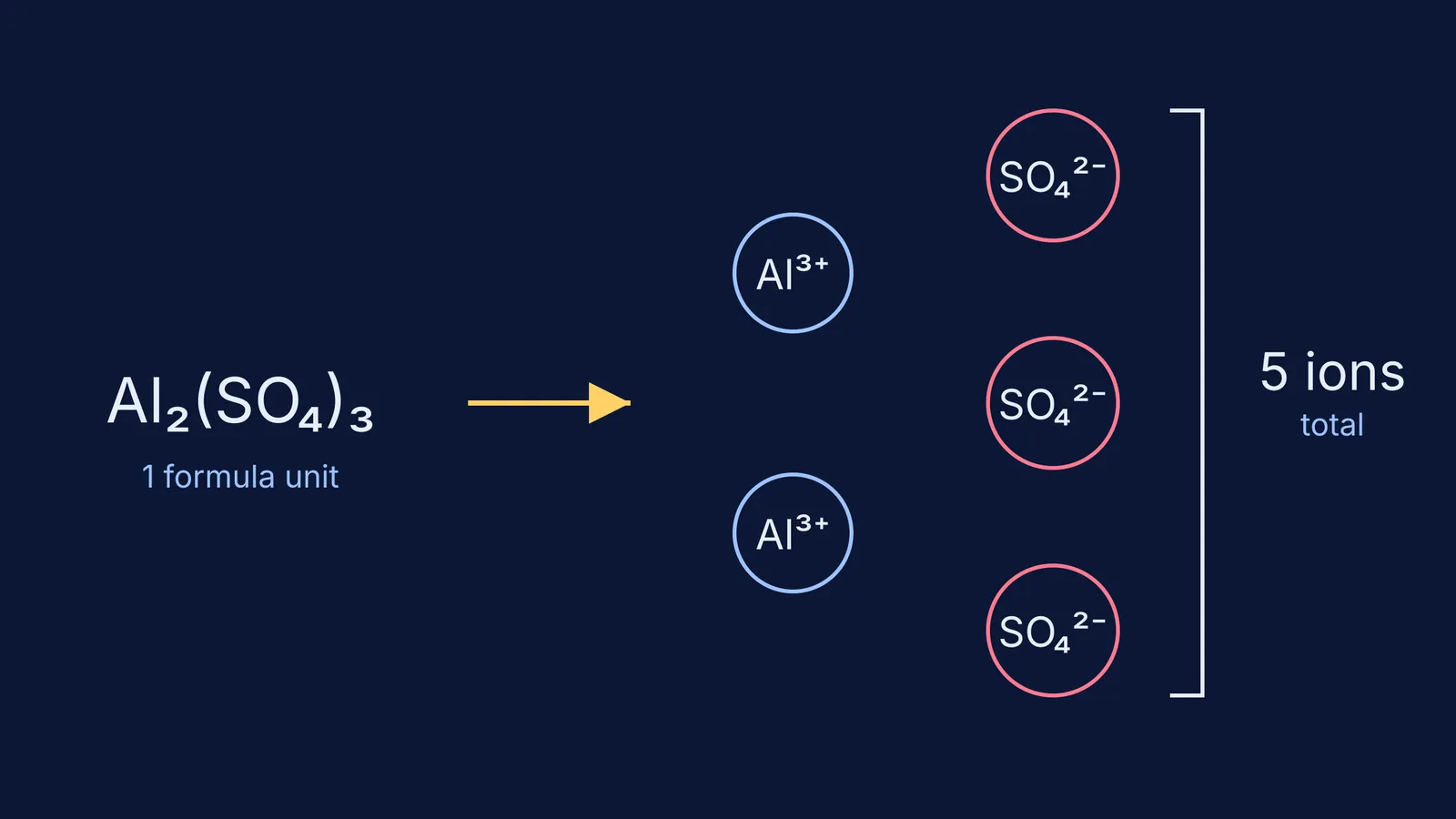
The balanced equation for this dissociation is: Al₂(SO₄)₃ → 2 Al³⁺ + 3 SO₄²⁻
From this, you can see that one single formula unit produces:
2 aluminium cations (Al³⁺)
3 sulphate anions (SO₄²⁻)
Adding these together gives a total of 5 ions per formula unit. Notice that we do not break apart the sulphur and oxygen inside the sulphate; SO₄²⁻ stays together as one polyatomic ion.
What is the number of ions in one mole of aluminium sulphate?
A mole is simply a number used to count microscopic things, just as a "dozen" means 12. This number is Avogadro's constant, which the International Union of Pure and Applied Chemistry (IUPAC) defines exactly as 6.02214076 × 10²³ per mole.
Since one formula unit of Al₂(SO₄)₃ contains 5 ions, one mole of the compound will contain 5 moles of ions.
Total ions = 5 × Avogadro's constant Total ions = 5 × (6.022 × 10²³) Total ions = 30.11 × 10²³ Total ions = 3.011 × 10²⁴
Therefore, there are 3.011 × 10²⁴ ions in one mole of aluminium sulphate.
If you are practising these calculations for an exam and keep getting the powers of 10 wrong, checking using AI for mole concept numericals can help you spot where your arithmetic is slipping. The Fermi Problem Library has worked problems with a step-by-step solver that explains the reasoning rather than printing an answer.
How to calculate the total number of atoms in one mole
Sometimes, an examiner will ask for the number of atoms instead of ions. This requires a different count.
Let us look at Al₂(SO₄)₃ again:
Aluminium (Al): 2 atoms
Sulphur (S): 1 × 3 = 3 atoms
Oxygen (O): 4 × 3 = 12 atoms
Adding these up, one formula unit contains 17 atoms in total.
To find the number of atoms in one mole, multiply by Avogadro's constant (IUPAC): Total atoms = 17 × (6.022 × 10²³) Total atoms = 1.024 × 10²⁵
Knowing what a balanced chemical equation gives helps you switch between counting molecules, ions, and atoms without getting confused.
How to find the total electrical charge
You can also use this same counting skill to find the total positive or negative charge in a mole of a substance.
In one formula unit of Al₂(SO₄)₃, there are two Al³⁺ ions. The total positive charge is 2 × (+3) = +6 elementary charges. Similarly, the three SO₄²⁻ ions give a total negative charge of 3 × (-2) = -6 elementary charges. The salt is electrically neutral overall.
To find the total positive charge in one mole of aluminium sulphate, you simply take the charge per formula unit (+6) and multiply it by Avogadro's constant. Alternatively, in chemistry, we use the Faraday constant, which is the charge of one mole of electrons (approximately 96,485 coulombs per mole, according to NIST). So, one mole of aluminium sulphate contains 6 moles of positive charge, or 6 Faradays of positive charge, and an equal amount of negative charge.
A checklist for counting particles
When you face a mole concept question, use this framework before picking up your calculator:
Identify the target: Is the question asking for molecules, formula units, ions, or atoms?
Write the formula: Ensure the valencies are correct.
Dissociate if needed: If asked for ions, split the compound into cations and anions. Keep polyatomic ions intact.
Count per unit: Find the number of the target particle in just one molecule or unit.
Multiply: Multiply your count by the given number of moles, and then by Avogadro's constant (6.022 × 10²³, defined by IUPAC).
If you are missing foundational ideas like valency or atomic structure, the Fermi Concept Library has every concept in chemistry with its own lesson to help you tackle stoichiometry with confidence.


