

On this page
Have you ever looked at a single drop of water from a tap and wondered exactly how much is inside it? In chemistry, that tiny drop holds an unimaginable number of molecules. The *how many molecules are in one drop of water calculation* is a classic stoichiometry problem that brings the sheer scale of atoms into focus.
By combining the volume of a standard drop, the density of water and Avogadro's number (Wikipedia), you can find the exact answer in a few short steps. This exercise is one of the best ways to test your understanding of the mole concept.
What is the volume and mass of a drop of water?
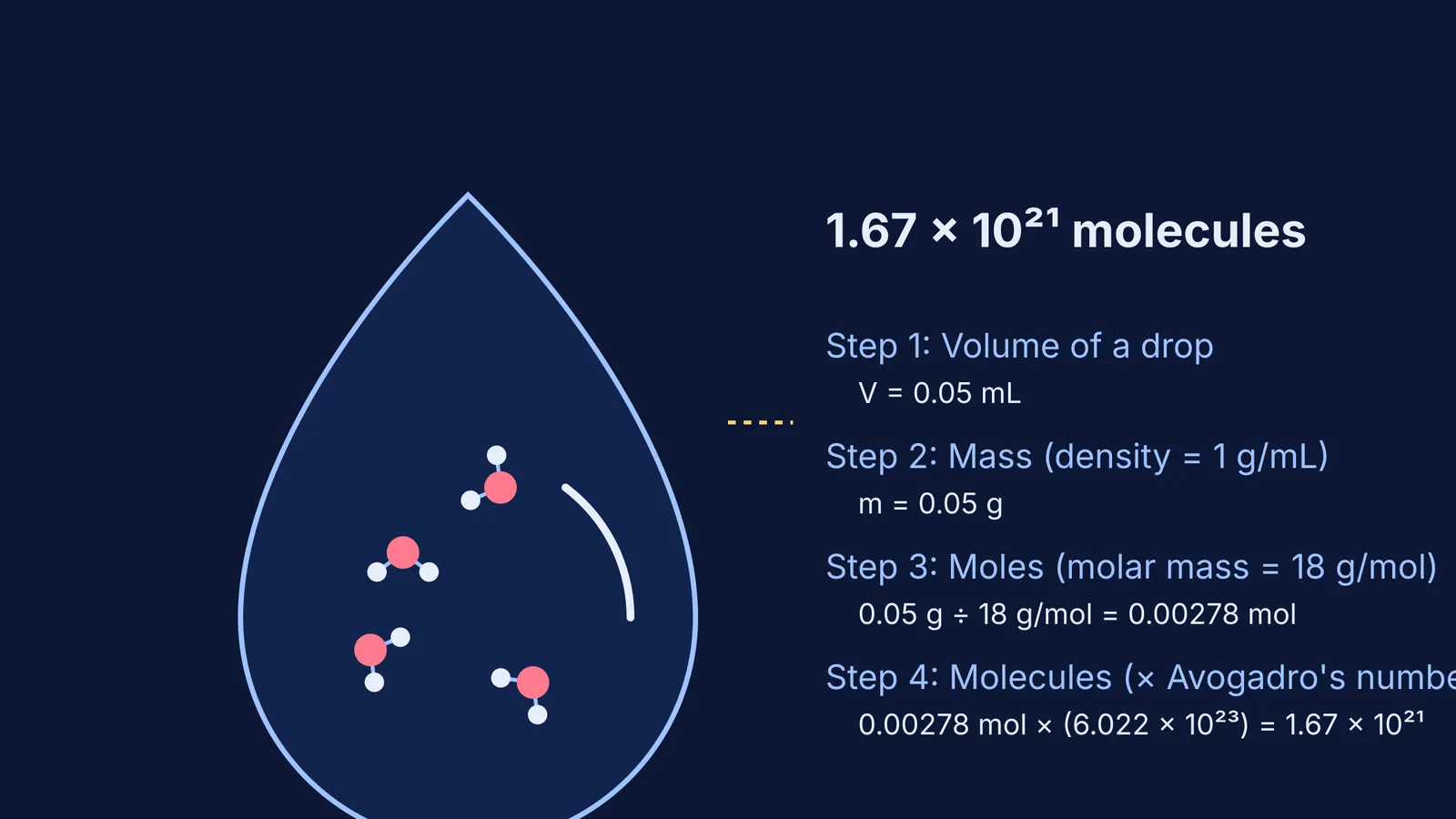
Before you can count molecules, you need to know exactly how much water you are dealing with. Drops from a standard pipette or a tap can vary in size depending on the surface tension of the liquid, the temperature, and the physical opening they fall from. However, to make calculations consistent across different experiments, scientists use a defined measure. In scientific and pharmaceutical settings, a metric drop is standardized at exactly 0.05 mL (Wikipedia)). This formal definition means there are exactly 20 drops in one milliliter of liquid.
Once you have the volume, finding the mass is straightforward. Liquid water has a density of about 1 gram per milliliter at room temperature (Wikipedia). Multiplying the volume by the density gives you the mass:
1.0 g/mL × 0.05 mL = 0.05 grams
So, a single standard metric drop of water has a mass of 0.05 g.
How do you calculate the moles in a drop?
Atoms and molecules are far too small to weigh on a conventional laboratory scale, so chemists count them in massive groups called moles. A mole is simply a standard batch of particles, much like a dozen is a batch of twelve, but on a vastly larger scale. To find out how many moles are in your 0.05 g drop of water, you must divide its measured mass by the theoretical molar mass of the substance.
The chemical formula for water is H₂O. It contains two hydrogen atoms (which have an atomic mass of about 1 each) and one oxygen atom (which has an atomic mass of 16). Adding these together gives water a molar mass of 18 g/mol (Wikipedia).
Mass ÷ Molar Mass = Moles 0.05 g ÷ 18 g/mol ≈ 0.002778 moles
Your single drop of water holds approximately 0.002778 moles of water. Fermi Concept Library explains every concept in physics and chemistry, including how to set up these mole conversions step by step.
How do you use Avogadro's number?
To convert your answer from moles back into a raw particle count, you need a conversion factor. This is where Avogadro's number comes in. Named after the Italian scientist Amedeo Avogadro, this fundamental physical constant is exactly 6.022 × 10²³ particles per mole (Wikipedia).
Avogadro's constant acts as a bridge between the macroscopic world of grams and liters that we can measure in the lab, and the microscopic world of individual atoms and molecules that we cannot see. Because it is a universal constant, it applies to absolutely anything you want to count. One mole of carbon atoms contains 6.022 × 10²³ atoms, one mole of water contains 6.022 × 10²³ water molecules, and one mole of electrons contains 6.022 × 10²³ electrons.
How many molecules are in a drop of water?
Now you have all the pieces required to finish the calculation. You simply multiply the number of moles in the drop by Avogadro's number (Wikipedia) to find the final molecule count.
0.002778 moles × (6.022 × 10²³ molecules/mole) ≈ 1.67 × 10²¹ molecules
There are about 1.67 × 10²¹ molecules in a single 0.05 mL drop of water.
Furthermore, because each individual water molecule (H₂O) is made of three atoms, that same drop holds roughly 5.01 × 10²¹ individual atoms.
What does 1.67 sextillion actually mean?
The number 1,670,000,000,000,000,000,000 is staggeringly large, and human brains are not built to comprehend it easily.
These calculations are not just mathematical trivia; they are the foundation of modern stoichiometry. Whether you are finding the average molar mass of a gas mixture or reading about Jean Perrin and the proof that atoms exist, the mole concept is what makes all of chemistry measurable and predictable.
What if the drop is a different size?
While the metric drop of 0.05 mL (Wikipedia)) is the standard for medical and laboratory calculations, real-world drops are rarely so precise. A heavy raindrop, for example, might have a volume closer to 0.1 mL. If you repeat the calculation for this larger drop, the numbers double.
A 0.1 mL raindrop has a mass of 0.1 g. Dividing by the molar mass of 18 g/mol gives about 0.005556 moles. Multiplying by Avogadro's number yields roughly 3.34 × 10²¹ molecules. Conversely, a tiny droplet from a fine mist might be only 0.01 mL, holding a "mere" 3.34 × 10²⁰ molecules. Regardless of the size of the drop, the three-step method—finding the mass, converting to moles, and multiplying by Avogadro's constant—always works perfectly.


