

On this page
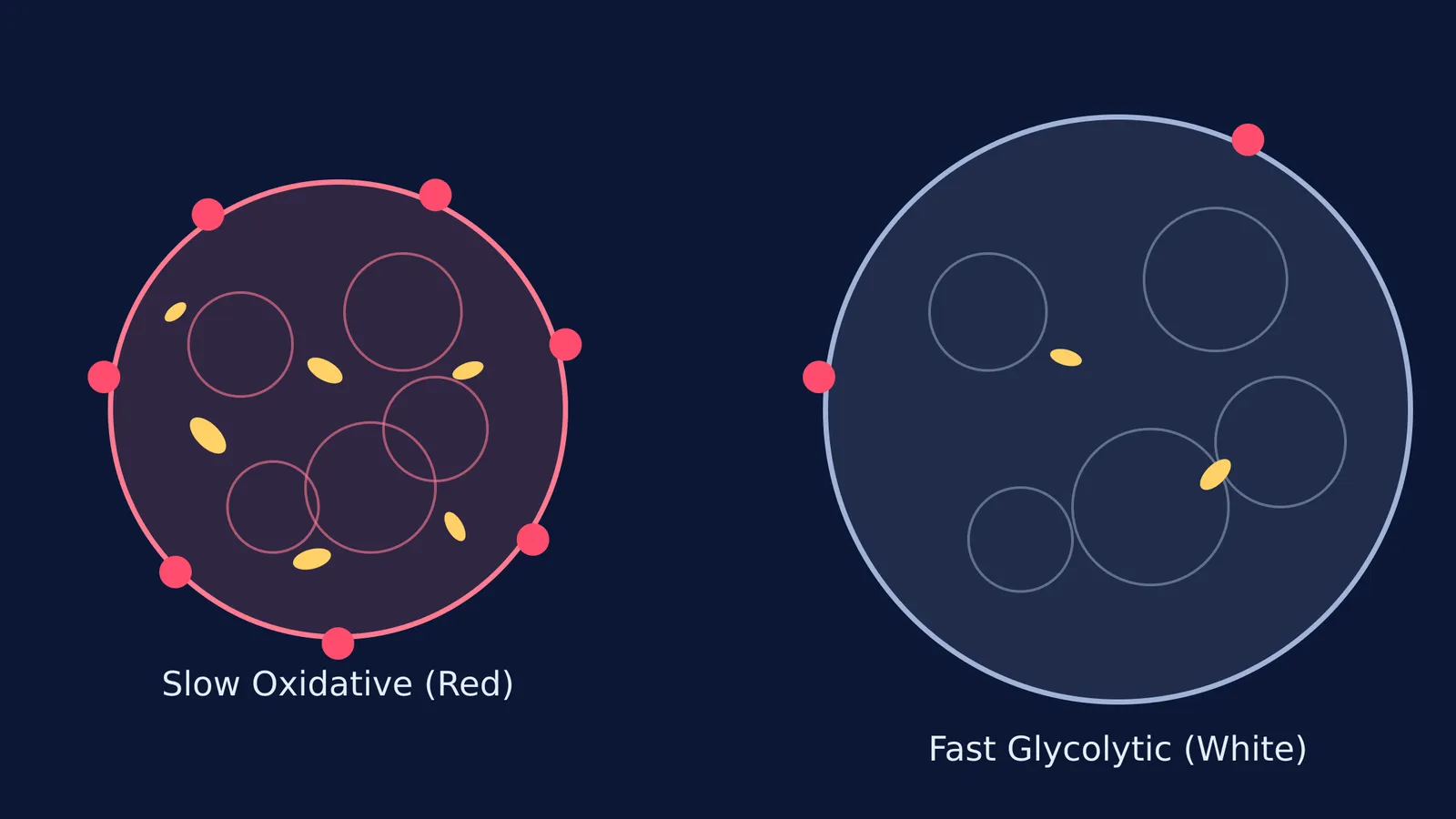
Red muscle fibres (Type I and Type IIa) are built for endurance and sustained activity. They contain high levels of the oxygen-binding protein myoglobin, which gives them a dark red appearance, and rely on an abundance of mitochondria to generate energy aerobically.
White muscle fibres (Type IIb), on the other hand, are the body's powerhouses for brief, explosive movements. They have a larger diameter but contain very little myoglobin and significantly fewer mitochondria. Instead of using oxygen, they generate energy through anaerobic glycolysis, which produces rapid power but leads to quick fatigue.
According to a review of skeletal muscle physiology by the National Center for Biotechnology Information (NCBI), these structural differences dictate whether a muscle is suited for a marathon or a sprint (NCBI).
Why do red muscle fibres have so much myoglobin?
Myoglobin acts as a local oxygen reservoir inside the muscle cell. Because red fibres rely on oxidative phosphorylation—a process that requires a steady supply of oxygen to produce ATP—they need myoglobin to store oxygen and pull it from the bloodstream (NCBI).
When you run a long distance, the dense capillary network surrounding red fibres delivers oxygen, and myoglobin shuttles it directly to the mitochondria. This system is highly efficient, allowing muscles to contract repeatedly over long periods without tiring. If you are preparing for a biology exam, understanding this oxygen pathway is crucial. When you hit a roadblock on these physiological pathways, the Fermi Concept Library maps out how myoglobin, mitochondria, and respiration connect, helping you see the big picture rather than memorising isolated facts.
Do white muscle fibres use anaerobic energy?
Yes. Because white muscle fibres lack a dense population of mitochondria, they cannot rely on aerobic respiration to meet their high energy demands (NCBI). Instead, they turn to anaerobic glycolysis.
In this pathway, glycogen stored in the muscle is quickly broken down to produce ATP without oxygen. While this generates energy rapidly—perfect for a heavy weightlift or a 100-metre sprint—it also produces lactate as a byproduct. The NCBI notes that this reliance on anaerobic metabolism is exactly why white fibres fatigue much faster than their red counterparts. This process is famously linked to Otto Meyerhof, who discovered how muscle turns sugar into lactic acid during intense bursts of work.
What are intermediate (Type IIa) muscle fibres?
Not all fibres fall perfectly into the extreme red or white categories. Intermediate fibres, known as Type IIa, bridge the gap between slow oxidative and fast glycolytic fibres (NCBI).
Like Type I fibres, they contain high amounts of myoglobin and mitochondria, which gives them a pinkish-red colour and allows them to rely heavily on aerobic respiration. However, like Type IIb fibres, they have a fast contractile speed and can also use anaerobic glycolysis when a sudden burst of energy is required. This dual capability makes Type IIa fibres highly adaptable.
These fibres are essential for activities that demand both endurance and moderate power, such as walking briskly, swimming, or cycling.
A framework for studying muscle physiology
Understanding human physiology requires linking microscopic structures to macroscopic movement. When tackling this topic for school or competitive exams, use this three-step framework:
Start with the function: Ask yourself what the muscle needs to do. If the goal is holding your head upright all day, the muscle needs endurance. If the goal is jumping, it needs immediate power.
Identify the energy source: Endurance requires steady energy from oxygen (aerobic), while immediate power relies on stored fuel without waiting for oxygen delivery (anaerobic).
Map the cellular machinery: Aerobic energy demands oxygen-carrying myoglobin, ATP-producing mitochondria, and a vast capillary network. Anaerobic energy demands large stores of glycogen and thick bundles of contractile proteins, leading to a larger fibre diameter.
When you link structure directly to function, you no longer have to rote-learn the differences. When you review muscle contraction step by step or tackle problems on locomotion and movement, try to visualise how the energy supply matches the sliding filaments.
If you struggle with matching these functional differences to their cellular structures, the AI tutor within the Fermi Problem Library will walk you through worked problems step by step. Rather than just giving you the final answer, it explains the reasoning—such as why a high capillary density is functionally useless without mitochondria to process the delivered oxygen.


