

On this page
Blood plasma is mostly water. Cortisol, a steroid from the adrenal glands, and thyroxine (T4), from the thyroid, are fat-loving molecules. That helps them pass through the fatty membranes of target cells, but it causes a problem on the journey, which the body solves with carrier proteins.
Why do fat-soluble hormones need carrier proteins?
The usual textbook line is that these hormones do not dissolve in water. The real reason is more interesting. A 2019 review of thyroid hormone carriers in Frontiers in Endocrinology points out that the maximum solubility of T4 at pH 7.4 is 2.3 μM, about 100,000 times the free T4 concentration in human blood (24 pM). So, for T4 at least, dissolving is not the main issue.
The real problem is that these hormones stick to fat. Because thyroid hormones are lipophilic, they tend to move into the fatty layer of cell membranes, the same review explains. Without carriers, hormone leaving the thyroid would tend to be taken up by the first cells it met. The review describes rat liver experiments in which T4 pumped through a liver without binding proteins stayed in the first cells it touched. When the binding proteins were added, T4 spread evenly through the whole liver.
Steroids face the same chemistry. Biologically active steroids are carried in blood by albumin, sex hormone-binding globulin (SHBG) and corticosteroid-binding globulin (CBG), according to a review by Geoffrey Hammond in the Journal of Endocrinology. Carrier proteins do three jobs:
Delivery: they keep the hormone in the bloodstream so it reaches distant tissues, not just the nearest ones.
Buffering: albumin binds steroids only weakly, but there is so much of it in blood that it smooths out large swings in hormone levels, Hammond writes.
Gatekeeping: CBG and SHBG grip their steroids tightly and control how much can reach target cells.
What is the difference between bound and free hormone?
Free hormone is the fraction not attached to any protein, and it is the part considered biologically active. According to the free hormone hypothesis, only free steroids pass through cell membranes by simple diffusion, as Hammond's review puts it. Carl Mendel set out a mathematical model of this idea in Endocrine Reviews in 1989.
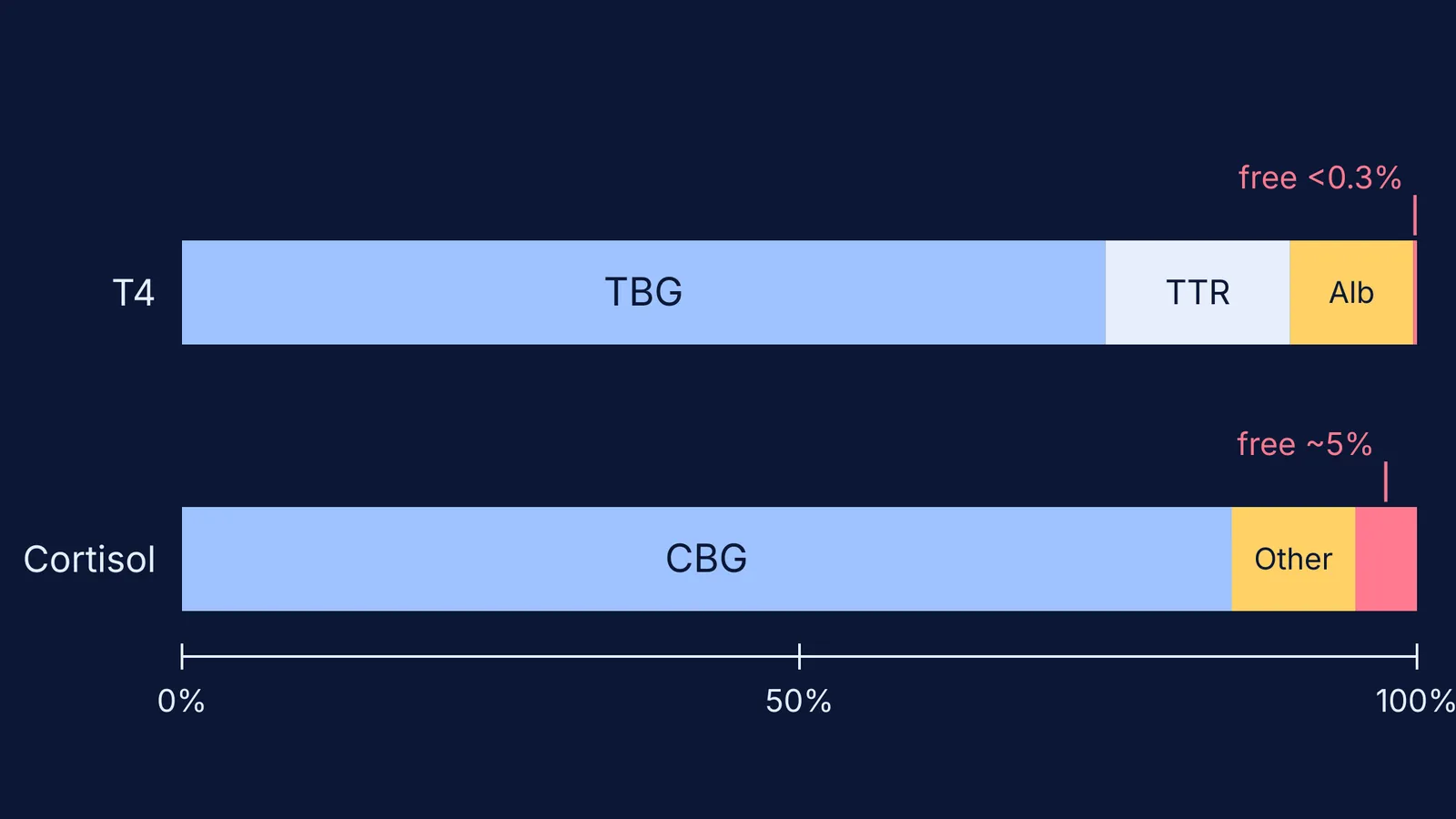
About 80-90% of serum cortisol binds to CBG and only about 5% stays unbound, according to a review by Yoon Ju Bae and Juergen Kratzsch in Best Practice & Research Clinical Endocrinology & Metabolism.
More than 99.7% of thyroid hormone in mammalian blood is bound to carrier proteins, Rabah and colleagues report. Of T4, thyroxine-binding globulin (TBG) binds about 75%, transthyretin (TTR) about 15% and albumin about 10%.
Worked example: follow 1,000 hormone molecules
Sort 1,000 molecules of each hormone in plasma. For thyroxine, using Rabah and colleagues' figures:
More than 997 are bound to protein.
Of the bound ones, roughly 750 sit on TBG, 150 on TTR and 100 on albumin.
Fewer than 3 are free to enter a cell at any moment.
For cortisol, using Bae and Kratzsch's figures:
About 800 to 900 are on CBG.
About 50 are free.
The rest are held loosely by other plasma proteins, such as albumin, which binds all classes of steroids weakly.
Now think of it as an equilibrium, the way you would in chemistry: hormone-protein complex ⇌ hormone + protein. When cells take up free hormone, the equilibrium shifts to the right and more hormone leaves its carrier.
The free T4 figure of 24 pM shows how small the working amount is, which ties in with why hormones work in such tiny amounts. It is also why a blood report can give a total level and a free level for the same hormone. Our explainer on how hormone levels are measured in a blood test covers the lab side. If you are trying to read your own or a family member's report, take the questions to a doctor rather than to a biology textbook.
How do you write this in an exam answer?
A strong answer on hormone transport covers five points in order:
Name the problem: lipophilic hormones in watery plasma would move into the first cell membranes they meet.
Name the carriers: CBG and albumin for cortisol; TBG, transthyretin and albumin for thyroxine.
Define free hormone and say that it is the active fraction.
Say that binding is reversible, so the bound pool acts as a reservoir.
Give one number per hormone, such as about 5% free cortisol.
If the equilibrium step is the part that feels shaky, the Fermi Concept Library gives every concept in biology and chemistry its own lesson, so you can revise reversible reactions and hormone action side by side. If you are not sure where your gap is, Fermi's AI tutor can work out what you already know and build a plan for the session.
Next, see how this transport links to timing in why some hormones act fast and others slowly.


