

On this page
A thyroid test and a cortisol test share one problem: find a single kind of molecule among thousands in blood, and count it when there is almost none. Most hormone tests solve it with antibodies, the same idea behind the ELISA from your Class 12 biotechnology chapter.
How are hormone levels measured in a blood test?
A health professional takes blood from a vein in your arm with a small needle, as MedlinePlus explains for the TSH test. The lab then runs it through an immunoassay: a test that uses antibodies to recognise one specific molecule.
Total thyroid hormones circulate at nanomolar concentrations, while free T4 and free T3 circulate in the picomolar range, according to Carole Spencer's Endotext chapter on thyroid assays. The same chapter notes that free T4 is only about 0.02% of total T4, and that third-generation TSH tests have a functional sensitivity of about 0.01 mIU/L. One picomole per litre is about 6 × 10^8 molecules per millilitre (10^-12 mol/L × 6.02 × 10^23 per mol ÷ 1,000). Antibodies are choosy enough to pick it out, which is why most hormone tests are built on them. Most current TSH tests, the chapter adds, are automated assays that read light (chemiluminescence) instead of colour; the antibody logic is the same.
What does an ELISA actually do, step by step?
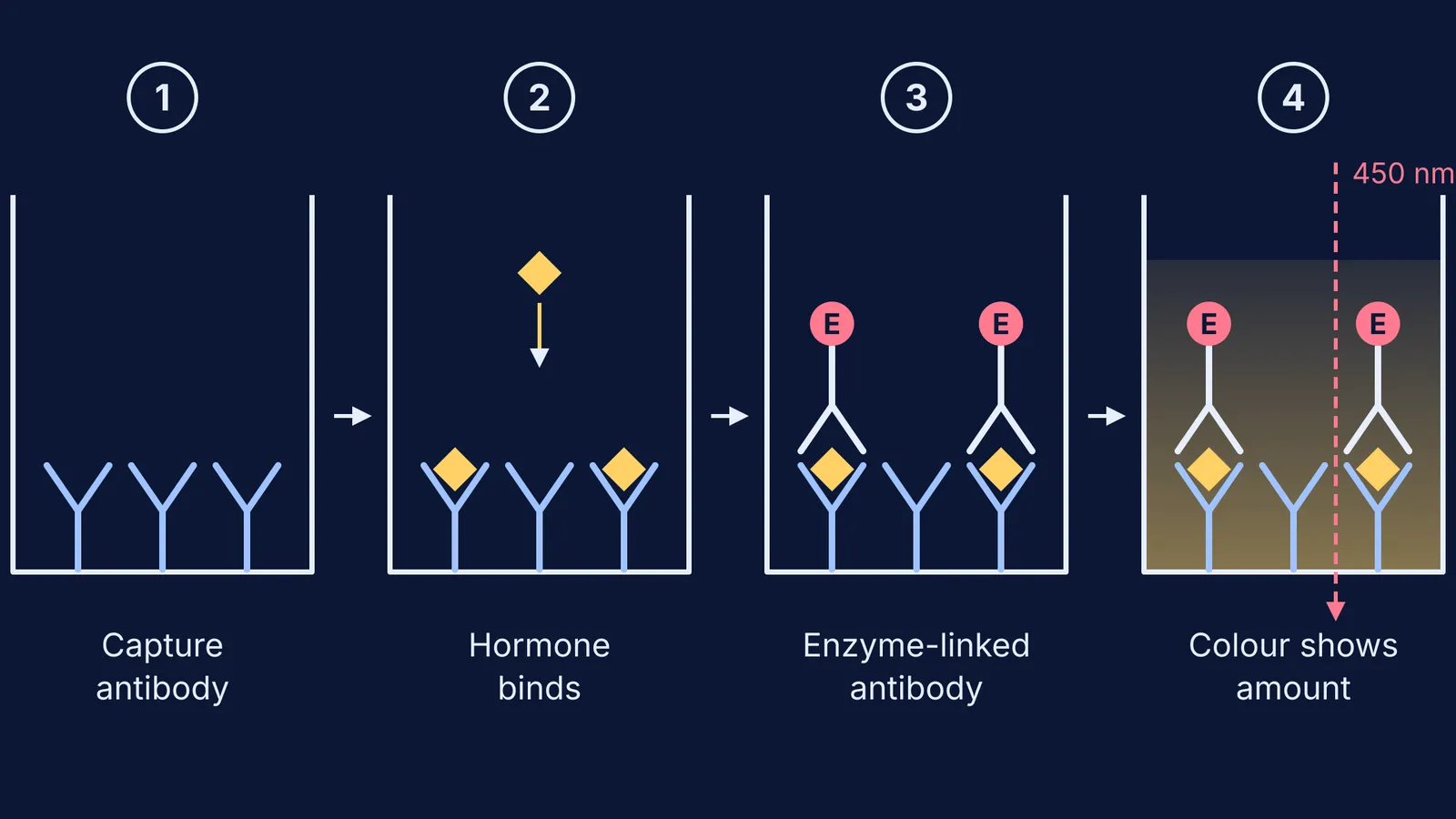
ELISA (enzyme-linked immunosorbent assay) is an assay that detects and measures antigens, antibodies, proteins and hormones in biological samples, as defined in a 2025 review by Aydin and colleagues. The name comes from Eva Engvall and Peter Perlmann's 1971 paper in Immunochemistry90454-X). For a large hormone such as TSH, the common format is the sandwich, shown in the diagram above:
Capture antibody. The plastic well is coated with antibodies that bind one site on the hormone.
Hormone binds. Serum is added; the hormone sticks to the capture antibodies and everything else is washed away.
Enzyme-linked antibody. A second antibody, aimed at a different site on the same hormone and carrying an enzyme (often HRP), binds on top. Unbound antibody is washed off.
Colour shows amount. A substrate such as TMB is added. The enzyme turns it coloured, a stop solution (usually an acid) ends the reaction, and a reader measures absorbance, most often at 450 nm.
The lab runs standards of known concentration alongside your sample and plots a standard curve, with concentration on a log scale and absorbance on a linear scale, as the Aydin review describes. Your sample's absorbance is read off that curve.
Why are small hormones measured differently?
A sandwich needs two antibodies gripping two separate sites, so the hormone must be fairly large. The 2022 review of hormone immunoassays by Ghazal and colleagues lists sandwich assays for larger molecules such as pituitary hormones, insulin and parathyroid hormone, and competitive assays for small ones such as T3, T4 and steroids.
In a competitive assay, the patient's hormone and a labelled copy of it compete for a limited number of antibody sites. More hormone in the sample means less label bound, so the signal goes down as the concentration goes up.
Worked example: reading a standard curve
These numbers are made up for practice, using the log-scale curve described in the Aydin review. A sandwich ELISA gives these standards: 0.1 mIU/L reads 0.08, 1 mIU/L reads 0.45, and 10 mIU/L reads 1.60. Your sample reads 0.80.
Find the bracket: 0.80 lies between 0.45 (1 mIU/L) and 1.60 (10 mIU/L).
Work in log units, because the x-axis is logarithmic: log 1 = 0 and log 10 = 1.
Fraction of the way along: (0.80 − 0.45) ÷ (1.60 − 0.45) = 0.35 ÷ 1.15 ≈ 0.30.
So log(concentration) ≈ 0.30, and the concentration ≈ 10^0.30 ≈ 2.0 mIU/L.
How does this connect to your biotechnology chapter?
The NCERT Class 12 chapter Biotechnology and its Applications lists ELISA with PCR and recombinant DNA technology as tools for early diagnosis, and states that ELISA is based on the principle of antigen-antibody interaction. Hormone tests use the same principle, with the hormone as the antigen. For revision, check that you can:
name the two antibodies in a sandwich ELISA and say why they must bind different sites
say which way the signal moves in sandwich and in competitive formats
read a value off a log-scale standard curve
If the antibody part feels shaky, read how antibodies bind antigens so specifically, then see what sets a hormone level in the thyroid negative feedback loop. For chapter-wide practice, try our Class 12 board exam guide to Biotechnology and its Applications. If a term such as antigen or enzyme still feels vague, the Fermi Concept Library gives each biology concept its own lesson and shows where it sits in the map.
For families: a lab value only makes sense next to its reference range and the person's health history, so leave the reading to a doctor.


