

On this page
The Class 11 chapter on chemical coordination defines hormones as non-nutrient chemicals which act as intercellular messengers and are produced in trace amounts (NCERT Biology Class 11, Chapter 19). This post shows where that trace amount goes, following one adrenaline molecule with the numbers laid out step by step.
How small is a hormone dose, really?
Hormones typically circulate in blood in the picomolar (10⁻¹² mol/L) or nanomolar (10⁻⁹ mol/L) range (MSD Veterinary Manual, Kemppainen).
Two facts from NCERT explain how such a dilute signal still works (NCERT Biology Class 11, Chapter 19). Each receptor is specific to one hormone, and receptors sit in the target tissues only. Hormones that bind membrane receptors normally do not enter the cell; they generate second messengers such as cyclic AMP (cAMP) inside it. The second messenger is where the multiplying happens.
How does one adrenaline molecule release so much glucose?
An open biochemistry textbook by Kevin Ahern, Indira Rajagopal and Taralyn Tan states that binding of one epinephrine (adrenaline) molecule to its receptor results in the activation of a million glycogen phosphorylase enzyme molecules (Biochemistry Free For All, 7.9 Signaling/07:_Information_Processing/7.09:_Signaling)). Glycogen phosphorylase is the enzyme that cuts glucose units off stored glycogen as glucose-1-phosphate (GMCH Chandigarh, glycogen metabolism notes).
The relay runs in this order (OpenStax Biology 2e, 37.2; Bergtrom, Signal Transduction/17%3A_Membrane_Function/17.07%3A_17.7_Signal_Transduction)):
Adrenaline binds a receptor on a liver cell, and the receptor switches on G proteins.
The G protein switches on adenylyl cyclase, and each adenylyl cyclase makes many cAMP molecules from ATP.
cAMP switches on protein kinase A (PKA).
PKA switches on phosphorylase kinase.
Phosphorylase kinase switches on glycogen phosphorylase.
Glycogen phosphorylase releases glucose-1-phosphate from glycogen.
One step shrinks the count instead of growing it. PKA is an R2C2 complex: two cAMP molecules bind each regulatory (R) subunit, so four cAMP free two active catalytic (C) subunits (Mutalik and Venkatesh, 2005).
The numbers, step by step
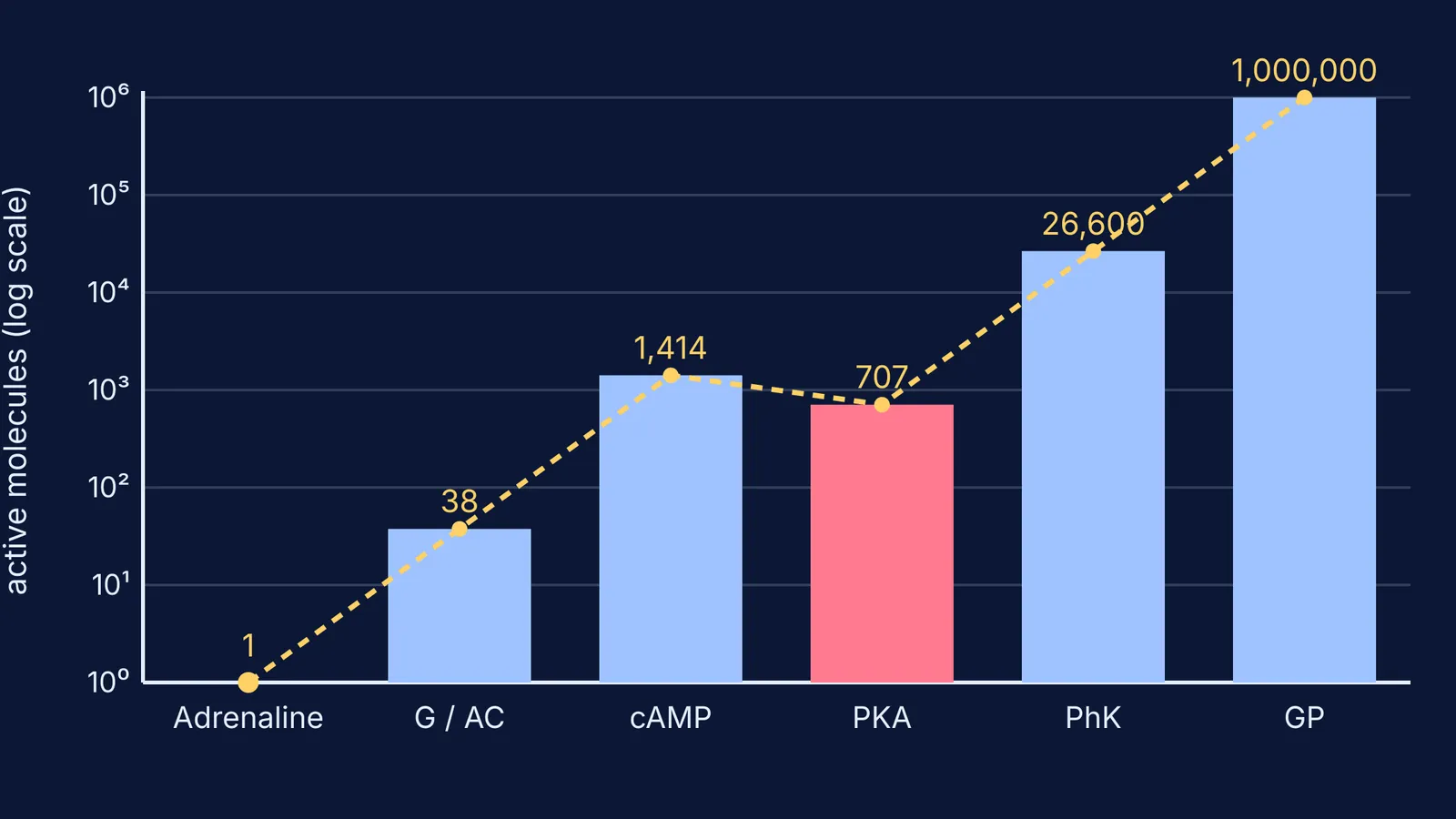
Textbooks give the end point, not a number for each step, so here is a model that splits the million evenly. Four steps multiply and the PKA step halves, so the four together must give 2,000,000. Each therefore multiplies by the fourth root of 2,000,000, about 37.6.
Adrenaline molecules bound: 1
Active G protein and adenylyl cyclase: 1 × 37.6 ≈ 38
cAMP molecules: 37.6 × 37.6 ≈ 1,414
Active PKA catalytic subunits: 1,414 ÷ 2 ≈ 707
Active phosphorylase kinase: 707 × 37.6 ≈ 26,600
Active glycogen phosphorylase: 26,600 × 37.6 ≈ 1,000,000
Now the glucose. Each phosphorylase is an enzyme, so it is not used up; each reaction removes one glucose unit as glucose-1-phosphate, and the enzyme can then act again (GMCH Chandigarh). Even if each of the million enzymes clipped only one unit, that would be a million glucose-1-phosphate molecules from one adrenaline molecule. In the liver, glucose-1-phosphate becomes glucose-6-phosphate, and the enzyme glucose-6-phosphatase frees glucose into the blood; most other tissues lack this enzyme.
Why are hormones needed in very small amounts, and not more?
OpenStax Anatomy and Physiology puts it plainly: thousands of signalling events can be initiated simultaneously in response to a very low concentration of hormone in the bloodstream, thanks to the phosphorylation cascade (OpenStax Anatomy and Physiology 2e, 17.2). The same section explains why a large dose would not help.
Fast off-switch. Epinephrine has a half-life of approximately one minute, so its effect fades quickly unless more is released.
Too much blunts the signal. A significant circulating level of a hormone can cause target cells to decrease their number of receptors for it, called downregulation.
NCERT adds a third point: because receptors sit in target tissues only, a tiny amount spread through the whole bloodstream acts only where it is meant to (NCERT Biology Class 11, Chapter 19).
Related reading: how membrane and intracellular hormone receptors differ, why adrenaline is called the emergency hormone and why a hormone is a signal and an enzyme is a catalyst.
How do you write this answer in an exam?
Use four sentences, in this order:
Definition: hormones are intercellular messengers produced in trace amounts.
Specificity: they act only on cells with matching receptors.
Amplification: a second messenger (cAMP) starts a cascade that multiplies the signal at each step.
Control: small amounts are cleared fast, and excess hormone makes cells cut their receptors.
To check yourself, redo the arithmetic with a different multiplier, say 30 per step, and see where you land (about 405,000). If the order of the relay keeps slipping, the Fermi Concept Library gives every concept in biology its own lesson and its place in the map, so you can revisit second messengers, receptors and enzymes one at a time.


