

On this page
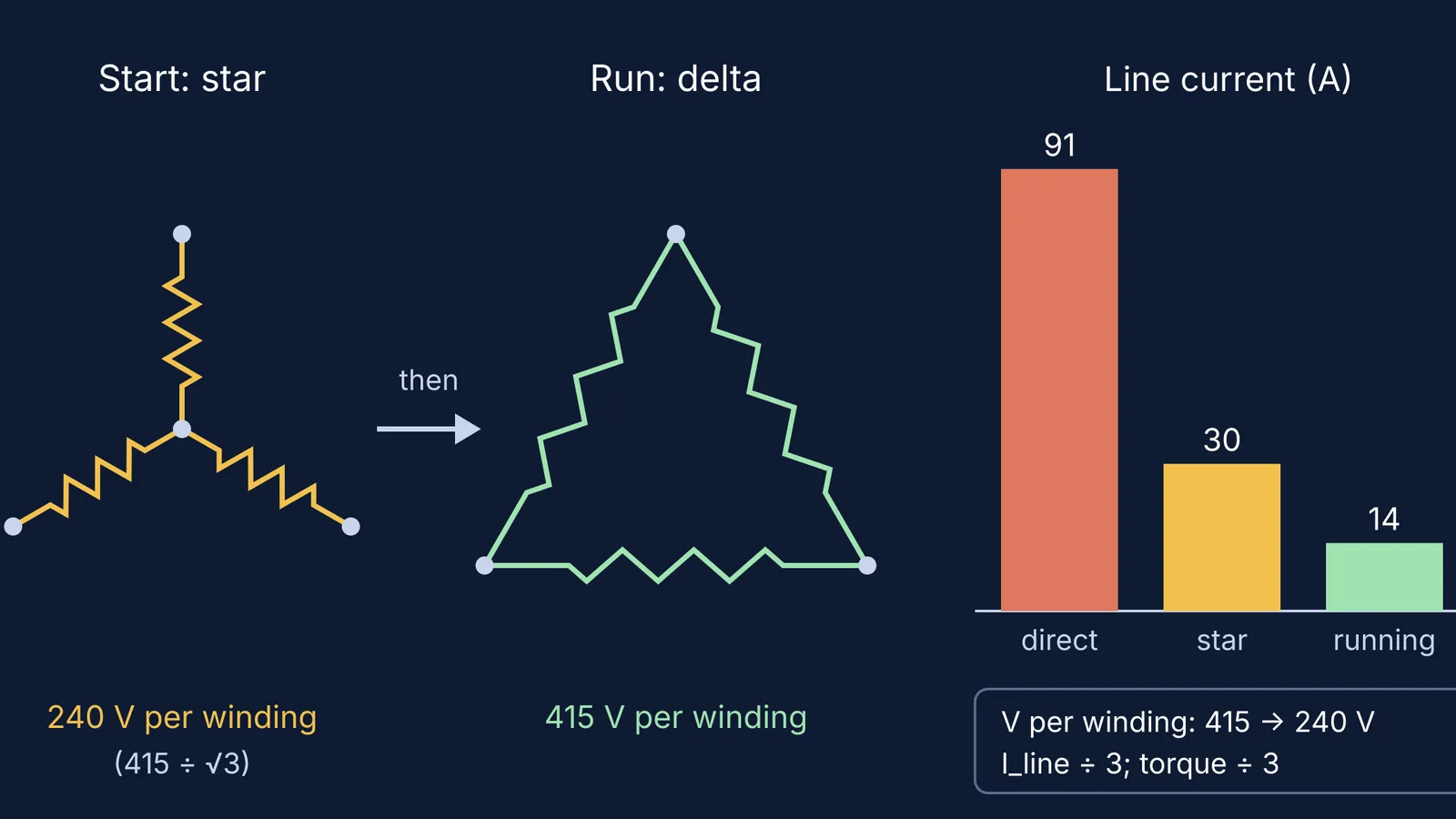
Switch on a large three-phase motor straight across the mains and, for a second or two, it draws several times its running current. On a weak supply that dips the voltage for everyone else on the line. A star–delta starter is the classic cure: it starts the motor with its windings in star, then switches them to delta once it is up to speed. The result is that the line current at starting falls to a third. So does the starting torque, and that second fact decides which machines can use it. This post works both with real catalogue numbers.
Why does an induction motor draw so much current at start?
In a running induction motor the rotor turns only a little slower than the rotating field, so the field sweeps past the rotor bars slowly and induces only a small current in them. At standstill the slip is 1: the field sweeps past the bars at full speed, the induced emf in the rotor is at its largest, and a large rotor current flows. The stator has to supply it. How the rotating field and slip work is covered in Ferraris and the rotating magnetic field. The idea is the same as in a DC motor at rest, which has no back emf to hold the current down, explained in why a DC motor's starting current is so large.
How large? An ABB starter catalogue (ABB, Starting Combinations, 1SBC009500R1002) gives direct-on-line starting as 5.5 to 7 times nominal current, with a starting torque of 1.9 to 2.1 times full-speed torque. ABB's motor-starting guide (ABB, Motor Starting Solutions) adds that some utilities restrict direct starting for motors of 5.5 kW and above.
What does a star–delta starter actually change?
A three-phase motor has three windings. Each one can be connected in one of two ways:
Delta: each winding sits between two lines, so it gets the full line voltage V_L.
Star: the three windings meet at a common point, so each gets V_L/√3.
The motor is built to run in delta. The starter connects it in star for the first few seconds, then changes over to delta. To do this, both ends of every winding must be available, so the motor needs six terminals instead of three, and its windings must be designed to take the full line voltage in delta. A motor designed to run in star cannot be started this way.
What is the line voltage in India? The Bureau of Indian Standards' IS 12360 lists 240/415 V. A 2006 amendment moved this to 230/400 V with a tolerance of ±10%, and a 2011 amendment put that changeover "in abeyance for the time being". So you will see both 415 V and 400 V on nameplates. The physics is identical: in star, each winding gets 415/√3 = 240 V or 400/√3 = 231 V. Why 400 V and 230 V are the same supply is explained in why three-phase reads 400 V when each phase is 230 V. Here we use 415 V.
Why does the line current fall by 3, not by √3?
Two factors of √3 multiply. Let Z be the impedance of one winding at standstill.
Delta, direct start. Winding voltage V_L, so winding current V_L/Z. In delta, the line current is √3 times the winding current: I_line = √3 V_L/Z.
Star start. Winding voltage V_L/√3, so winding current V_L/(√3 Z). In star, the line current equals the winding current: I_line = V_L/(√3 Z).
Ratio. (V_L/√3Z) ÷ (√3 V_L/Z) = 1/3.
One √3 comes from the lower voltage on each winding. The other comes from the star connection itself, where line current and winding current are the same.
Why does the starting torque also fall to a third?
An induction motor's torque at a given slip goes as the square of the voltage across each winding. In star the winding voltage is 1/√3 of its delta value, so the torque is (1/√3)² = 1/3 of the direct-start torque. ABB's catalogue states both results: on starting, inrush current is reduced to a third and motor torque is reduced to a third of the direct values.
Worked example: a 7.5 kW motor on 415 V
ABB's table of typical motor currents gives 14.0 A for a 7.5 kW, 4-pole, 50 Hz motor at 415 V. You can check that with an illustrative power factor of 0.85 and efficiency of 88%: I = P ÷ (√3 × V × pf × η) = 7,500 ÷ (√3 × 415 × 0.85 × 0.88) = 13.9 A.
Direct starting current. Take 6.5 times nominal, inside ABB's 5.5–7 range: 6.5 × 14.0 = 91 A (between 77 A and 98 A across the range).
Winding impedance at standstill. In delta the winding current is 91 ÷ √3 = 52.5 A, so Z = 415 ÷ 52.5 = 7.9 Ω.
Star starting current. Winding voltage 415 ÷ √3 = 240 V, so the current is 240 ÷ 7.9 = 30.3 A. That is also the line current.
Check. 91 ÷ 30.3 = 3.0. The starter has cut the peak from 6.5 times to about 2.2 times running current.
Torque. Taking a direct-start torque of 2.0 times full-load torque, the star torque is 2.0 ÷ 3 = 0.67 times full-load torque (0.63 to 0.70 across ABB's 1.9–2.1 range).
On a low supply. If the line voltage sags by 10%, torque falls by 0.9² = 0.81, so the star torque drops to 0.81 × 0.67 = 0.54 times full-load torque.
Which loads can a star–delta starter start?
The motor in star must still produce more torque than the load needs at every speed until the changeover. ABB's catalogue says this mode suits machines that start with no load and little inertia, such as machine tools and centrifugal compressors. Its guide describes pumps and fans as quadratic loads: their torque rises as the square of speed, so they need little torque at first. That is why a centrifugal pump suits a star–delta start.
A loaded conveyor is a constant-torque load. If it needs its full-load torque from standstill, a motor giving 0.67 times full-load torque in star cannot start it, and at 0.54 on a low supply even less so. A direct start or a different starter is needed.
The changeover is not free. ABB's guide notes that the transition can briefly interrupt the supply to the motor and cause a current spike, typically lower than a direct start, and that the star phase must last until the motor is near full speed. If the changeover comes too early, the motor is still slow and the delta current jumps back up.
If you want to practise three-phase and motor problems like these, the Fermi Problem Library has a step-by-step solver that explains the reasoning.
Quick checklist
At standstill, slip is 1 and starting current is 5.5 to 7 times nominal (ABB).
Star: winding voltage V_L/√3 (240 V on 415 V; 231 V on 400 V).
Line current falls by 3: one √3 from voltage, one from the connection.
Torque falls by 3, because it goes as V².
The motor must run in delta and have six terminals.
Good for pumps and fans; poor for loads needing full torque from rest.


