

On this page
Every embryo starts out with the same reproductive parts. In their review of human sex development, Grinspon, Bergadá and Rey (2020) note that the gonads, both pairs of ducts and the external genitalia are identical in XX and XY embryos between the 3rd and 5th weeks of embryonic life. At this stage the gonad is bipotential: it can become an ovary or a testis.
SRY decides which way it goes, but it is only a switch. Two hormones from the new testis build the male body. Remember the chain: gene, testis, hormones, organs.
What is the SRY gene?
SRY (sex-determining region Y) is a gene on the Y chromosome whose protein starts the processes that make a fetus develop testes, according to MedlinePlus Genetics. The same page says the protein also prevents the uterus and fallopian tubes from forming.
In 1990, Sinclair and colleagues searched a 35-kilobase region of the human Y chromosome needed for male sex determination and found SRY. Its protein resembles a known DNA-binding motif, which made it a strong candidate for the testis-determining gene.
Koopman and colleagues (1991) then showed that Sry on a 14-kilobase piece of DNA was enough to make chromosomally female (XX) mouse embryos form testes and develop as males.
How does the SRY gene make an embryo male?
SRY works by turning on another gene, SOX9. Sekido and Lovell-Badge (2008) showed in mice that SRY and a partner protein, SF1, bind together to an enhancer of the Sox9 gene and switch it on. SOX9, which Sertoli cells need in order to form, then helps keep its own expression going after SRY has switched off, so the gonad stays on the testis path.
From there, the testis works as a hormone gland. The 2020 review describes two products:
AMH (anti-Müllerian hormone), made by Sertoli cells, makes the Müllerian ducts regress. These ducts can only form the fallopian tubes, uterus and upper vagina.
Testosterone, made by Leydig cells, keeps the Wolffian ducts, which become the epididymis, vas deferens and seminal vesicles. It also masculinises the external genitalia, either directly or after being converted to the stronger androgen dihydrotestosterone (DHT).
For what these hormones do later in life, see the functions of androgens, oestrogens and progesterone.
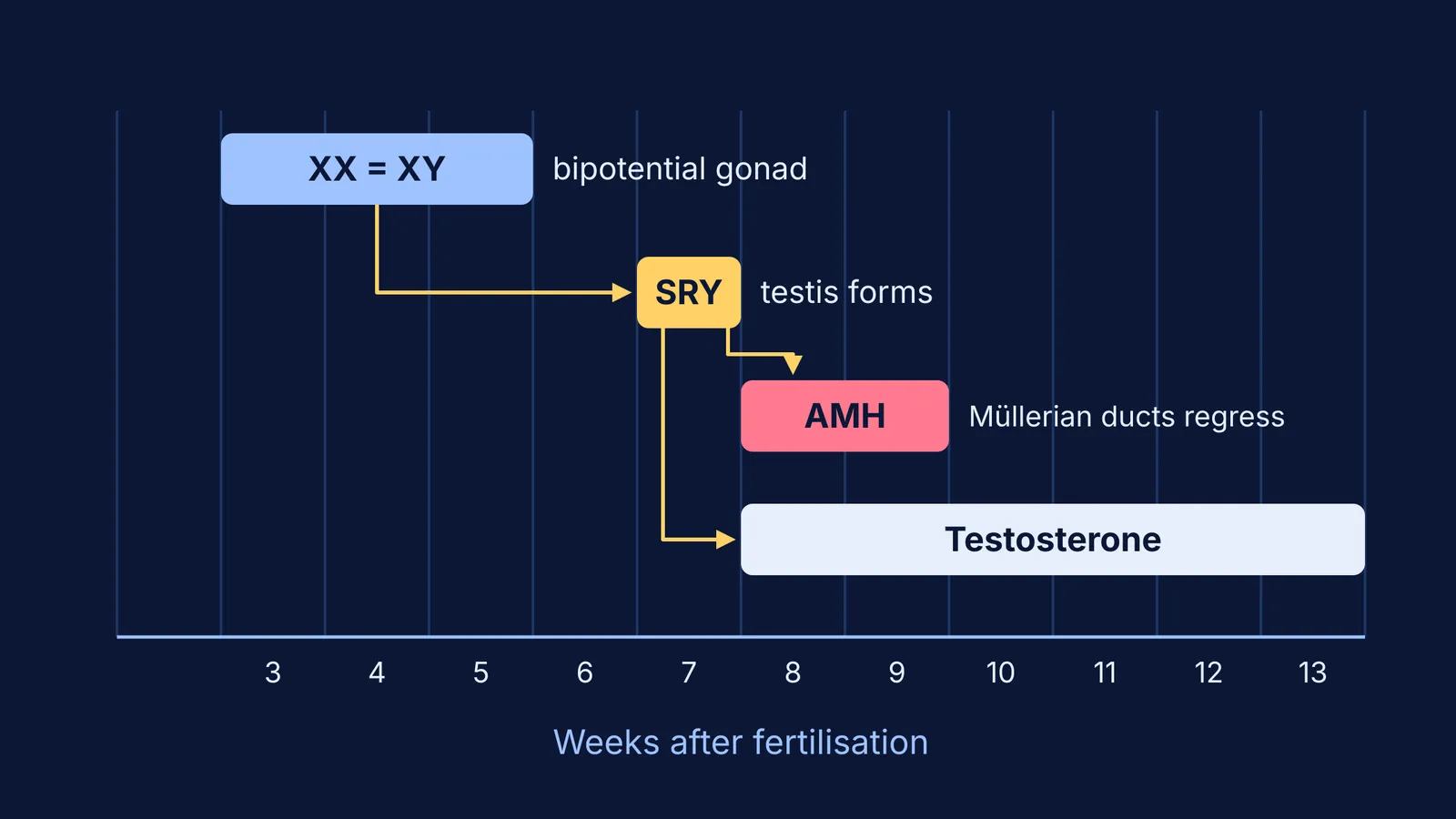
When does each step happen, week by week?
These weeks are counted from fertilisation, as in the review by Grinspon, Bergadá and Rey (2020). Pregnancy is usually dated from the last menstrual period, which runs about two weeks ahead: the review gives weeks 3 to 5 of embryonic life as 5 to 7 weeks of amenorrhea.
Weeks 3 to 5: the gonads, both pairs of ducts and the external genitalia form, identical in XX and XY embryos.
Week 7: SRY on the Y chromosome tips the gene network towards the testis, and SOX9 keeps it there.
Weeks 8 and 9: Sertoli cells release AMH and the Müllerian ducts regress.
Weeks 8 to 13: testosterone from Leydig cells, and DHT made from it, turns the Wolffian ducts into male internal organs and shapes the external genitalia.
What happens if one step in the chain is missing?
Find the broken link and follow the arrows forward:
An XX embryo that carries SRY. SRY sits near a region the Y shares with the X, so it can be moved onto the X by mistake. In people with such translocations, SRY triggers testis development, as Grinspon and Rey (2019) explain. Chain: SRY, testis, AMH and testosterone, typically a male body despite XX chromosomes.
An XY embryo whose gonads do not form a proper testis. The 2020 review notes that this gives too little androgen and AMH, leading to ambiguous or female genitalia.
An XY embryo whose testes make testosterone but no AMH. Wolffian ducts are kept, but nothing removes the Müllerian ducts. The same review links faulty AMH production or action to persistent Müllerian duct syndrome.
For conditions where the number of sex chromosomes changes, such as 47,XXY, see our explainer on Turner and Klinefelter syndrome karyotypes.
How should you revise this for exams?
Use this three-step drill before a Class 12 or NEET-UG revision session:
Draw the chain from memory: Y chromosome, SRY, SOX9, Sertoli cells (AMH) and Leydig cells (testosterone), then the duct each hormone acts on.
Pin a week to each box: 3 to 5, 7, 8 and 9, 8 to 13, as given in the 2020 review.
Break one box at a time and say what changes downstream.
Revise this alongside the chromosome side, covered in our guide to XO, XY and ZW sex determination.
If a term in the chain feels shaky, the Fermi Concept Library has every concept in biology, each with its own lesson and its place in the map. If you would rather talk it through, Fermi's AI tutor can draw the figure and check your understanding as it goes.
Try the drill tonight from a blank page. If you can break each box without notes, you have this topic.


