

On this page
Every human embryo starts with the same pair of gonads that could become either testes or ovaries. One gene on the Y chromosome, SRY, tips the balance. Understand this switch and Class 12 sex determination, rare cases included, falls into place.
What does the SRY gene on the Y chromosome do?
SRY stands for sex-determining region Y. According to the US National Library of Medicine, the SRY gene gives instructions for a protein that works as a transcription factor: it controls the activity of other genes, starting testis formation and preventing female reproductive structures from forming (MedlinePlus Genetics: SRY gene).
The gene was found in 1990, when Andrew Sinclair and colleagues searched a 35-kilobase stretch of the Y chromosome needed for male development and found a gene they named SRY, whose protein carries a DNA-binding motif (Sinclair et al., Nature, 1990). It became the leading candidate for the testis-determining factor, or TDF.
Two studies made the case. In 1990, Philippe Berta and colleagues found a new mutation in SRY in an XY woman, a change not present in her father or brother, which showed that SRY is needed for male development (Berta et al., Nature, 1990). In 1991, Peter Koopman, Robin Lovell-Badge and colleagues showed that adding mouse Sry on a 14-kilobase DNA fragment to chromosomally female (XX) mouse embryos was enough to make them develop testes and go on to male development (Koopman et al., Nature, 1991). Needed and enough: that is what makes SRY a switch.
How does SRY switch on testis development?
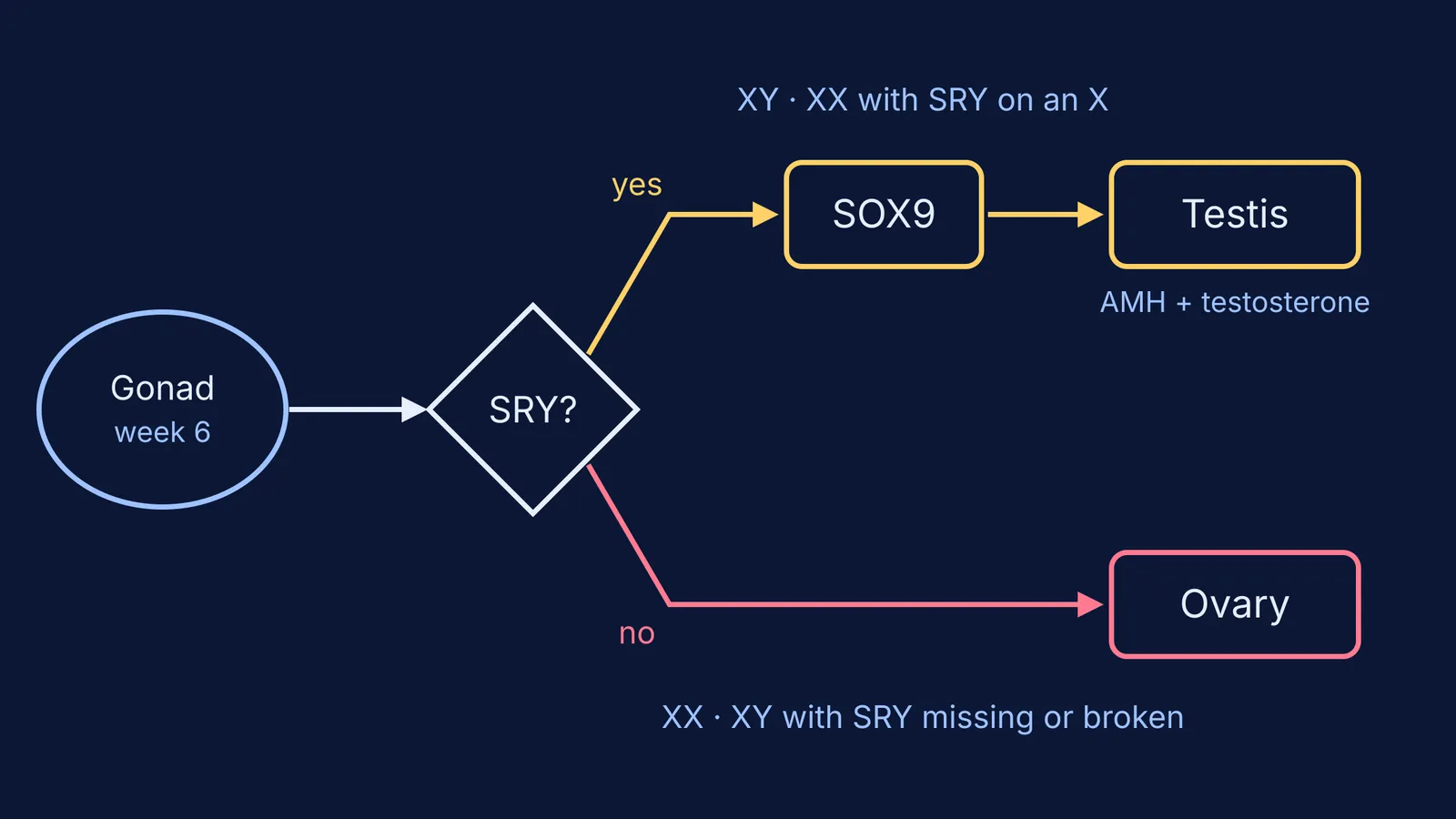
A 2018 review in Endocrine Reviews sets out the timing in humans: the gonad first forms around gestational week 4, and SRY is switched on briefly in the gonad's supporting cells around week 6 (Rotgers, Jorgensen and Yao, 2018). From there the steps run like dominoes:
In mice, SRY, working with a partner protein called SF1, binds an enhancer of the SOX9 gene and turns it up (Sekido and Lovell-Badge, Nature, 2008).
SOX9 then binds the same enhancer and keeps its own expression going after SRY has faded, so the decision locks in (same study).
The supporting cells become Sertoli cells, and SOX9 triggers anti-Mullerian hormone (AMH), which makes the Mullerian ducts, the starting point of the uterus and fallopian tubes, shrink away (Rotgers et al., 2018).
Fetal Leydig cells make androgens such as testosterone, which shape male internal and external genitalia (same review).
If SRY never switches on, the gonads take the ovary path instead (McClelland, Bowles and Koopman, 2011).
Why does the Y chromosome decide sex, not the number of X chromosomes?
In humans, the Y chromosome is what counts, because SRY sits on it. In 1959, Patricia Jacobs and John Strong described a case of human intersexuality with a possible XXY sex-determining mechanism (Jacobs and Strong, Nature, 1959). Today we know Klinefelter syndrome (47,XXY) affects male development and occurs in about 1 in 650 male newborns (MedlinePlus Genetics), while Turner syndrome, in which one copy of the X chromosome is missing or altered and there is no Y, occurs in about 1 in 2,000 female newborns (MedlinePlus Genetics). Our explainer on Turner and Klinefelter karyotypes goes further, and XO, XY and ZW sex determination compares humans with insects and birds.
What do XX males and XY females reveal about SRY?
These rare cases are strong evidence for the switch.
XX males. About 1 in 20,000 people with a male appearance have 46,XX testicular difference of sex development, and in about 80 percent of them, an exchange of genetic material has moved SRY onto an X chromosome (MedlinePlus Genetics).
XY females. Swyer syndrome occurs in about 1 in 80,000 people: they have XY chromosomes but a uterus and non-working gonads, and SRY variants are found in about 15 percent of them (MedlinePlus Genetics).
Because SRY changes account for only some cases, other genes in the pathway are involved too. These are real people, not just exam examples; questions about anyone's own diagnosis belong with a doctor or genetic counsellor.
How do you answer an SRY question in the exam?
Try this worked example. *An individual has a 46,XX karyotype but has testes. Explain.*
Name the switch: testis development is started by SRY on the Y chromosome.
Spot the clue: no Y chromosome, yet testes formed, so SRY must be present elsewhere.
Give the mechanism: most often, an exchange of genetic material between chromosomes moved SRY onto an X.
Finish the chain: SRY turns on SOX9, Sertoli cells form, AMH and testosterone follow.
Flip it for an XY female: SRY is missing or mutated, so the gonads do not become testes. If you need to refresh transcription factors or meiosis before tackling these, the Fermi Concept Library covers every concept in biology, each with its own lesson and its place in the map. For the history of how sex chromosomes were found, read our profile of Nettie Stevens.


