

On this page
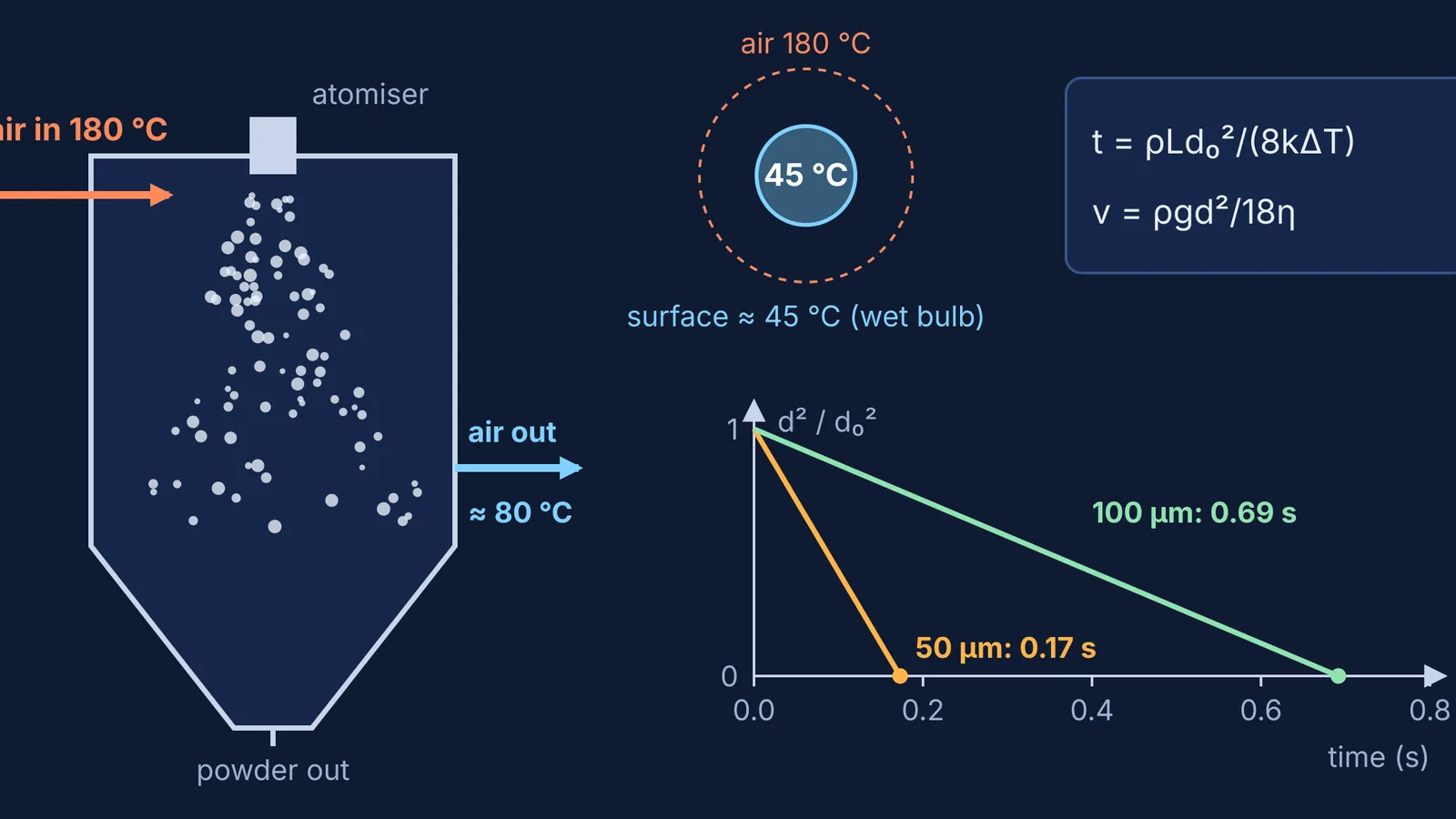
Milk powder is made by spraying concentrated milk into air hotter than an oven, at about 180 °C. Milk browns and its proteins change when heated strongly, so you might expect burnt powder. Instead the powder comes out white and dissolves in tea. The reason is the same physics that cools you when you sweat: a wet surface that is evaporating stays far colder than the air around it. Add the d² law and Stokes' law, and Class 11 physics explains the whole tower.
How does a spray dryer turn milk into powder?
Milk is first concentrated in an evaporator. A review of dairy spray drying by Mujumdar, Huang and Chen in Dairy Science and Technology (2010) gives the numbers: the concentrate reaches 48 to 52% total solids, and a spinning wheel or a high-pressure nozzle at the top of the tower breaks it into droplets of 1 to 200 µm. The droplets fall with a stream of hot, filtered air. Water evaporates from their surfaces, the droplets shrink, and a solid crust forms. A fluid bed below the tower then takes the powder from 8 to 9% moisture down to 3 to 4%, with air at 80 to 120 °C.
Air temperatures vary by plant and product. In a 2024 pilot-scale study of skimmed milk powder in the journal Foods, an outlet temperature of 80 °C went with an inlet of 180 °C. A 2023 review in the Journal of Food Engineering gives inlet air up to 250 °C for food products and outlet air of typically 60 to 125 °C. We use 180 °C in and 80 °C out below.
Why doesn't the milk get as hot as the air?
Evaporation needs energy: about 2.39 MJ for every kilogram of water at 45 °C. While the droplet surface is still wet, almost all the heat arriving from the hot air is used up evaporating water, not warming the droplet. The droplet settles at the temperature where heat in equals heat carried off by evaporation. That temperature is the wet-bulb temperature of the air.
The 2023 review states this directly: during the first, constant-rate stage of drying, the droplet temperature settles at the wet-bulb temperature. You met the same idea in why air coolers stop working in humid weather, where evaporating water cools air towards its wet-bulb temperature.
For hot dryer air, the wet-bulb temperature depends on how much water vapour the air already holds. Solving the standard psychrometric balance, (T − T_wb) × c_p = (W_s − W) × L, with c_p ≈ 1.03 kJ/kg K and a saturation vapour pressure of about 9.6 kPa at 45 °C, gives:
air at 180 °C with 0.005 kg of water per kg of dry air: wet bulb about 44 °C
with 0.010 kg/kg: about 46 °C
with 0.020 kg/kg: about 48 °C
These are our approximate calculations. Note also that as the air cools in the tower by evaporating water, it moves along a line of nearly constant wet-bulb temperature. Air that enters at 180 °C and leaves at 80 °C still has a wet bulb near 46 °C. So every droplet with a wet surface sits near 45 °C, wherever it is in the tower.
How long does a droplet take to dry? The d² law
Picture a droplet moving along with the air, so heat reaches it only by conduction through the air around it. For a sphere of diameter d in still air, the conducted heat flow is Q = 2πkdΔT, where k is the thermal conductivity of air and ΔT is the air temperature minus the droplet temperature.
That heat evaporates water: Q = −L × d(mass)/dt, with mass = ρπd³/6. Working through:
d(mass)/dt = (ρπd²/2) × dd/dt.
So (ρπd²/2) × dd/dt = −2πkdΔT/L.
Rearranging: d × dd/dt = −4kΔT/(ρL), which is d(d²)/dt = −8kΔT/(ρL).
The right side is a constant, so d² falls in a straight line with time. The droplet vanishes at
t = ρLd₀² / (8kΔT)
Drying time grows as the square of the starting diameter, which is why the ultrasonic humidifier's 3 µm mist disappears almost at once.
Worked example: a 50 µm droplet in 180 °C air
Use an illustrative pure-water droplet: ρ = 1,000 kg/m³, L = 2.39 × 10⁶ J/kg, k = 0.032 W/m K for air at around 110 °C, droplet at 45 °C, air at 180 °C.
Temperature difference. ΔT = 180 − 45 = 135 K.
Starting size. d₀ = 50 µm = 5.0 × 10⁻⁵ m, so d₀² = 2.5 × 10⁻⁹ m².
Drying time. t = (1,000 × 2.39 × 10⁶ × 2.5 × 10⁻⁹) ÷ (8 × 0.032 × 135) = 5.98 ÷ 34.6 ≈ 0.17 s.
Units. (kg/m³)(J/kg)(m²) ÷ (W/m) = s.
Double the size. A 100 µm droplet takes 4 × 0.17 ≈ 0.69 s.
Cooler air. In 90 °C air, ΔT = 45 K, so the 50 µm droplet takes about 0.52 s, three times longer.
Real milk concentrate is only about half water, so a droplet never shrinks to zero. Once enough water has gone, the crust slows drying, as the 2023 review describes. The d² law describes only the first stage, so read these times as the order of magnitude of that stage.
For more problems that combine latent heat and conduction, the Fermi Problem Library has a step-by-step solver that explains the reasoning at each stage.
Why do the droplets float instead of falling straight down?
A small droplet falling through air reaches terminal velocity quickly. By Stokes' law, as derived in terminal velocity of a sphere in a viscous fluid, v = ρgd²/(18η).
For a 50 µm droplet with air viscosity η ≈ 2.3 × 10⁻⁵ Pa s (air near 130 °C): v = (1,000 × 9.81 × 2.5 × 10⁻⁹) ÷ (18 × 2.3 × 10⁻⁵) ≈ 0.059 m/s, about 6 cm/s. The Reynolds number is about 0.1, so Stokes' law applies. A 100 µm droplet falls at about 24 cm/s. Either way the droplets mostly ride the air stream.
How much water does a kilogram of powder cost?
Take powder with 3.5% moisture made from a 48% solids concentrate.
Solids in 1 kg of powder: 0.965 kg.
Concentrate needed: 0.965 ÷ 0.48 = 2.01 kg, holding 1.045 kg of water.
Water left in the powder: 0.035 kg, so water evaporated: 1.045 − 0.035 = 1.01 kg.
Latent heat alone: 1.01 × 2.39 ≈ 2.4 MJ, before counting the heat carried off in the warm exhaust air.
Quick checklist
A wet droplet sits near the air's wet-bulb temperature, about 45 °C here, not the 180 °C air temperature.
As air cools in the tower, its wet-bulb temperature stays nearly constant.
d² law: d² falls linearly; t = ρLd₀²/(8kΔT), so time grows as d₀².
50 µm: about 0.17 s; 100 µm: about 0.69 s in 180 °C air.
Stokes' law: a 50 µm droplet falls at about 6 cm/s and rides the air.
After a crust forms, drying slows and the particle warms; the d² law no longer applies.


