

On this page
Much of a car body is held together by small round welds, each made in about a fifth of a second. Two copper electrodes squeeze two steel sheets, a current of around ten thousand amperes flows for a moment, and a button of steel melts where the sheets touch. The copper tips carry exactly the same current, yet they stay solid. The reason is Joule heating, H = I²Rt, applied with some care about where the resistance is.
How does resistance spot welding work?
The two sheets are overlapped and clamped between two rod-shaped copper electrodes, and a large current passes straight through the stack. According to AHSS Insights' guide to resistance spot welding, a typical weld time for steel is about 1/5 of a second, with a current in the range of 8 to 15 kA.
No filler metal or flame is used. Where the current heats the steel enough, it melts into a lens-shaped pool called the nugget, which freezes under the electrodes' squeeze when the current stops.
The heating law itself, and how Joule found it, is covered in the history of Joule's law, H = I²Rt. Here the question is why the heat lands in the middle of the stack.
Where does the heat go in a stack of copper and steel?
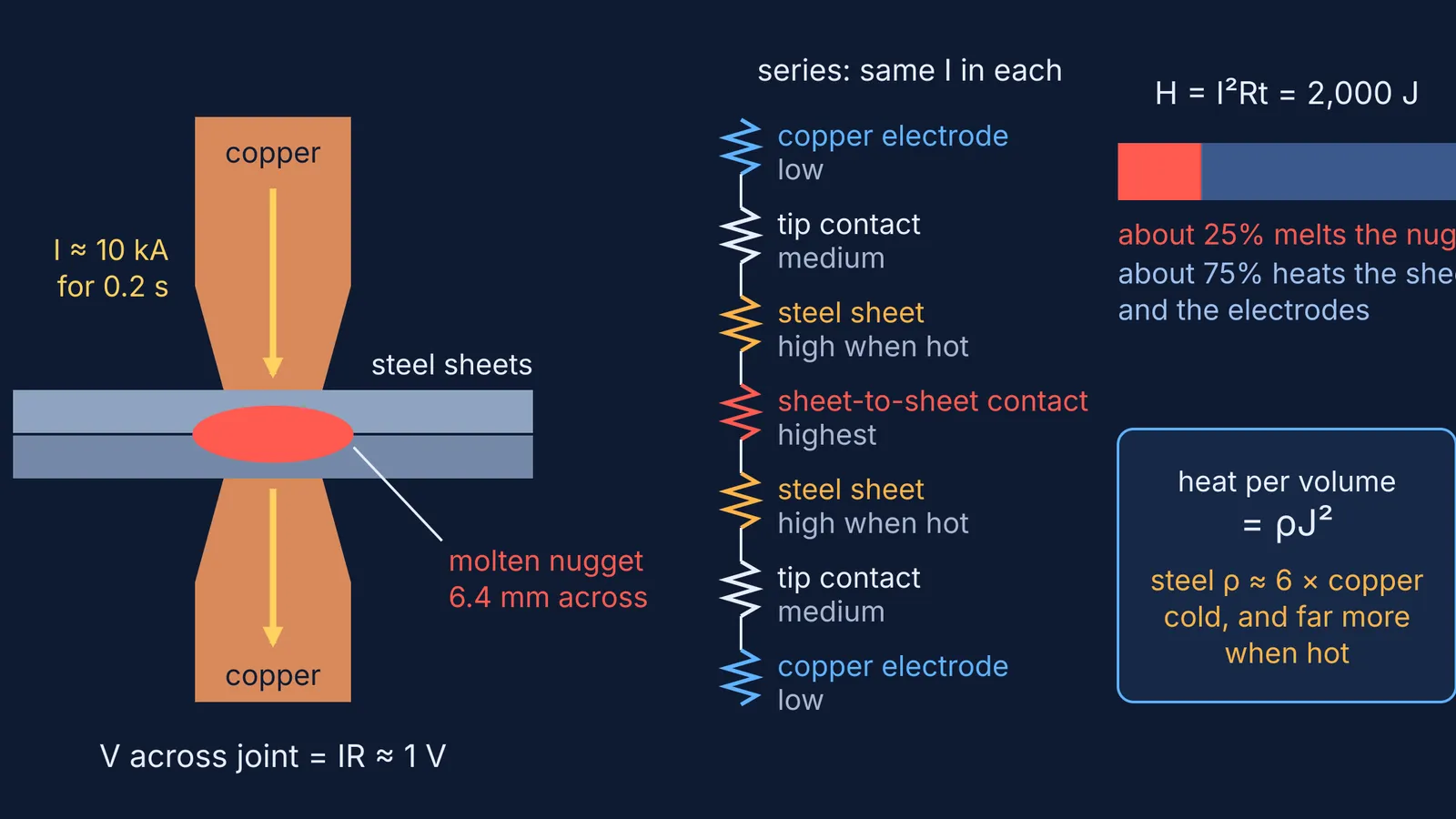
The current passes through a chain of resistances in series: copper electrode, the contact between electrode and sheet, the first sheet, the contact between the two sheets, the second sheet, another electrode contact and the second electrode. In a series circuit the same current I flows through every part, so each part gets heat I²R × t in proportion to its own resistance.
Three things make the middle the hottest place:
The sheet-to-sheet contact. Two steel surfaces touch only at tiny high points, so the current is squeezed through a small real area. The AHSS guide notes that the highest resistance is where the sheets meet.
Steel's resistivity. In the NCERT table, copper is about 1.7 × 10⁻⁸ Ω m and iron about 10 × 10⁻⁸ Ω m, roughly six times more. As steel heats up its resistivity rises further, so, in the guide's words, its resistivity relative to copper increases even more. Hot steel heats faster, which heats it more: the heating runs away in the steel, not in the copper.
Cooling. The copper electrodes conduct heat well and act as a heat sink, pulling heat out of the outer faces of the sheets. The middle of the stack is furthest from them.
The contact resistance falls during the weld as the softening steel flattens the high points, so any single resistance value is an average.
Why does hot steel heat faster than copper at the same current?
In a piece of metal carrying current density J (current per unit area), the power released per unit volume is ρJ². Near the tips the current flows through a similar cross-section in copper and steel, so J is about the same and the heating rate per cubic millimetre is proportional to ρ. Steel's ρ is several times copper's when cold and rises as it heats, while the cooled copper stays near room temperature. That is why the steel melts and the tips survive.
Worked example: how much heat goes into one spot weld?
Question. A spot weld joins two mild steel sheets about 1 mm thick. Take an illustrative average joint resistance of 100 µΩ, a current of 10 kA and a weld time of 0.2 s (10 cycles of 50 Hz mains). Find the heat released, the voltage across the joint, and the fraction of the heat that ends up melting a nugget 6.4 mm across.
These settings match published guidance in scale: the AWS C1.1 table reproduced by AHSS Insights lists, for 1.02 mm bare low-carbon steel of 350 to 700 MPa strength, a weld current of about 10,500 A for 10 cycles (60 Hz), an electrode face of 6.35 mm, an electrode force of about 3.1 kN and a set-up nugget diameter of 6.4 mm. The 100 µΩ is a round teaching value, not a measured one.
Heat. H = I²Rt = (10,000)² × 100 × 10⁻⁶ × 0.2 = 2,000 J.
Power. P = I²R = 10 kW while the current flows.
Voltage. V = IR = 10,000 × 100 × 10⁻⁶ = 1.0 V. A huge current, a tiny voltage.
Nugget mass. Treat the nugget as a disc 6.4 mm across and 1.5 mm thick (an illustrative size). Volume = π × (3.2 mm)² × 1.5 mm = 48 mm³. With steel at 7,850 kg/m³, the mass is 0.38 g.
Heat to melt it. Use round illustrative values: an average specific heat of about 0.7 kJ/(kg K) from 25 °C to about 1,500 °C, plus a latent heat of about 270 kJ/kg. That is 0.7 × 1,475 + 270 ≈ 1,300 kJ/kg. For 0.38 g: about 490 J.
Fraction. 490 / 2,000 ≈ 25%. The other three quarters heat the surrounding sheet and flow into the electrodes.
Check the units: A² × Ω × s = W × s = J. For scale, a 2 kW kettle gives 2,000 J in one second.
How big is the current density in a spot weld?
Take the 10 kA flowing through an electrode face 6.35 mm across. The area is π × (3.175 mm)² = 31.7 mm², so
J = 10,000 / 31.7 ≈ 316 A/mm²
That is about 50 times the 6.4 A/mm² in a 2.5 mm² household wire carrying 16 A. At this J, steel with ρ = 1.0 × 10⁻⁷ Ω m heats at ρJ² ≈ 10 W per cubic millimetre, and copper at about 2 W per cubic millimetre. Melting steel from room temperature needs about 10 J per cubic millimetre with the values above, so cold bulk steel alone would need about a second. The weld finishes in 0.2 s because contact resistance concentrates the early heat and hot steel's rising resistivity speeds it up. For how to choose R and wire length to get a set power in an ordinary heater, see finding the length of nichrome wire for a heater.
Why is the low voltage not a shock risk, and what is the real hazard?
The current comes from a step-down transformer. For an ideal transformer, V_p I_p = V_s I_s. If 230 V mains feeds a secondary that gives an illustrative 2 V, the turns ratio is 115 : 1 and the primary draws 10,000 × 2 / 230 ≈ 87 A while the secondary supplies 10 kA. A couple of volts cannot push a dangerous current through skin. The real dangers are molten metal spraying from the joint, very hot parts, and electrodes closing with several kilonewtons. These are industrial machines run with training and guards, not something to build or try at home. Arc welding, a different process with its own light hazard, is covered in why welding glass shade numbers matter.
To practise series and parallel heating problems step by step, the Fermi Problem Library has a step-by-step solver that explains the reasoning.
Quick checklist
Spot welding: two copper electrodes squeeze two sheets and pass about 10 kA for about 0.2 s.
Series stack: same I everywhere, so heat goes where R is largest.
The largest resistances are the sheet-to-sheet contact and hot steel.
Heat per unit volume = ρJ²; steel has several times copper's ρ, and more when hot.
Worked numbers: 2 kJ in, about 1 V across the joint, about a quarter of the heat in the nugget.
High current at low voltage comes from a step-down transformer.


