

On this page
If you are building a room heater or solving a physics problem, finding the exact length of nichrome wire you need takes two steps. You cannot guess the length: too short, and the wire will draw too much current and melt. Too long, and it will not get hot enough to reach the power you want.
Here is the straightforward method to calculate the length of nichrome wire needed for a heater of a given power, using standard Indian mains voltage as a practical example.
How to calculate resistance from power and voltage?
A heating element is just a resistor that converts electrical energy into heat. Before you can measure out wire, you need to know the target resistance for your heater.
The standard Indian mains voltage is nominally 230 V alternating current (AC) at a frequency of 50 Hz. When calculating the power dissipation for a purely resistive load like a heating element, you can treat this root-mean-square (RMS) voltage exactly as you would a direct current (DC) voltage. Therefore, the formula connecting power (P), voltage (V) and resistance (R) works perfectly: P = V² / R
Rearranging this to solve for resistance gives: R = V² / P
If you are designing a 1000 W heater to run on the standard supply of 230 V, your target resistance is: R = 230² / 1000 = 52900 / 1000 = 52.9 Ω
What is the correct resistivity of Nichrome?
Nichrome is the most common material for heating elements because it forms a protective layer of chromium oxide when heated, preventing it from burning up in the air.
To find the length, you need the material's resistivity (ρ). Nichrome typically has an electrical resistivity of around 1.12 × 10⁻⁶ Ω·m (Source).
(Note: Some school textbooks simplify this to 100 × 10⁻⁶ Ω·m or 10⁻⁴ Ω·m to make the maths easier. Always use the textbook value if you are solving an exam paper.)
You will also need the cross-sectional area (A) of your wire. Heating coils typically use a wire gauge like 22 SWG. A 22 SWG wire has a diameter of 0.711 mm (Source), which gives a cross-sectional area of 0.397 mm², or 0.397 × 10⁻⁶ m².
How to find the length of the heating element?
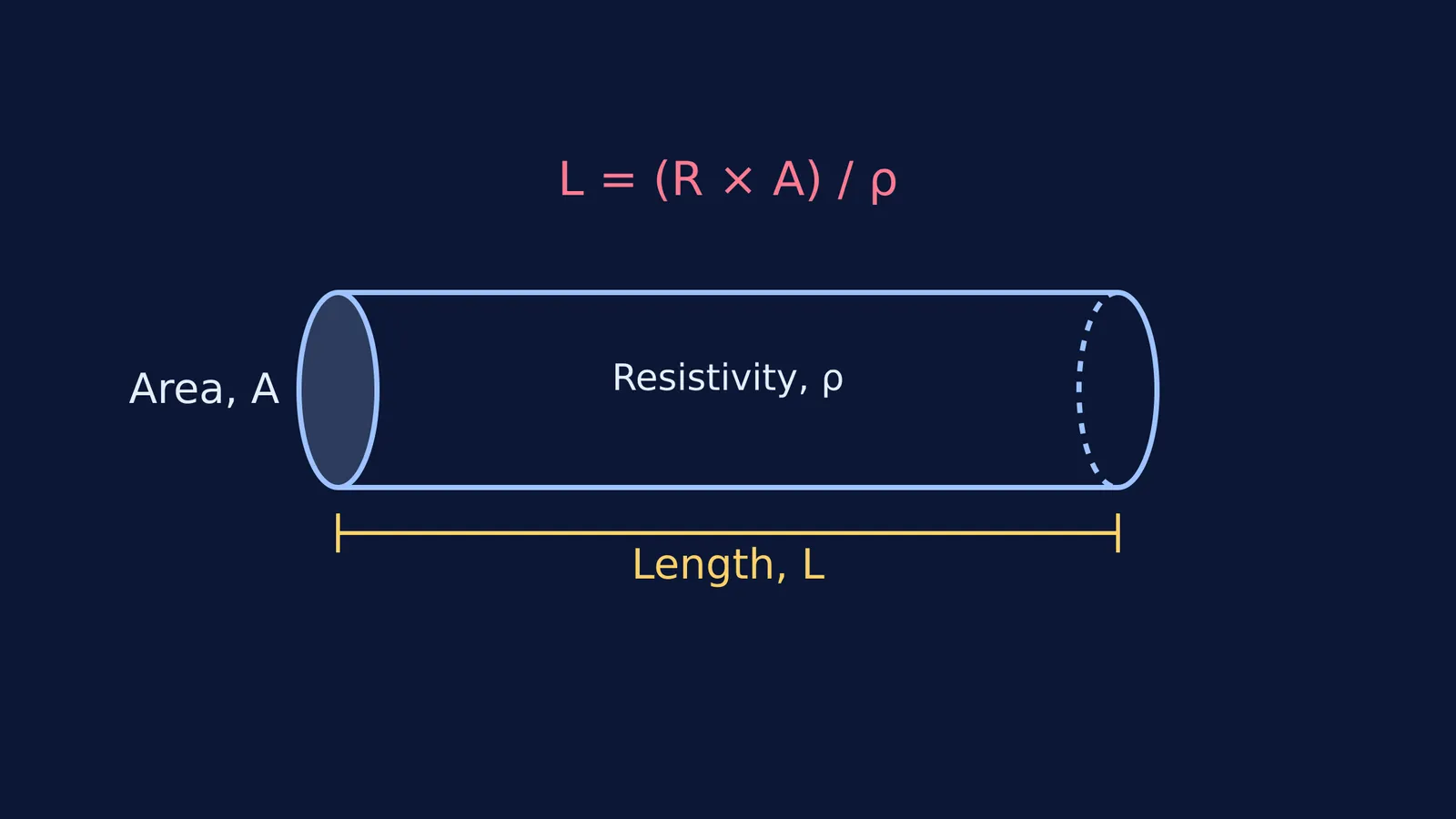
The resistance of a wire depends on its material, its length (L) and its thickness. The formula is: R = ρ × L / A
Rearranging this to solve for length gives: L = (R × A) / ρ
Let us calculate the length for our 1000 W heater:
R = 52.9 Ω
A = 0.397 × 10⁻⁶ m²
ρ = 1.12 × 10⁻⁶ Ω·m
L = (52.9 × 0.397 × 10⁻⁶) / (1.12 × 10⁻⁶)
The 10⁻⁶ terms cancel out: L = 21.0013 / 1.12 = 18.8 metres
To build this 1000 W heater, you would need exactly 18.8 metres of 22 SWG nichrome wire. In a real heater, this long wire is wound into a tight, spring-like coil so it fits inside a small quartz tube or ceramic block.
How does changing the wire gauge affect the length?
If you look at the formula above, you can see that the length is directly proportional to the cross-sectional area for a fixed target resistance. This means if you use a thicker wire, which has a lower SWG number and a larger area, you will need a much longer piece of wire to achieve the same resistance and power.
For instance, if you were to use a 20 SWG wire instead of 22 SWG, the diameter would be 0.914 mm (Source). The cross-sectional area would increase to 0.656 × 10⁻⁶ m². Plugging this new area into the same equation for our 1000 W heater gives: L = (52.9 × 0.656 × 10⁻⁶) / (1.12 × 10⁻⁶) = 31.0 metres
Using a thicker wire requires almost double the length of nichrome. While a thicker wire is more durable and less likely to break over time, finding the space to coil 31 metres of wire inside a compact heater casing can be a significant mechanical challenge. Engineers must balance durability against the physical size limits of the appliance when choosing the wire gauge.
If you are reviewing this for JEE or board exams and find yourself stuck on where to start, Fermi's AI tutor can work out what you already know and build a plan for the session. You can also explore the Concept Library, which covers every concept in physics, chemistry, biology, mathematics and computing, each with its own lesson and its place in the map.
If you want to see how this geometry changes when the wire is not uniform, read our guide on Stretching a wire: how its resistance changes with length and how to calculate the Resistance of a tapered conductor: setting up the integral.


