

On this page
A sponge looks like one solid animal. Under a microscope it is closer to a well-run cooperative: many kinds of cells, each doing its own job, with nothing tying them into tissues. That is why the NCERT Class 11 chapter on the animal kingdom calls sponges primitive multicellular animals with a cellular level of organisation. The OpenStax Biology 2e textbook places sponges, together with the tiny placozoans, in a group called Parazoa.
What does "cellular level of organisation" mean?
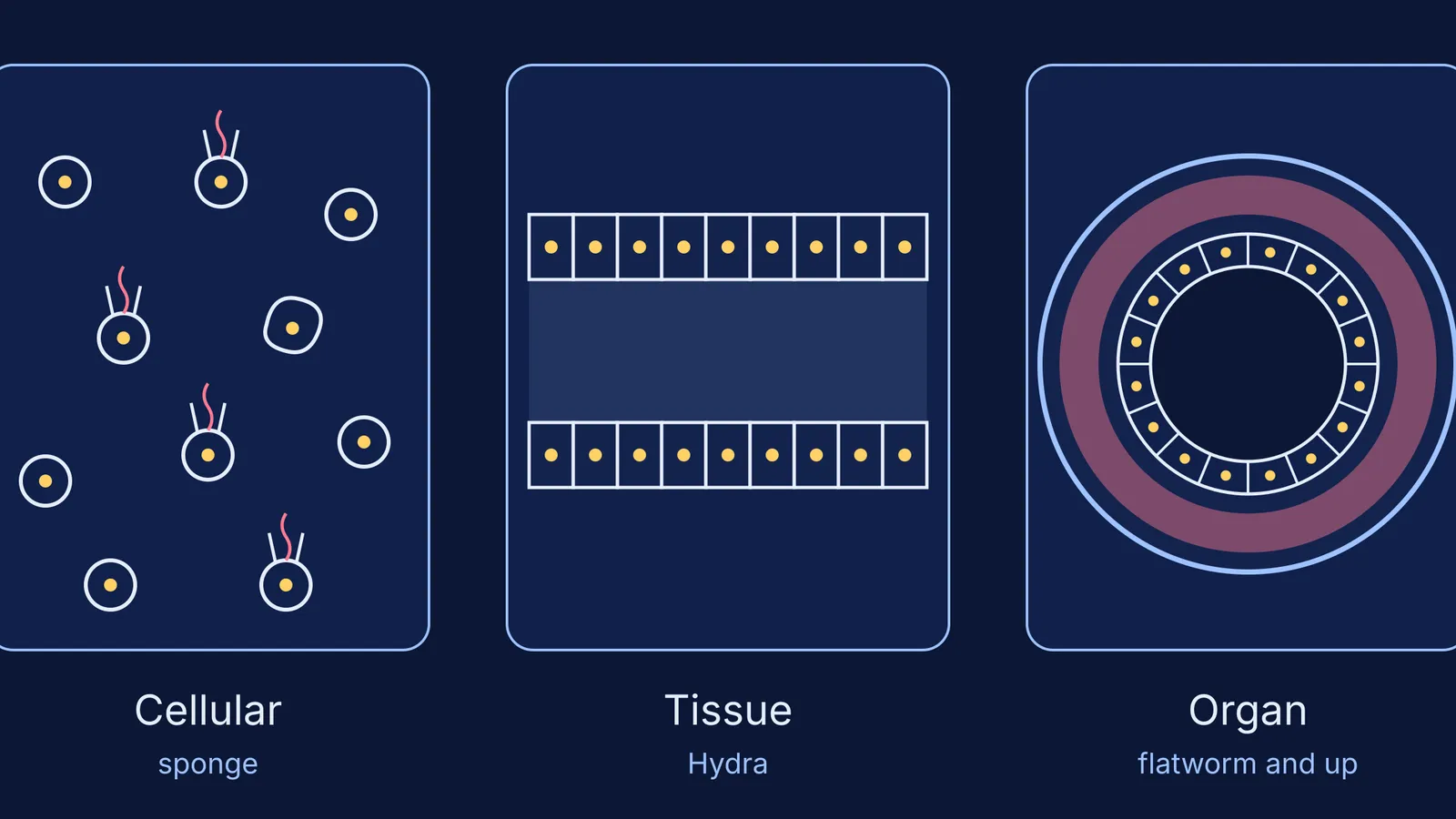
NCERT sorts animals into four levels of organisation in the Animal Kingdom chapter. Sponges sit at the first level, where cells form loose aggregates. Coelenterates sit at the second: "Cnidarians exhibit tissue level of organisation and are diploblastic." Flatworms reach the organ level, and annelids, arthropods, molluscs, echinoderms and chordates reach the organ-system level.
A tissue is a group of similar cells that stay together and do one job as a team. A sponge has the cells but not the team.
If you want the whole ladder with every phylum placed on it, our post on sorting animals into cellular, tissue and organ levels walks through it the NCERT way.
Why do sponges have no true tissues?
The OpenStax Biology 2e chapter on Porifera lists several cell types:
Pinacocytes form the outer layer.
Choanocytes, or collar cells, beat their flagella to drive water and catch food particles.
Porocytes control water flow through the pores.
Amoebocytes crawl through a jelly-like layer called the mesohyl and can change into other sponge cell types.
So why not call these tissues? The answer comes from how embryos develop. OpenStax states that sponges "do not possess 'true' tissues that are embryologically homologous to those of all other derived animal groups" because "they do not create a true gastrula during embryogenesis". The same section adds that, functionally, sponges can be said to have tissues, but these are likely not embryologically homologous to ours. The gastrula is the stage where other animal embryos set up germ layers such as ectoderm and endoderm, and true tissues grow from those layers. For the germ-layer side of this story, see diploblastic vs triploblastic animals.
An old experiment shows how loosely sponge cells cooperate. Zoologist H. V. Wilson strained the sponge *Microciona prolifera* through fine cloth, so that "the sponge cells are squeezed free of the skeleton". He reported that "the originally separate cells quickly combine with one another", and that about a week after the cell crust was moved to open sea water it had become "a functional sponge with pores, oscula, well-developed canal system, and flagellated chambers" (Wilson, Bulletin of the Bureau of Fisheries, 1908.43.pdf)).
Do sponges have nerves, muscles or organs?
Nerves: no. A summary of a 2021 study of the freshwater sponge *Spongilla lacustris* states that sponges "do not have a nervous system" (Musser et al., Science, 2021). The same team found that many genes used in synapses are active in cells of the sponge's small digestive chambers, which hints at how nerve signalling may have begun. A separate review notes that sponges carry many genes linked to nerve-cell processes in other animals, and argues that the sponge's nerve-like elements fit an early specialisation for filter feeding (Leys, Journal of Experimental Biology, 2015).
Muscles: not in the textbook sense. Sponges are "believed to lack muscles", yet they can contract their whole body to flush debris from their canals. In the sponge *Ephydatia muelleri*, the canal lining carries a contractile kit built from proteins also used in muscle (Colgren and Nichols, Nature Communications, 2022). For your exam, stick to the NCERT answer: sponges are at the cellular level, with no true tissues.
Organs: none. NCERT notes that water enters through tiny pores called ostia, passes the spongocoel and leaves through the osculum, and that digestion is intracellular (NCERT). There is no gut: food is digested inside individual cells. The route is mapped step by step in our post on the Porifera canal system.
How do you tell cellular, tissue and organ levels apart?
Here is the one-line test: find the smallest unit that does a whole job on its own: one cell means cellular level, a sheet of similar cells means tissue level, and several tissues built into one structure means organ level.
Try it on four NCERT animals:
Sycon or Spongilla: collar cells catch food and digestion happens inside single cells, with no tissue doing the job, so this is the cellular level.
Hydra: two cell layers work as sheets, so this is the tissue level.
Planaria (a flatworm): tissues are built into structures with one job each, so this is the organ level.
Earthworm: organs work together in systems, such as a digestive system, so this is the organ-system level.
If a term like gastrula or germ layer still feels shaky, the Fermi Concept Library gives each biology concept its own lesson and shows where it sits on the concept map. When you are ready to practise, the Fermi Problem Library has worked problems with a step-by-step solver that explains the reasoning rather than printing an answer.
Next time a question says "specialised cells", run the one-line test before you tick "tissue".


