

On this page
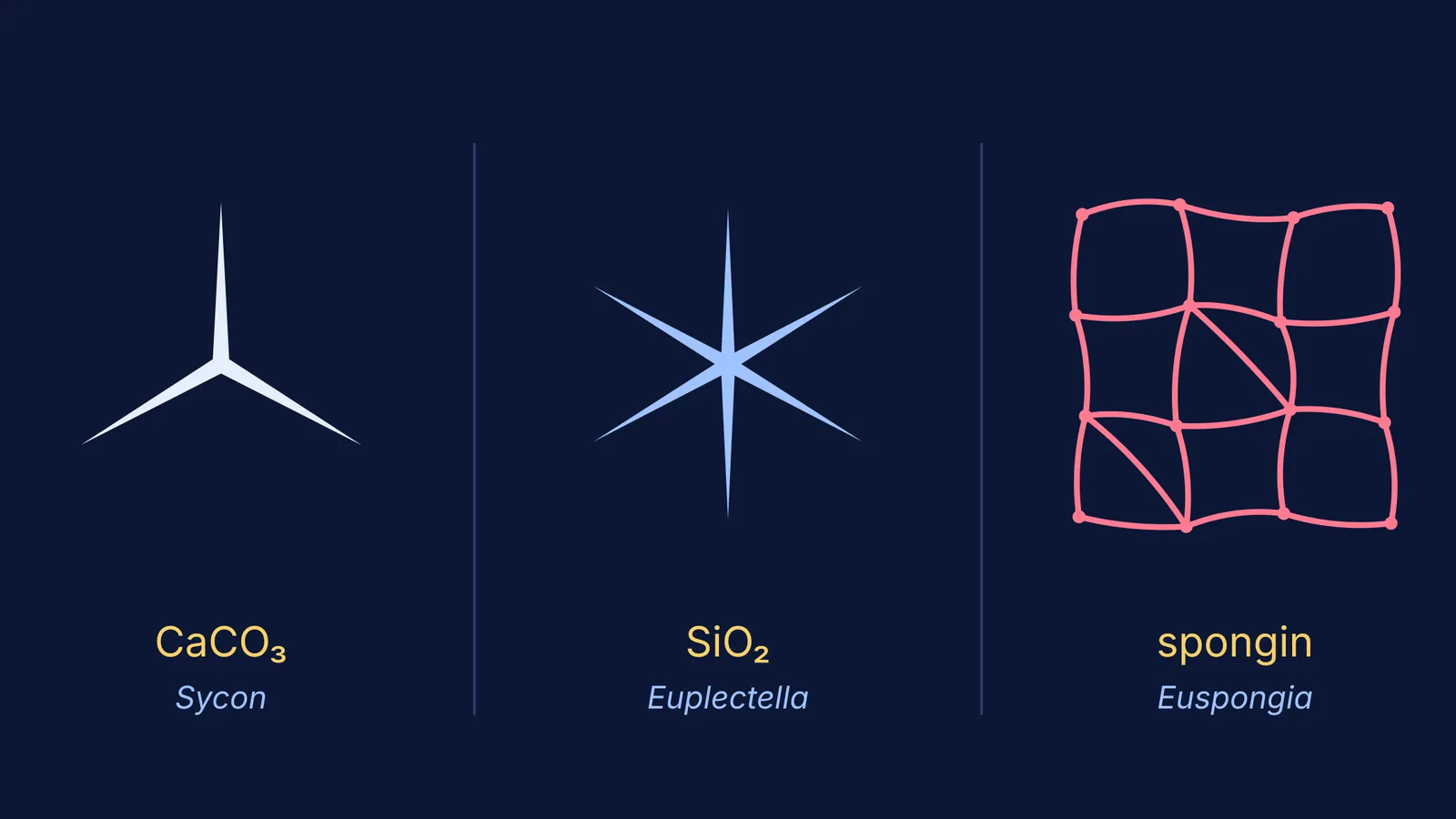
Crush a bit of sea sponge, look at it under a microscope, and you may find tiny needles, crosses and stars. Those are spicules, and what they are made of is the cleanest way to sort sponges into groups. NCERT's Class 11 chapter says the sponge body "is supported by a skeleton made up of spicules or spongin fibres" and gives three examples: Sycon, Spongilla and Euspongia (NCERT Biology Class 11, Chapter 4). This post explains the chemistry behind that one line, so the examples stop being a list to memorise.
What are sponge spicules made of?
Spicules are small skeletal pieces made by specialised sponge cells, and they come in two chemistries: calcium carbonate or silica.
Calcareous spicules are up to about 10 mm in size, have one to four rays and consist mainly of magnesium-calcite, a form of calcium carbonate, according to a review by Ingo Sethmann and Gert Wörheide (Sethmann and Wörheide, Micron, 2008). The same review contrasts them with the amorphous silica spicules of the classes Hexactinellida and Demospongiae.
Spongin is not a mineral at all. A review in Marine Drugs notes that spongin has also been called a "collagen-like protein" and a scleroprotein (Jesionowski and colleagues, 2018). So "spicules or spongin fibres" in your textbook really means: chalk or glass needles, or protein threads.
Which sponge class has which skeleton?
The World Register of Marine Species lists four classes of Porifera: Calcarea, Demospongiae, Hexactinellida and Homoscleromorpha (WoRMS, Porifera). NCERT's three examples fall into two of them, Calcarea and Demospongiae; the glass sponge Euplectella adds Hexactinellida.
Calcarea: calcium carbonate, as in Sycon
Calcarea sponges build their spicules from calcium carbonate (Animal Diversity Web, Calcarea). Sycon, NCERT's first example, is placed in class Calcarea (GBIF, Sycon).
Hexactinellida: six-pointed glass, as in Euplectella
The skeleton of a hexactinellid is made entirely of silica, and its spicules are generally made of three perpendicular rays, which gives six points (Animal Diversity Web, Hexactinellida). That is where the name comes from: hex means six. Euplectella aspergillum is a hexactinellid (GBIF, Euplectella aspergillum). A 2005 study of a Euplectella species by Joanna Aizenberg and colleagues found nanometre-scale silica spheres arranged in concentric rings and glued together by organic matrix to form layered spicules, a design that "overcomes the brittleness of its constituent material, glass" (Aizenberg et al., Science, 2005).
Demospongiae: spongin, silica or both, as in Euspongia and Spongilla
Demosponges may contain spicules with one to four rays, spongin fibres, both, or neither (Animal Diversity Web, Demospongiae). NCERT's Euspongia is now treated as a synonym of the genus Spongia, with the bath sponge Spongia officinalis as its type species (WoRMS, Euspongia). Spongia officinalis is a demosponge (GBIF, Spongia officinalis), and so is the freshwater sponge Spongilla lacustris (GBIF, Spongilla lacustris). If you want the canal system that these skeletons hold open, our explainer on ostia, spongocoel and choanocytes walks through it.
Why is a bath sponge soft when other sponges are chalk or glass?
Because a bath sponge is the skeleton itself. The FAO describes the commercial sponge as "the macerated and dried skeleton of a sponge" and says its large internal surface lets it absorb water up to 20 to 35 times its weight (FAO, sponge fisheries).
The Marine Drugs review adds that the commercial sponge comes from a sponge "that has no proper spicules", that its spongin fibres range from 5 to 100 microns across, and that the qualities you want (holding water, compressibility, resiliency, toughness) all depend on the spongin fibre pattern (Jesionowski and colleagues, 2018).
Now flip it round. Dry out a Sycon or a Euplectella and what is left is a frame of calcite or glass needles. The material decides the use.
How do you sort a sponge in an exam question?
Ask three questions in this order:
Is there any mineral in the skeleton? If it is only protein fibres, it is a spongin sponge (Demospongiae), like Euspongia.
If there is mineral, is it calcium carbonate or silica? Calcium carbonate means Calcarea, like Sycon.
If it is silica, are the spicules six-pointed with three perpendicular axes? Yes points to Hexactinellida, like Euplectella; otherwise, at textbook level, think Demospongiae.
Worked example: a spicule placed in dilute hydrochloric acid gives off bubbles. Which class? Metal carbonates react with acids to give a salt, carbon dioxide and water (NCERT Science Class 10, Chapter 2), so bubbles mean carbonate, and carbonate spicules mean Calcarea. A silica spicule has no carbonate to release, so you would not expect it to fizz.
For more practice, try our calcareous, siliceous and horny sponges drill, then fit sponges back into the whole chapter with the Class 11 animal kingdom guide. If the link between the chemistry and the classification still feels shaky, the Fermi Concept Library has a lesson for each concept in biology and chemistry, and the Fermi Problem Library has worked problems with a step-by-step solver that explains the reasoning rather than printing an answer.


