

On this page
A spider has no nose, yet it breathes air through book lungs: pockets in the abdomen packed with thin plates like the pages of a closed book. Here is how they work, how they differ from an insect's tubes and a horseshoe crab's gills, and what they say about how arachnids reached land.
How do spiders breathe with book lungs?
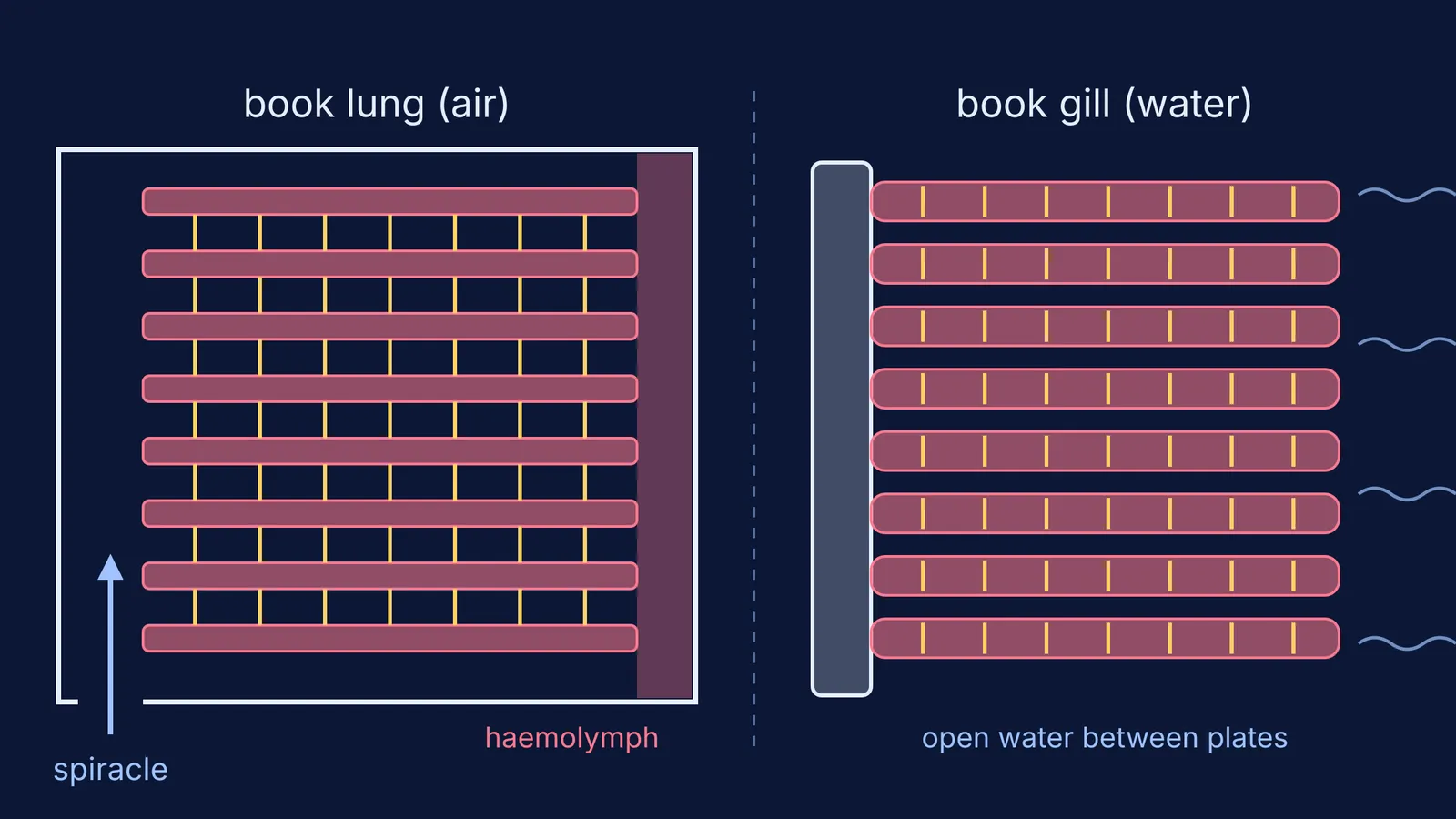
A book lung is an air-filled chamber holding a stack of thin plates (lamellae), with haemolymph inside each plate and air in the gaps between them (Wikipedia: Book lung). Air enters through a small opening called a spiracle into a chamber called the atrium, and the air gaps open off it.
Haemolymph, the spider's blood, flows through each plate and picks up oxygen across its thin wall. More pages means more surface for exchange in a small space.
Tiny cuticle pillars called trabeculae sit between the plates and keep each air gap permanently open, as Kamenz and colleagues (2008, Biology Letters) describe.
In most arachnids, passive ventilation alone is enough to meet the body's needs. Most spiders have one pair of book lungs and scorpions have four pairs, while most advanced spiders have replaced at least one pair with tracheae (all from the Wikipedia book lung page).
Spiders are the only animal group that breathes with lungs and tracheae at the same time, according to a review by Anke Schmitz (2016, Journal of Comparative Physiology B).
How are book lungs different from insect tracheae?
NCERT's Class 11 chapter on Breathing and Exchange of Gases says insects "have a network of tubes (tracheal tubes) to transport atmospheric air within the body." That is the key difference.
Insect tracheae carry the air itself through branching tubes inside the body.
Book lungs keep the air in one chamber. Exchange happens at the plates, and haemolymph carries the oxygen onward.
For the tube system in detail, read how insects breathe through spiracles, tracheae and tracheoles. If the two groups still blur, start with why a spider is not an insect.
How do book lungs differ from horseshoe crab book gills?
Horseshoe crabs breathe in water with book gills. A study of how Limulus embryos grow them by Robert Farley (2012, Frontiers in Zoology), read alongside the lung work above, points to three differences:
Inside or outside. Gill plates sit outside the body, on the back of flap-like appendages on the abdomen. Lung plates sit inside a chamber.
Where the pillars are. In a gill, space holders sit inside each haemolymph plate and the water channels between plates have none. In a lung, they sit in the air gaps.
How they grow. Gill plates fold outward from the appendage. Scorpion lung plates form from cells that move inward and line up in rows.
Farley's earlier study (2010, Arthropod Structure and Development) said these differences in embryology "refine but do not preclude" the idea that book gills and book lungs share an origin. For the animal itself, read why Limulus, the king crab, is called a living fossil.
What do book lungs tell us about arachnid evolution?
Scorpions and spiders carry their lungs on different segments, so some scientists argued they reached land separately. Scholtz and Kamenz (2006, Zoology) compared the lungs under the microscope, found several detailed similarities, and concluded they are homologous, pointing to a single move onto land by a common ancestor.
Fossils agree. In a roughly 410-million-year-old arachnid from Scotland's Rhynie chert, Kamenz and colleagues (2008) resolved up to 34 plates with pillars between them: the modern design, already in place.
A 340-million-year-old sea scorpion described by Lamsdell and colleagues (2020, Current Biology) had pillar-like trabeculae on its gill plates. The team took this as a sign it could breathe air, and that book gills were the direct forerunners of book lungs.
The family tree is still debated. A 2022 analysis of 506 genomes and transcriptomes by Ballesteros and colleagues (Molecular Biology and Evolution) consistently placed horseshoe crabs inside the arachnids, not beside them. The authors argue that convergent adaptations to land made arachnids look like one group. Treat the single move onto land as a strong hypothesis, not a settled fact.
How to answer a book lung question in an exam
Use these five checks to compare any two breathing organs:
Where is the exchange surface: inside the body or outside?
What touches it: air or water?
What holds it open, and where: pillars in the air or in the blood?
What carries oxygen onward: tubes of air, or haemolymph?
How does it form in the embryo: folding in or folding out?
Worked example. Statement: spiders and insects both take in air through spiracles, so their breathing organs work the same way. Answer: first half true, second false. Checks 1 and 2 match (inside, air), but check 4 splits: insects carry air through tubes, while a book lung exchanges gas at its plates and haemolymph carries the oxygen. Against a horseshoe crab, checks 1, 2 and 3 all flip.
If a term in this chain is fuzzy, the Fermi Concept Library gives each biology concept its own lesson. To practise comparisons like this, the Fermi Problem Library has a step-by-step solver that explains the reasoning rather than printing an answer.


