On this page
Small spiders can travel long distances without wings. A spider climbs to the top of a grass stem, lifts its abdomen, lets out a few strands of silk and floats away. This is called ballooning. Wind has long been the standard explanation, but in 2018 a laboratory experiment showed that an electric field alone can make spiders take off. This post works out, with Class 12 electrostatics, how much charge a spider would need, and why the tip of a grass blade makes the job about 800 times easier.
How did scientists test whether spiders fly on electricity?
Erica Morley and Daniel Robert at the University of Bristol put Erigone spiders (small money spiders) in a closed box between two metal plates 0.8 m apart, which limited air movement. They set the vertical field to 0, 1.25 kV/m or 6.25 kV/m. With the field on, more spiders dropped silk lines, and at the higher field more spiders did the "tiptoe" stance that comes before ballooning. Airborne spiders moved up when the field was switched on and down when it was switched off. They also found that the fine sensory hairs on a spider's legs, called trichobothria, are moved mechanically by fields of this size, which suggests a way for spiders to detect them. The paper is Electric Fields Elicit Ballooning in Spiders, Current Biology 28, 2324 (2018), free to read on PubMed Central.
Keep the claim in proportion. The authors say wind drag and electric force probably work together, and that the electric force "may not always be necessary". Wind is still a major part of the story. The experiment shows that electric lift is possible, not that every flight uses it.
How strong is the Earth's electric field on a clear day?
On a fine day the air carries a downward electric field, because the upper atmosphere is positive and the ground is negative. The same paper gives about 120 V/m over a flat field under clear skies, and the value changes with weather and place. Why this field exists, and why the Earth does not simply discharge, is covered in how long the Earth's surface charge would take to leak away, so it is not repeated here.
Because the field points down, a positive charge is pushed down. For an upward force the spider and its silk must carry negative charge.
How much charge does a 1 mg spider need to float?
To float, the electric force must balance the weight: qE = mg. All values below are illustrative round numbers for a small spider, not measurements from the paper, which did not report body mass.
Weight. m = 1 mg = 1 × 10⁻⁶ kg, so mg = 1 × 10⁻⁶ × 9.81 = 9.81 × 10⁻⁶ N.
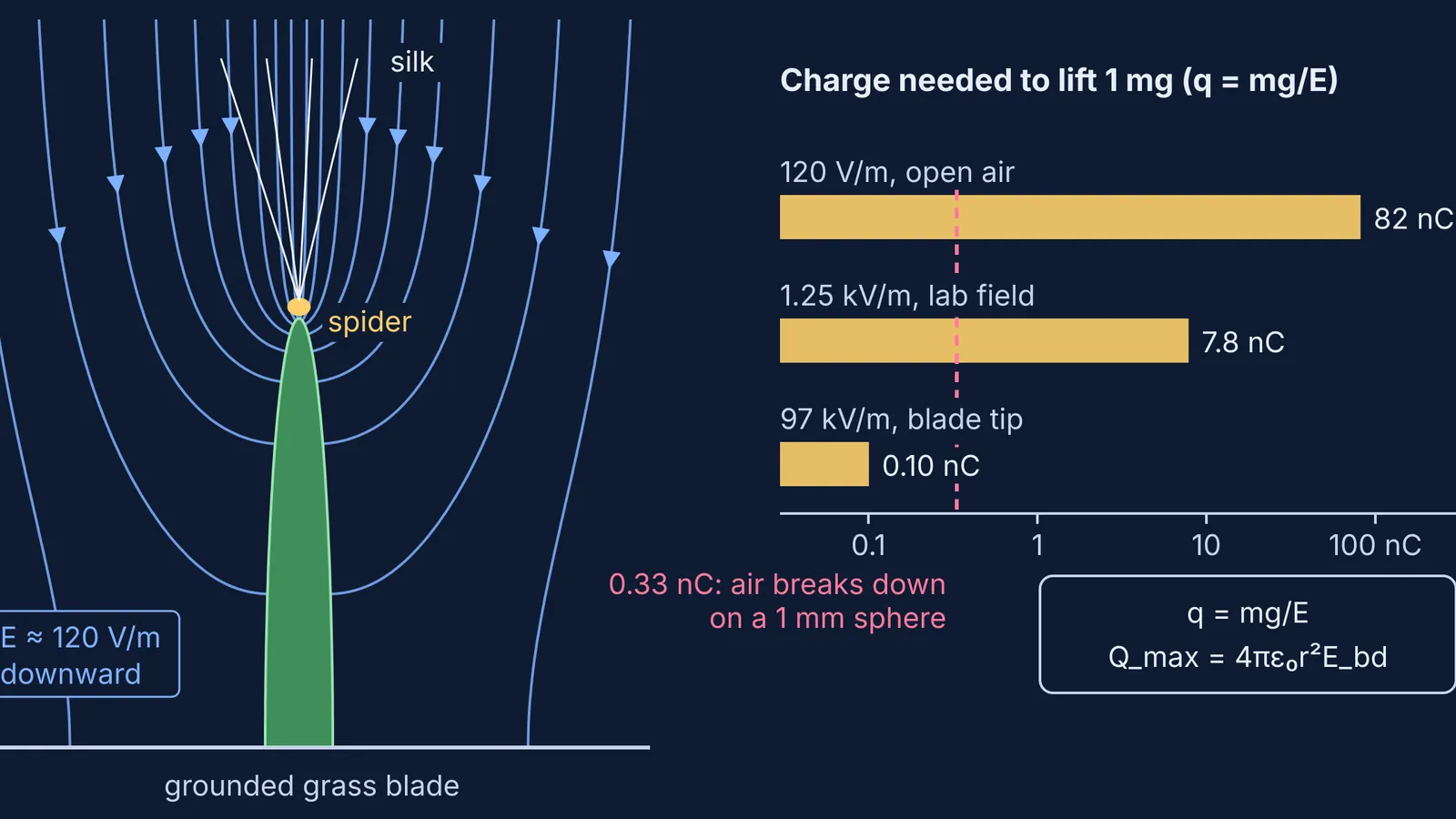
Fair-weather field, 120 V/m. q = mg/E = 9.81 × 10⁻⁶ / 120 = 8.2 × 10⁻⁸ C = 82 nC.
Laboratory field, 1.25 kV/m. q = 9.81 × 10⁻⁶ / 1250 = 7.8 × 10⁻⁹ C = 7.8 nC.
Higher laboratory field, 6.25 kV/m. q = 1.6 nC.
Check the units: N ÷ (V/m) = N m/V = J/V = C. The answers are in coulombs, as they should be.
Can a spider-sized object even hold 82 nC?
No. Charge on a small conductor is limited by the air around it. When the surface field reaches about 3 × 10⁶ V/m, air breaks down and the charge leaks away as a corona. For a sphere the surface field is Q/(4πε₀r²), so the most it can hold is Q_max = 4πε₀r²E_bd, the result worked in the most charge a sphere can hold before the air breaks down.
For a sphere of radius 1 mm:
Q_max = 4π × 8.854 × 10⁻¹² × (1 × 10⁻³)² × 3 × 10⁶ = 3.3 × 10⁻¹⁰ C = 0.33 nC.
That is about 250 times less than the 82 nC needed in open air, and even the lab's 7.8 nC is out of reach. So a spider sitting in a uniform field cannot lift itself on charge alone. Something has to make the field much stronger.
Why does the tip of a grass blade make lift possible?
A grass blade is wet enough to conduct and is connected to the ground. Like any grounded conductor sticking up into a field, it pulls the field lines towards its tip, where they crowd together. This is the same physics as a lightning conductor, explained in why charge crowds at sharp points.
To put a number on it, model the blade as a thin conducting spheroid standing on the ground, with height h and tip radius ρ. For a slender spheroid the field at the tip is larger than the background field by a factor of about (h/b)² / [ln(2h/b) − 1], where b = √(hρ) is the half-width at the base.
Shape. h = 0.3 m and ρ = 0.1 mm, so h/ρ = 3000 and b = √(0.3 × 0.0001) = 5.5 mm.
Enhancement. (h/b)² = h/ρ = 3000, and ln(2h/b) − 1 = ln(109.5) − 1 = 3.70. Factor = 3000/3.70 ≈ 810.
Field at the tip. 120 × 810 ≈ 97,000 V/m = 97 kV/m.
Charge needed. q = 9.81 × 10⁻⁶ / 97,000 = 1.0 × 10⁻¹⁰ C = 0.10 nC.
Now the answer is below the 0.33 nC breakdown limit. In the lab's 1.25 kV/m field the same blade would give about 1.0 MV/m at its tip, still under 3 MV/m. The induced charge on a grounded tip in a downward field is negative, which is the sign the spider needs.
What does this estimate leave out?
Real shapes. A grass blade is flat, not a spheroid, and nearby blades shield one another, which lowers the enhancement. Treat 810 as an order of magnitude.
Where the charge sits. Most of a ballooning spider's charge would be on its silk, not on a compact body, so the 1 mm sphere limit is a guide rather than a hard ceiling.
Varying fields. The fair-weather field changes through the day and is much larger under storm clouds.
Drag. Even a slight breeze pulling on several metres of silk can add a force comparable to the weight.
If you want to see how field lines bend around a grounded conductor and crowd at its tip, the Simulation Lab has interactive simulations for ideas that are easier to see than read.
Quick checklist
Ballooning spiders lift off with silk; wind and electric force probably act together.
Fair-weather field: about 120 V/m, pointing down, so the spider needs negative charge.
Floating needs qE = mg: 82 nC at 120 V/m for a 1 mg spider.
Air breaks down near 3 MV/m, so a 1 mm sphere holds at most 0.33 nC.
A grounded tip multiplies the field, here by about 810, cutting the charge needed to 0.10 nC.
The tip estimate is idealised and only applies within a few tip radii.