

On this page
Spermatogenesis and oogenesis both use meiosis to halve the chromosome number, but exam questions test where they part ways. Below is each difference with the reason behind it, because a reason is easier to recall under pressure than a bare fact.
What is the difference between spermatogenesis and oogenesis?
Spermatogenesis is the process by which immature male germ cells divide, undergo meiosis and differentiate into haploid spermatozoa, as described in the Endotext chapter by O'Donnell, Stanton and de Kretser. Oogenesis is the female version: germ cells enter meiosis during fetal life and then wait, arrested, inside the ovary, according to a 2023 review by Pei and colleagues in Reproductive Biology and Endocrinology.
The short version: the male line is built for numbers and speed, the female line for one well-stocked cell and long storage.
Spermatogenesis vs oogenesis: the revision table
Site. Spermatogenesis happens in the seminiferous tubules of the testis, supported by Sertoli cells (Endotext). Oogenesis happens in the ovary, where oocytes grow inside follicles (Gosden and Lee, JCI). Why: developing sperm rely on Sertoli cells behind the blood-testis barrier; a growing oocyte relies on its follicle.
Start. Spermatogonial stem cells renew themselves throughout life, and Sertoli cells mature at puberty so they can support spermatogenesis (Endotext). In females the switch from mitosis to meiosis begins at the fetal stage (Pei et al.). Why: males keep a stem-cell supply; females are not thought to.
Timing. Human spermatogenesis takes up to 64 days and runs continuously, so an average man makes roughly 1,000 sperm per heartbeat (Endotext). The female supply only shrinks: a model of the ovarian reserve found that, for 95% of women, only 12% of the maximum pre-birth pool of non-growing follicles is left by age 30, and only 3% by 40 (Wallace and Kelsey, PLoS ONE). Why: no stem cells means no refill.
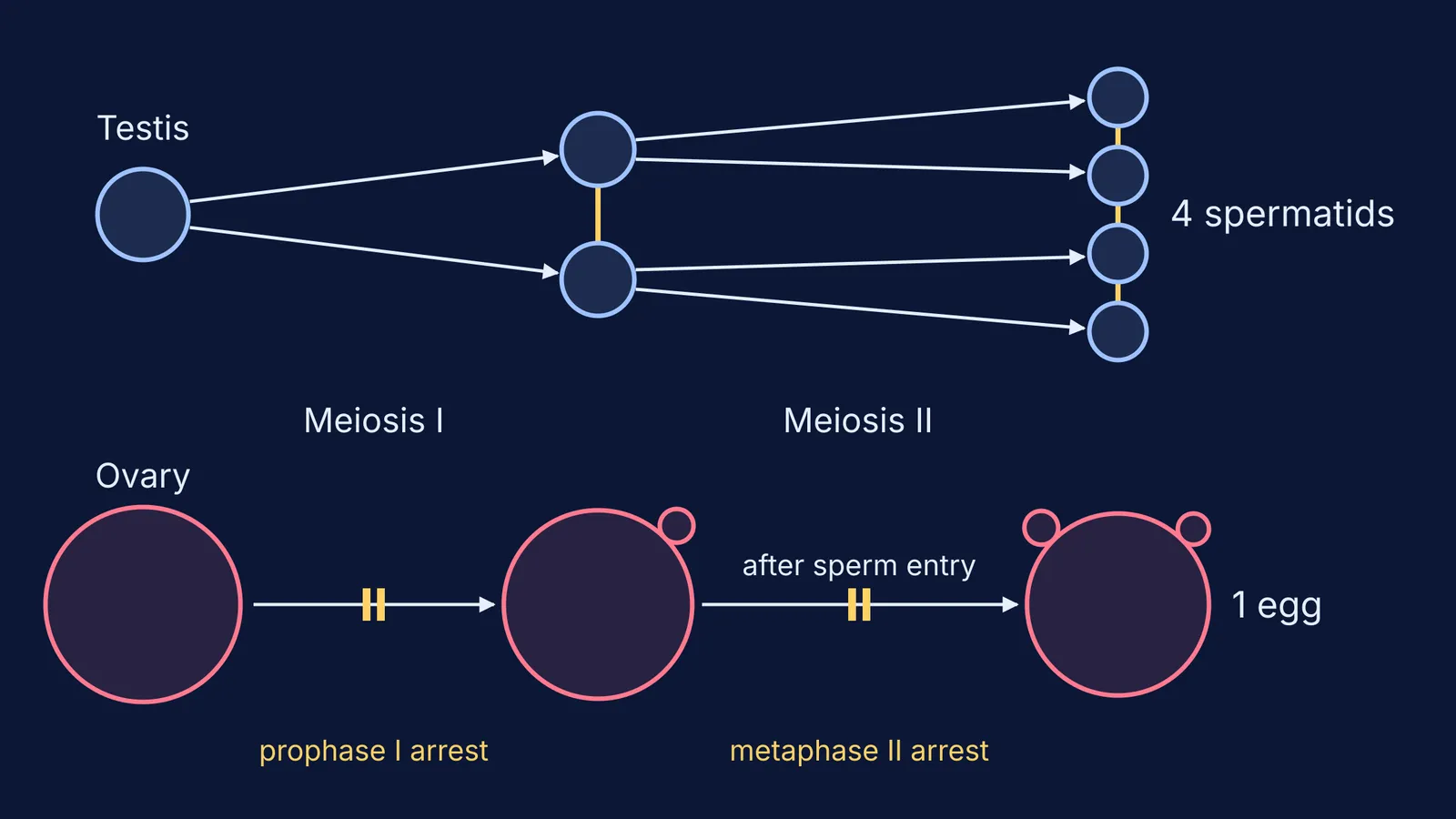
Arrests. Male meiosis has no long pause: a prophase of about two weeks is followed by two rapid divisions (Endotext). Oocytes stop twice: at the diplotene stage of prophase I, and again at metaphase II, where they wait for fertilization (Pei et al.).
Cytokinesis. In the male line the divisions split each cell evenly, and sister germ cells stay joined by stable intercellular bridges, a feature of gametogenesis (Greenbaum et al.). In the female line division is extremely unequal, giving an oocyte and a polar body with enormous volume differences (Evans and Robinson).
Products. Two meiotic divisions of one primary spermatocyte give four haploid spermatids, which then turn into sperm with no further division (Endotext). One primary oocyte gives one egg, and the rest leaves as polar bodies (Pei et al.).
Hormones. GnRH drives LH and FSH; LH makes Leydig cells release testosterone, and androgens plus FSH act on Sertoli cells (Endotext). In the ovary, a surge of LH restarts meiosis in certain oocytes (Pei et al.).
Why does oogenesis stop twice?
High cAMP inside the oocyte holds it at prophase I until a surge of LH restarts meiosis, the 2023 review by Pei and colleagues explains. Since meiosis began before birth, an egg ovulated at 30 has been paused for more than 30 years.
The second pause, at metaphase II, waits for a sperm; the same review notes that meiosis is completed once the oocyte is fertilized. So ovulation releases a secondary oocyte, not a finished ovum. Our post on the two arrests of oogenesis walks through each stage.
Why does one spermatocyte give four sperm but one oocyte gives one egg?
An embryo's first days run on the egg's stored cytoplasm, so the oocyte keeps almost all of it. Pei and colleagues describe oocyte cytokinesis as asymmetric, "generating a polar body, with an extremely small amount of cytoplasm, and the oocyte, with most of the cytoplasm" (Pei et al.). A sperm mainly has to carry DNA and swim, so splitting evenly four ways costs little.
Worked example: 100 primary spermatocytes give 400 sperm. 100 primary oocytes give at most 100 eggs. For more practice, see counting cells in gametogenesis, and for the male timeline, how long spermatogenesis takes.
How should you revise these differences for NEET?
Try this three-step drill:
Write the seven row names (site, start, timing, arrests, cytokinesis, products, hormones) down the margin.
Fill in both sides from memory, then write the "why" for each row.
Check against the table and redo only the rows you got wrong, two days later.
Then test yourself with an assertion-reason pair. Assertion: a primary oocyte gives one functional gamete. Reason: cytokinesis in oogenesis is unequal. Both are true, and the reason explains the assertion.
If a row still feels shaky because meiosis itself is unclear, the Fermi Concept Library has a lesson for each biology concept and shows its place in the map. For practice, the Fermi Problem Library has worked problems with a step-by-step solver that explains the reasoning rather than printing an answer.


