

On this page
When a sperm fertilises an egg, you usually hear about one thing it brings: the father's set of chromosomes. It also brings something much smaller that the zygote cannot divide without. That is the centriole, the structure that organises the poles of the first mitotic spindle.
Does the sperm contribute the centriole to the zygote?
In humans, yes. A 1991 study in PNAS by A. H. Sathananthan and colleagues examined fertilised human eggs with transmission electron microscopy and found sperm centrioles closely associated with the male pronucleus 16 to 20 hours after insemination (Sathananthan et al., PNAS 1991). At 25 to 26 hours, single or double centrioles sat at one pole of the first cleavage spindle. The authors concluded that human centrioles, "as those in most other animals, and unlike the mouse, are paternally derived", which they described as support for Boveri's classical theory.
A 1995 study in Nature Medicine by Calvin Simerly, Gerald Schatten and colleagues imaged inseminated human eggs and reported that "the sperm introduces the centrosome" (Simerly et al., Nature Medicine 1995). That centrosome grows a star of microtubules called the sperm aster, which the authors call a step essential for successful fertilisation. The same study found that eggs from some infertile patients failed to complete fertilisation because the sperm and egg nuclei did not unite.
Two definitions you need, both from the NCERT Class 11 chapter Cell: The Unit of Life:
A centrosome is an organelle usually containing two cylindrical centrioles, set perpendicular to each other and surrounded by amorphous pericentriolar material.
Each centriole is made of nine evenly spaced peripheral triplets of tubulin, arranged like a cartwheel, and centrioles give rise to the spindle apparatus during cell division in animal cells.
Why can't the egg use its own centrioles?
Because by the time it is fertilised, it has none. A 2005 review in Biology of Reproduction by Gaurishankar Manandhar, Heide Schatten and Peter Sutovsky describes how, during egg formation in animals, the centrioles degenerate completely and the egg switches to building its spindles without centrosomes (Manandhar et al., 2005). The review says this loss helps stop an egg from starting an embryo on its own, and keeps the number of centrosomes in the embryo's cells balanced.
When the count goes wrong, so does the spindle. The 1991 study described a three-poled spindle, with two centrioles at one pole, in an embryo that had formed three pronuclei instead of two (Sathananthan et al., 1991). The authors link such findings to abnormal cleavage in embryos fertilised by two sperm. It is one reason the egg works hard to keep out a second sperm, which we cover in how the zona pellucida stops polyspermy.
What did the 2018 study find about the second centriole?
As the 2018 paper puts it, "cells require two centrioles for normal division", yet the prevailing view was that the sperm has a single functional centriole, so the zygote would inherit only one (Fishman et al., Nature Communications 2018).
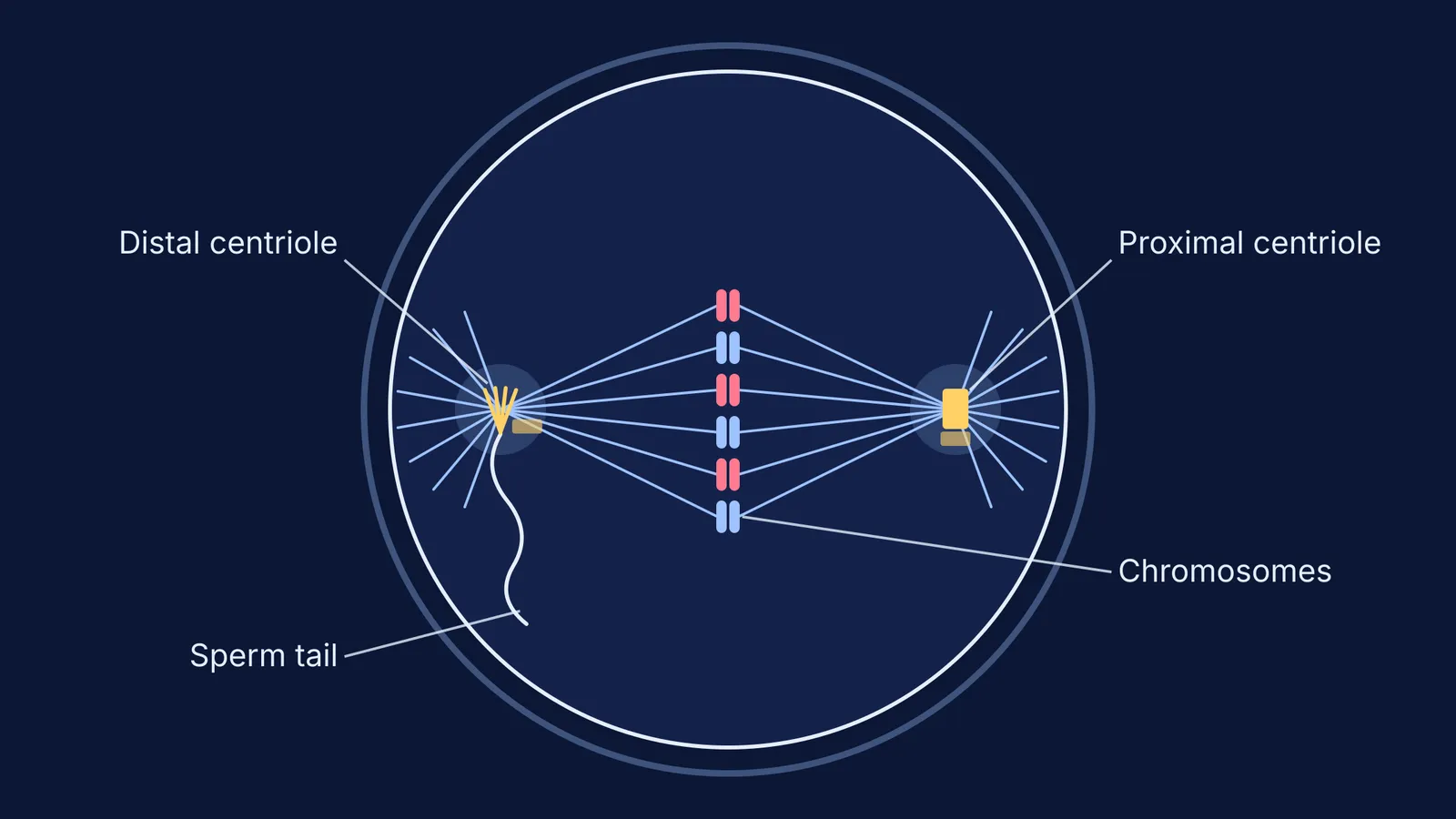
The team, led from Tomer Avidor-Reiss's lab, studied human sperm and cow zygotes. The sperm neck, they found, holds the familiar barrel-shaped proximal centriole and a second, atypical distal centriole whose microtubules are splayed out, attached to the base of the tail. In cow zygotes this distal centriole gathered pericentriolar material, formed a daughter centriole and sat at a spindle pole during mitosis. The authors concluded it "functions as the zygote's second centriole".
So, in the picture this study supports, each pole of the zygote's first spindle carries one of the father's two centrioles, with a newly made daughter beside it.
Is it the same in every animal and in plants?
No. The 1991 study itself flags the mouse as an exception. Plants are another case: NCERT notes that centrioles are absent in almost all plant cells, and our explainer on how plant cells build a spindle without centrioles shows how they manage. After the first division, the zygote keeps dividing without growing, covered in cleavage vs mitosis.
How should you answer this in NEET-UG?
NCERT is the main textbook for NEET-UG biology. The NCERT chapter describes centriole structure and its role in the spindle, but it does not say which parent supplies the zygote's centrioles. Know the research answer, and use NCERT wording for anything about structure.
Quick true-or-false check:
Centrioles form the basal body of cilia and flagella. True (NCERT).
A centrosome's two centrioles lie parallel. False: perpendicular.
The human egg keeps its centrioles until fertilisation. False.
Every mammal inherits zygote centrioles from the sperm. False: not the mouse.
An embryo with three pronuclei can form a three-poled spindle. True (1991 study).
A three-line answer for a viva: the egg's centrioles degenerate during oogenesis; the sperm brings two centrioles in its neck; these duplicate and organise the two poles of the zygote's first mitotic spindle.
If centrosome, centriole and basal body still blur together, the Fermi Concept Library gives every biology concept its own lesson and its place in the map. For practice, the Fermi Problem Library has worked problems with a step-by-step solver that explains the reasoning rather than printing an answer.


