On this page
Watch a fertilised egg divide and something looks wrong: the cell count goes 1, 2, 4, 8, 16, yet the ball of cells is no bigger than the egg. That is the defining feature of cleavage, and once you see why, most questions on it become easy.
Why does the embryo not grow during cleavage?
Cleavage divides a cell that already exists; it does not build new cytoplasm. A review by Jeffrey Farrell and Patrick O'Farrell in the Annual Review of Genetics says early embryonic cell cycles divide the large pre-existing cytoplasm without growth (Farrell and O'Farrell, 2014). The same review notes that many embryos begin with extremely short cycles that have no gap phases at all.
The egg starts out large, so there is plenty to divide. In a study of 314 mature (metaphase II) human eggs from 72 patients at a fertility clinic, the cytoplasm measured about 114 micrometres across on average (Valeri and colleagues, 2011). Cleavage spends that store, slicing it into smaller pieces.
In humans, the mitotic divisions called cleavage start as the zygote moves through the oviduct towards the uterus, forming 2, 4, 8 and 16 daughter cells called blastomeres (NCERT Class 12 Biology, Chapter 2).
How is cleavage different from ordinary mitosis?
Both are mitosis. The chromosomes are copied and shared out equally, so every blastomere has the same chromosome number as the zygote. The difference is what happens between divisions.
In an ordinary cell cycle, the cell grows during G1 and keeps growing during G2 while it prepares to divide (NCERT Class 11 Biology, Chapter 10). So each daughter cell grows back before it divides again. In cleavage, those growth steps are cut short or skipped.
Ordinary mitosis: grow, copy DNA, divide. Cell size stays roughly steady from one generation to the next.
Cleavage: copy DNA, divide, repeat. Cell number doubles while cell size falls.
Ordinary mitosis: the tissue or organism gets bigger over time.
Cleavage: the embryo stays about the size of the zygote.
Speed depends on the animal: frog embryos (Xenopus laevis) go through 12 rapid cycles of about 30 minutes each, while mammals start with slow cycles (Farrell and O'Farrell, 2014).
Worksheet: how small does each cell get from 2 to 16 cells?
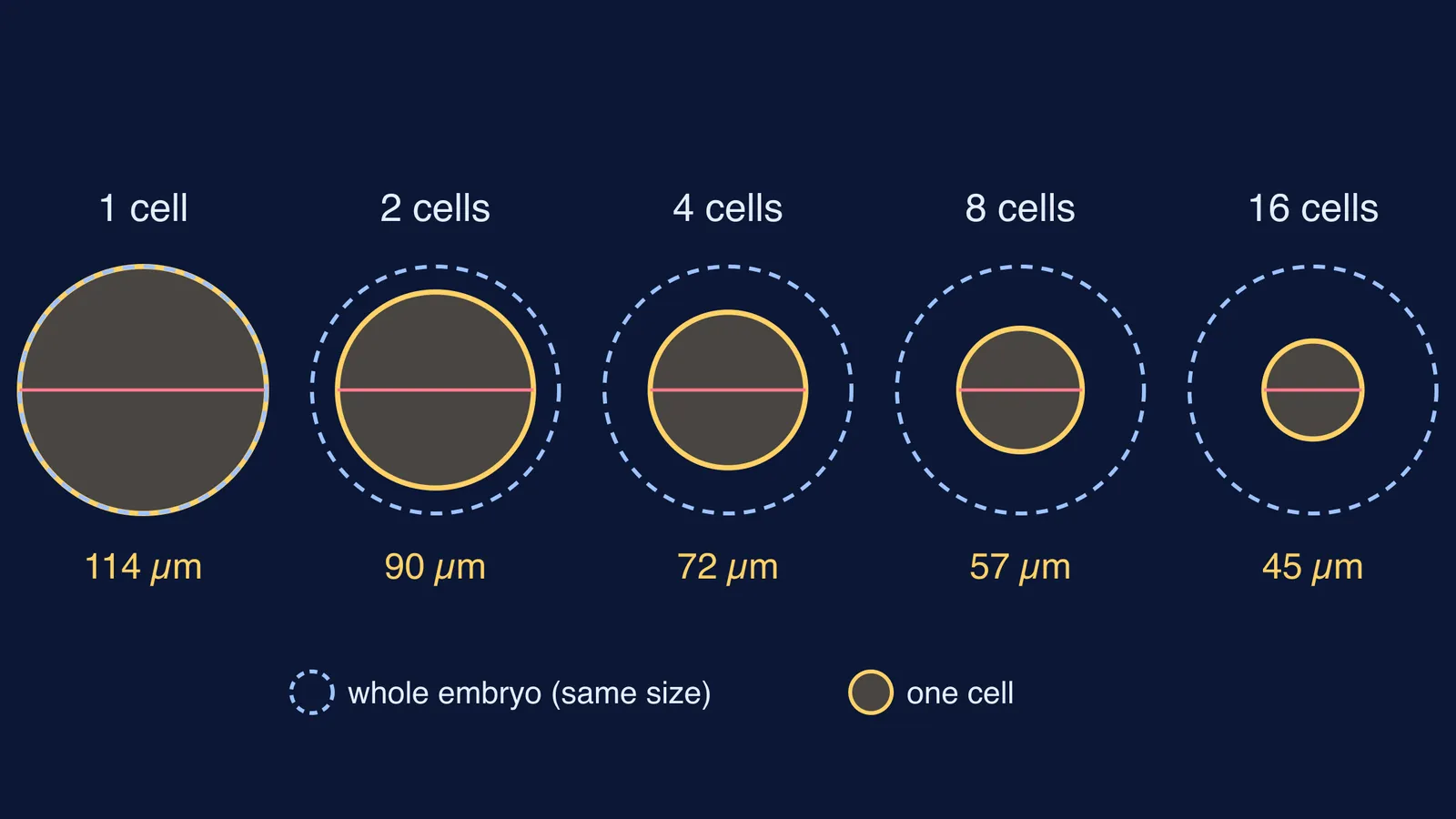
Start with the 114 micrometre cytoplasm from the Valeri study. Treat every cell as a sphere, assume each division is equal, and add no new cytoplasm. Real blastomeres press together and are not always equal, so these are model numbers.
Two rules do the work:
Volume halves at every division. The volume of a sphere is (π/6) × d³.
Diameter shrinks by the cube root of 2 (about 1.26) at every division. Three divisions cut the volume to 1/8 = (1/2)³, so the diameter halves.
Here is the table, worked from those rules:
1 cell (zygote): diameter 114 µm, volume about 776,000 µm³
2 cells: diameter 90 µm, volume about 388,000 µm³ each
4 cells: diameter 72 µm, volume about 194,000 µm³ each
8 cells: diameter 57 µm, volume about 97,000 µm³ each
16 cells (morula): diameter 45 µm, volume about 48,500 µm³ each
Check your work: 16 × 48,500 µm³ = 776,000 µm³. The total has not changed; only the number of pieces has.
Now try these:
A human zygote has 46 chromosomes. How many does each cell of the 16-cell stage have? Answer: 46. Cleavage is mitosis, not meiosis.
Predict the diameter at the 32-cell stage. Answer: 114 × 2^(−5/3), about 36 µm.
How many divisions give 64 cells? Answer: 6, because 2⁶ = 64. For more practice, see our guide to counting the divisions needed to produce a number of cells.
One more thing changes: each cell keeps a full set of DNA while its cytoplasm halves, so the nucleus-to-cytoplasm ratio rises at every division, which in frogs and flies helps time when the cycle slows (Farrell and O'Farrell, 2014).
What happens after the morula stage?
NCERT calls the embryo with 8 to 16 blastomeres a morula; it keeps dividing and becomes a blastocyst as it moves further into the uterus (NCERT Class 12 Biology, Chapter 2). Our explainer on the morula, blastocyst and inner cell mass picks up the story there, and zygote vs embryo vs foetus sorts out the names.
Three false statements to watch for in multiple-choice questions:
The embryo grows in size during cleavage.
Cleavage involves meiosis.
Blastomeres are haploid.
If the size argument still feels slippery, the Fermi Concept Library covers every concept in biology, each with its own lesson and its place in the map. For the worksheet maths, the Fermi Problem Library has worked problems with a step-by-step solver that explains the reasoning rather than printing an answer.
Next time you see 2, 4, 8, 16 in a question, ask what happened to the size of each cell. That one check answers most cleavage questions.