On this page
If you have read the competition section of NCERT's Class 12 Biology chapter "Organisms and Populations", you have met one line about barnacles in Scotland. Here is the experiment behind it, and how to turn it into a clean exam answer.
What does NCERT say about Connell's barnacles?
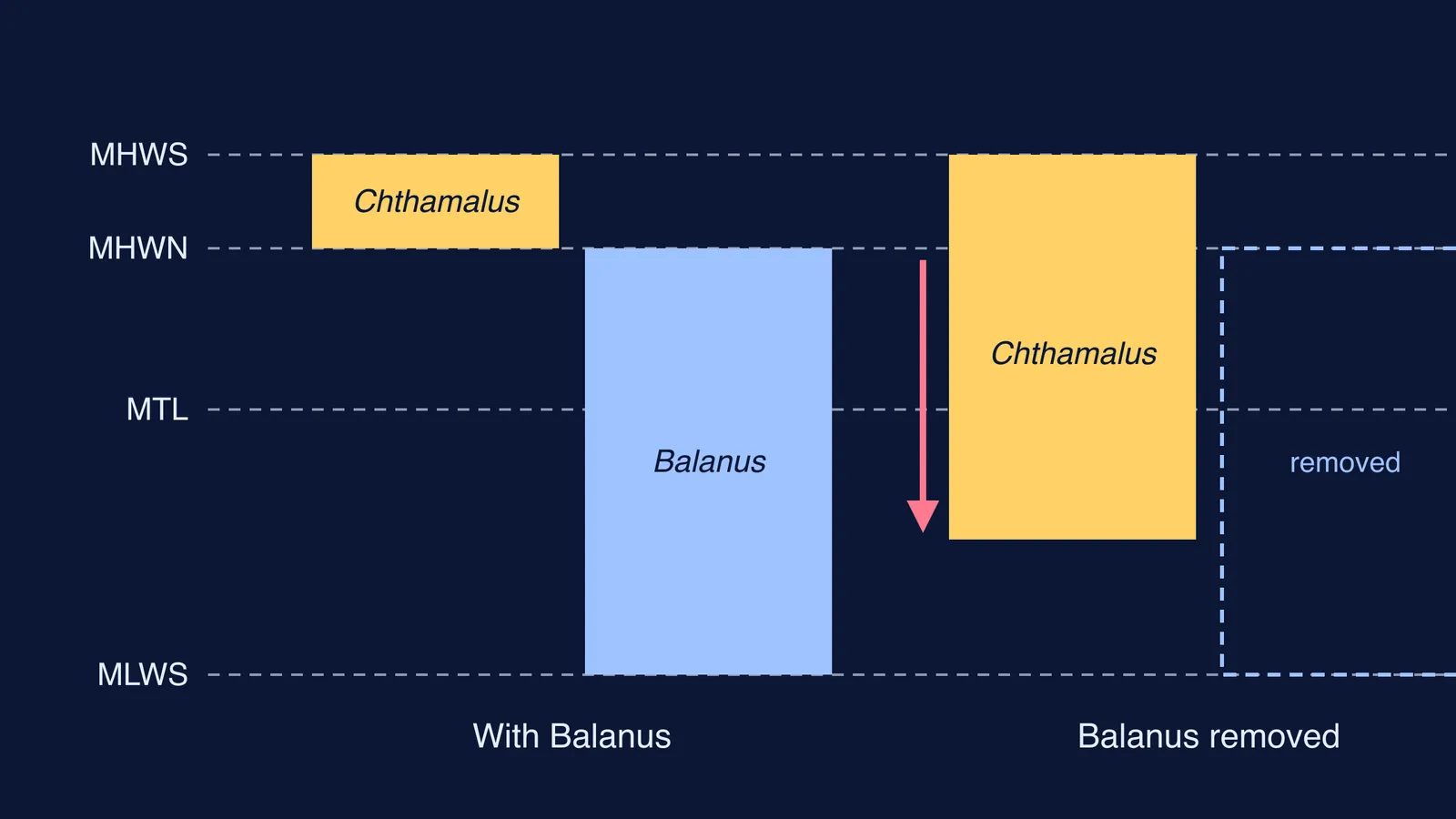
NCERT defines competitive release as the case where a species confined to a small area by a competitively superior species "is found to expand its distributional range dramatically when the competing species is experimentally removed" (NCERT Class 12 Biology, Chapter 11, page 199). The same page says Connell's field experiments showed that the larger, competitively superior barnacle *Balanus* dominates the intertidal area and excludes the smaller barnacle from that zone. NCERT spells the smaller one "Chathamalus"; Connell's paper uses *Chthamalus stellatus*, so use that spelling if you write the full name.
What did Connell actually do on the Scottish shore?
The study was made at Millport on the Isle of Cumbrae, in the Firth of Clyde, Scotland, and published in the journal Ecology in 1961 (Connell 1961, Ecology 42: 710-723). He noticed that adults of two barnacle species lived in two separate horizontal bands. Adult *Chthamalus* lived high up, between mean high water of neap tides (MHWN) and of spring tides (MHWS). *Balanus balanoides* covered almost the entire intertidal zone below that, down to mean low water of spring tides.
The puzzle: young *Chthamalus* settled in the *Balanus* zone, but few survived to adulthood there. Was it the extra time under water, a predator, or *Balanus* itself?
His method, from the same paper:
He mapped every *Chthamalus* in small patches using glass plates laid on the rock.
Because few *Chthamalus* settled below mid-tide level, he screwed rock pieces carrying them into the lower shore.
He divided each patch map into two portions with about equal numbers of *Chthamalus*, chose one by flipping a coin, and from it removed with a needle every *Balanus* touching or surrounding a *Chthamalus*. The other portion was left alone.
He counted survivors every 4 to 6 weeks for about a year, and caged some areas to keep out the predatory snail *Thais lapillus*.
What spread when Balanus was removed?
*Chthamalus* kept free of *Balanus* "survived very well at all intertidal levels", in Connell's own words in the paper's summary (Connell 1961). So time under water was not the killer. In the untouched portions, *Balanus*, which grew faster than *Chthamalus*, and Connell saw it smother, undercut or crush the *Chthamalus*. By early June, *Balanus* had reached 49 individuals per square centimetre on the experimental areas. The cages showed the snail was not greatly affecting *Chthamalus* survival; if anything, predation eased the competition.
The upper edge is a different story. In Table I of the paper, rock at MHWS is submerged about 4% of the time, against 21% at MHWN. Connell concluded that *Chthamalus* can live higher than *Balanus* mainly because it tolerates heat and drying better. His general lesson: the lower limit of intertidal animals is set mainly by biotic factors such as competition or predation, while the upper limit is more often set by physical factors.
How do you write this as an exam answer?
Use this four-part frame.
Observation: two barnacles live in separate bands on Scotland's rocky shore, the small *Chthamalus* above and the larger *Balanus* below.
Manipulation: *Balanus* was removed from patches lower on the shore, with neighbouring patches left untouched for comparison.
Result: without *Balanus*, *Chthamalus* survived well at every level tested; with it, *Chthamalus* was smothered or crushed.
Conclusion: *Balanus*, the superior competitor, restricts *Chthamalus*; its spread after removal is competitive release.
Worked example. Question: "A species confined to the upper zone of a rocky shore spreads lower when a second species is removed. Name the phenomenon and give the classic example." Answer: "Competitive release. In Connell's experiments on the rocky coast of Scotland, the smaller barnacle *Chthamalus* expanded into the lower intertidal zone when the larger, competitively superior barnacle *Balanus* was removed."
Traps to avoid:
Swapping the species. *Balanus* is removed; *Chthamalus* spreads.
Saying *Chthamalus* spread upward. It moved down, into the *Balanus* zone.
Calling it predation. The snail mattered little; competition for space was the cause.
Mixing it up with Gause, whose evidence NCERT presents as laboratory work; Connell's is from the field.
For the other interactions, see our population interactions (+, −, 0) signs table; to watch one species push out another, try the two-species competitive exclusion simulation; for the scientist, read our profile of Joseph Connell. If competition, predation and parasitism still blur together, the Fermi Concept Library gives each biology concept its own lesson and shows its place in the map, and the Fermi Problem Library has worked problems with a step-by-step solver that explains the reasoning.