

On this page
Laboratory experiments like Gause's showed that one species can push out another in a test tube. The harder question was whether this happens in the wild. Joseph Connell answered it on the rocky Scottish coast. This post tells his story, explains what his barnacles showed, and walks through how to read a removal experiment.
Who was Joseph Connell?
An obituary in Nature by Jane Lubchenco and Wayne Sousa, who both worked in his lab, tells his path. Connell was born in 1923 and grew up near Pittsburgh. In the Second World War he trained in meteorology and, while posted to the Azores, spent his free time birdwatching and identifying trees. After a meteorology degree at the University of Chicago he did a master's in zoology at Berkeley on brush rabbits, trapping only 40 in two years. He then adopted a rule of thumb: never again study anything bigger than his thumb.
As a doctoral student at the University of Glasgow he found that barnacles could be studied by the thousand on the seashore. He went on to the University of California, Santa Barbara, for the rest of his career, and set up long-term studies of coral reefs at Heron Island and of rainforests in Queensland, Australia, in 1962 and 1963. He coined the term "intermediate disturbance hypothesis". He died in 2020, aged 96.
What did the barnacles show?
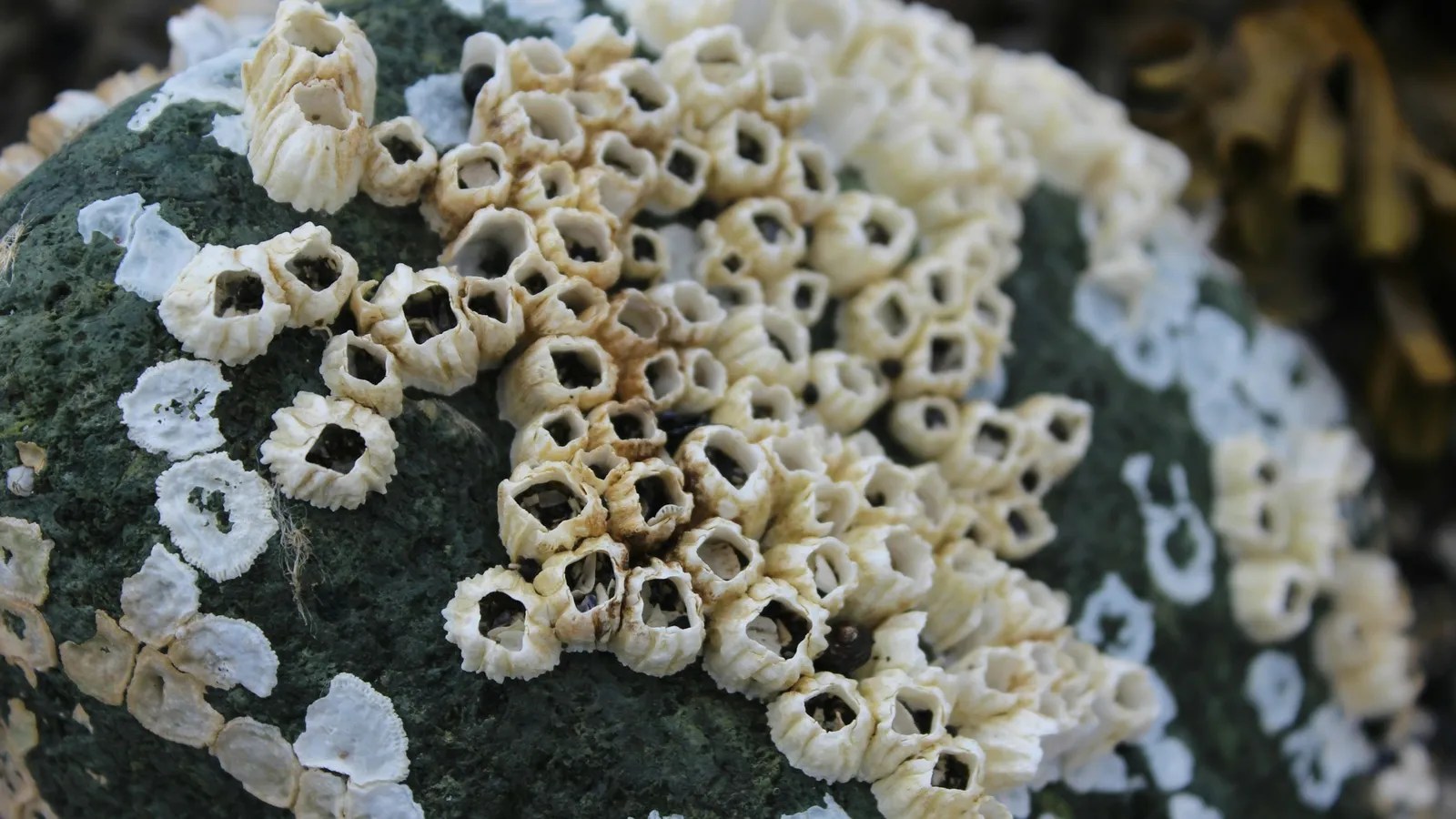
On the shore at Millport, Scotland, two barnacle species lived in two distinct bands. A 2022 paper in Science Advances summarises the result. The smaller *Chthamalus stellatus* lived higher up; *Balanus balanoides* lived lower down. Connell showed that *Chthamalus* was kept out of the lower zone by competition from *Balanus*. When he removed *Balanus*, *Chthamalus* expanded into the lower zone.
He published the main result in 1961 in Ecology as The Influence of Interspecific Competition and Other Factors on the Distribution of the Barnacle Chthamalus stellatus, alongside a companion paper in Ecological Monographs on *Balanus* and its predator, the snail *Thais lapillus*. The Nature obituary describes his method as "removing, adding or transplanting barnacles and their snail predators", and says that before his experiments field ecology was mainly descriptive.
NCERT's Class 12 chapter on organisms and populations cites "Connell's elegant field experiments" as evidence for competitive release: a species restricted by a superior competitor expands its range when that competitor is removed.
That last sentence links Connell to the niche idea; see our post on G. Evelyn Hutchinson and the ecological niche.
Why does a cancer paper cite barnacles?
The 2022 Science Advances study used Connell's idea to think about tumours. When treatment kills drug-sensitive cancer cells, it may remove the competitors that were holding drug-resistant cells back, letting the resistant cells grow. The authors set out to measure such competition in lung cancer cells in the laboratory. A sixty-year-old barnacle experiment now shapes questions in medicine.
A worked example: reading a removal experiment
These numbers are invented for practice; they are not Connell's data. On a hypothetical shore, 50 young barnacles of species X are marked in each of two lower-shore plots. In plot 1 the competitor is left alone (the control). In plot 2 the competitor is removed. After a year, 8 marked barnacles survive in plot 1 and 31 in plot 2.
Survival in the control = 8/50 = 0.16, or 16%.
Survival with the competitor removed = 31/50 = 0.62, or 62%.
Difference = 62 − 16 = 46 percentage points.
Ratio = 62/16 ≈ 3.9, so survival was almost four times higher without the competitor.
Common mistakes:
No control plot. Without plot 1, you cannot tell whether survival rose because of the removal or because it was a good year.
Confusing percentage points with per cent. A rise from 16% to 62% is 46 percentage points, but a 288% increase. Say which you mean.
One plot of each. A single pair could differ by chance, so a good design repeats each treatment in several plots.
What can a student take from his way of working?
Pick a question you can answer. His "smaller than my thumb" rule came from a failed rabbit study. Choose study problems you can actually test and finish.
Change something, then watch. Removing one species told him more than years of describing where barnacles sat.
Stay with a question. His Australian studies ran for decades.
When a removal experiment needs to be seen rather than imagined, the Fermi Simulation Lab has interactive simulations for ideas easier to see than read. For the laboratory side of competition, read our post on Georgy Gause and competitive exclusion.
Try it now: design a removal experiment for two plants competing in your school garden, naming the control, the treatment and what you would count.


