On this page
Step out on a cold December morning in Delhi and your body temperature barely moves. The grass under your feet does not get that choice: its temperature simply follows the air. That difference is the whole idea behind three words from NCERT ecology: regulators, conformers and partial regulators.
This topic comes from section 13.1.2, Responses to Abiotic Factors, in Chapter 13 of the 2020-21 NCERT Class 12 Biology textbook. The current NCERT reprint (2026-27) numbers Organisms and Populations as Chapter 11 and opens directly at 11.1 Populations, so check whether your board or exam syllabus still includes it.
What do regulators, conformers and partial regulators mean?
These definitions come from the 2020-21 NCERT chapter. Homeostasis is an organism keeping its internal environment, such as body temperature and the osmotic concentration of body fluids, constant despite a changing outside. New to homeostasis? Read what homeostasis means, with three body examples.
Regulators keep homeostasis by physiological, and sometimes behavioural, means. All birds and mammals, and a very few lower vertebrates and invertebrates, can do this. Humans hold 37°C by sweating in summer and shivering in winter.
Conformers cannot keep a constant internal environment. Their body temperature changes with the surrounding temperature, and in aquatic conformers the body fluids change with the salt concentration of the water. NCERT says an overwhelming majority (99 per cent) of animals and nearly all plants are conformers.
Partial regulators can regulate, but only over a limited range of conditions. Beyond that range they simply conform.
The salt side matters because water varies a lot: NCERT gives salinity as less than 5 parts per thousand in inland waters, 30-35 in the sea and more than 100 in some hypersaline lagoons.
How do you read NCERT's graph of organismic response?
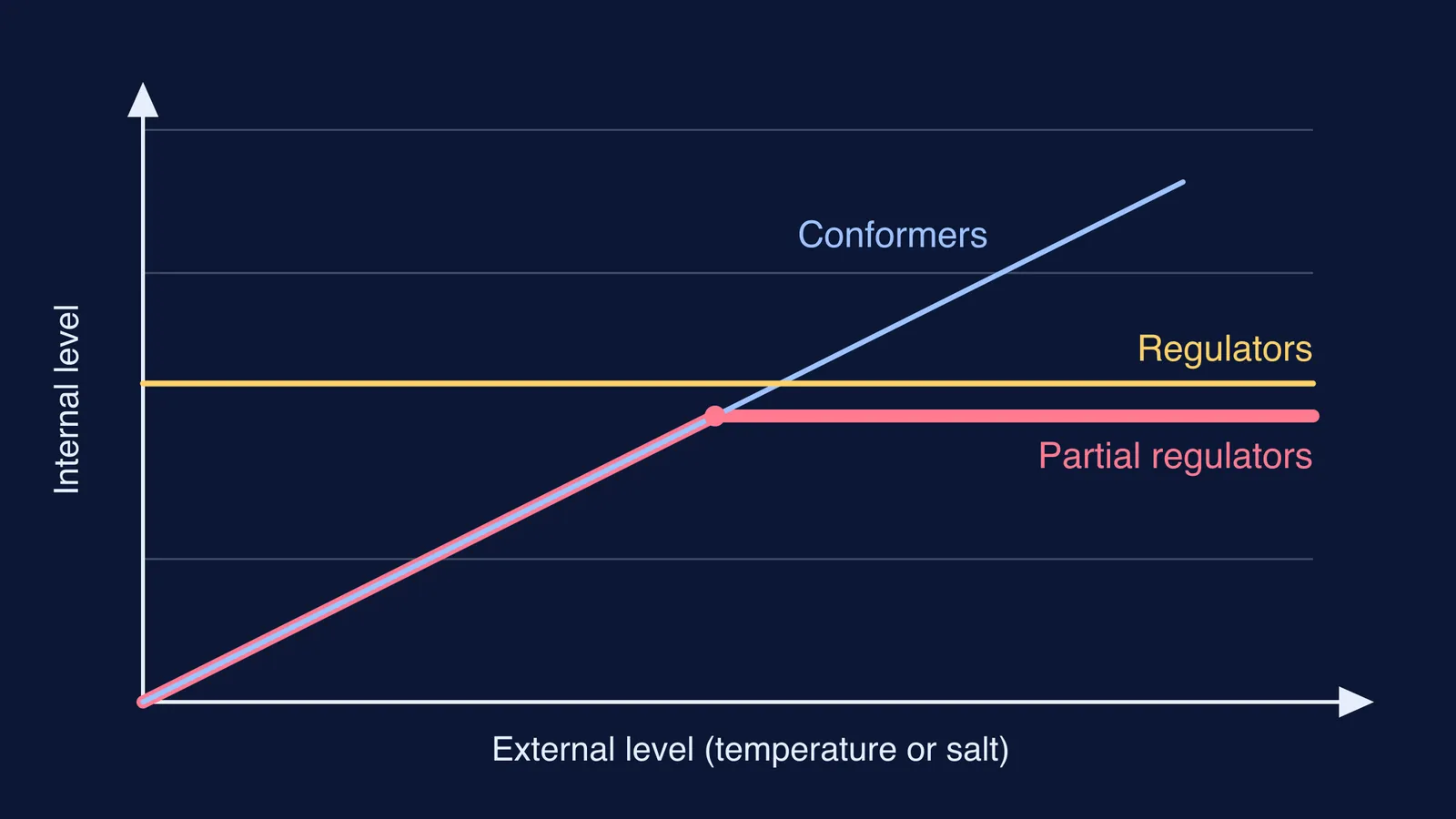
NCERT's Figure 13.3 plots external level on the x-axis and internal level on the y-axis. Read each line by asking one question: when the outside changes, does the inside change?
Conformers: a straight line rising from the origin. Internal level tracks external level.
Regulators: a flat horizontal line. Internal level stays the same whatever happens outside.
Partial regulators: a line that rises with the conformer line, then turns flat just below the regulator line. On the rising part the inside follows the outside; on the flat part it is held steady.
Why are small animals rarely found in polar regions?
NCERT's answer is about surface area. Heat loss or gain is a function of surface area, and small animals such as shrews and hummingbirds have a larger surface area relative to their volume, so they lose body heat very fast in the cold and must burn a lot of energy to make it back (NCERT, 2020-21). That is the main reason very small animals are rarely found in polar regions.
Here is the geometry, using a sphere as a simple stand-in for a body:
Surface area = 4πr² and volume = (4/3)πr³, so surface area ÷ volume = 3/r.
A small animal with r = 2 cm: 3 ÷ 2 = 1.5 cm² of skin for every cm³ of body.
A large animal with r = 20 cm: 3 ÷ 20 = 0.15 cm² of skin for every cm³ of body.
Ten times the radius gives one-tenth the skin per unit of body. The small body has ten times more surface, for its size, to leak heat through.
The same logic sits behind Bergmann's rule on bigger animals in colder places and Allen's rule: NCERT notes that mammals from colder climates generally have shorter ears and limbs.
Why didn't every animal evolve to be a regulator?
Because regulating costs energy. The NCERT chapter uses an analogy: a person who works best at 25°C could run an air conditioner in summer and a heater in winter, but not everyone can afford one. In the same way, thermoregulation is energetically expensive for many organisms, and NCERT says evolution weighed the costs and benefits: some species can regulate only over a limited range, and most animals are conformers.
When the stress is short or local, NCERT lists two more options: migrate away, or suspend activity through spores, seeds, hibernation, aestivation or diapause. Our guide to hibernation vs aestivation covers the second.
A three-question checklist for any example
When a question names an organism or shows a graph, run through this:
Does its internal temperature or salt level stay steady when the outside changes? If yes in all conditions, it is a regulator.
Does it follow the outside the whole way? Then it is a conformer.
Does it hold steady for a while and then give way? Then it is a partial regulator.
If the surface-area step trips you up, the Fermi Concept Library gives each concept in biology, physics and mathematics its own lesson and its place in the map, so you can revisit surface area and volume first.