

On this page
In 1847 the Göttingen anatomist and physiologist Carl Bergmann (1814–1865) took on a simple question: why does body size seem to change with climate? He published his answer in a German paper, "On the relationships of heat economy in animals to their size", in the journal Göttinger Studien, according to the Deutsche Biographie entry on Bergmann. His idea is now taught as Bergmann's rule, where geometry, physics and biology meet.
What is Bergmann's rule?
Bergmann's rule is the tendency for warm-blooded animals of the same species, or of closely related species, to be larger in colder places and smaller in warmer ones.
Because the original paper was published only in German, most scientists learned the rule through a translation by the biologist Ernst Mayr. That version says races from cooler climates tend to be larger than races of the same species living in warmer climates, as Watt, Mitchell and Salewski explain in Oikos (2010).
The same paper flags a long-running argument: does the rule mean only the pattern, or the pattern plus Bergmann's explanation? That matters later.
Why are animals bigger in colder climates?
Bergmann's reasoning rested on the ratio of the body's heat-giving surface to its heat-producing bulk, the Deutsche Biographie notes. A warm-blooded animal makes heat throughout its body, so heat production grows roughly with volume. It loses heat through its skin, so heat loss grows roughly with surface area. As a body gets bigger, volume grows faster than surface area, and each gram of body has less skin through which to leak heat.
You have seen this in your kitchen: a big pot of milk stays hot longer than the same milk poured into small cups, which together expose more surface.
Worked example: three cubes
Picture an animal simplified to a cube.
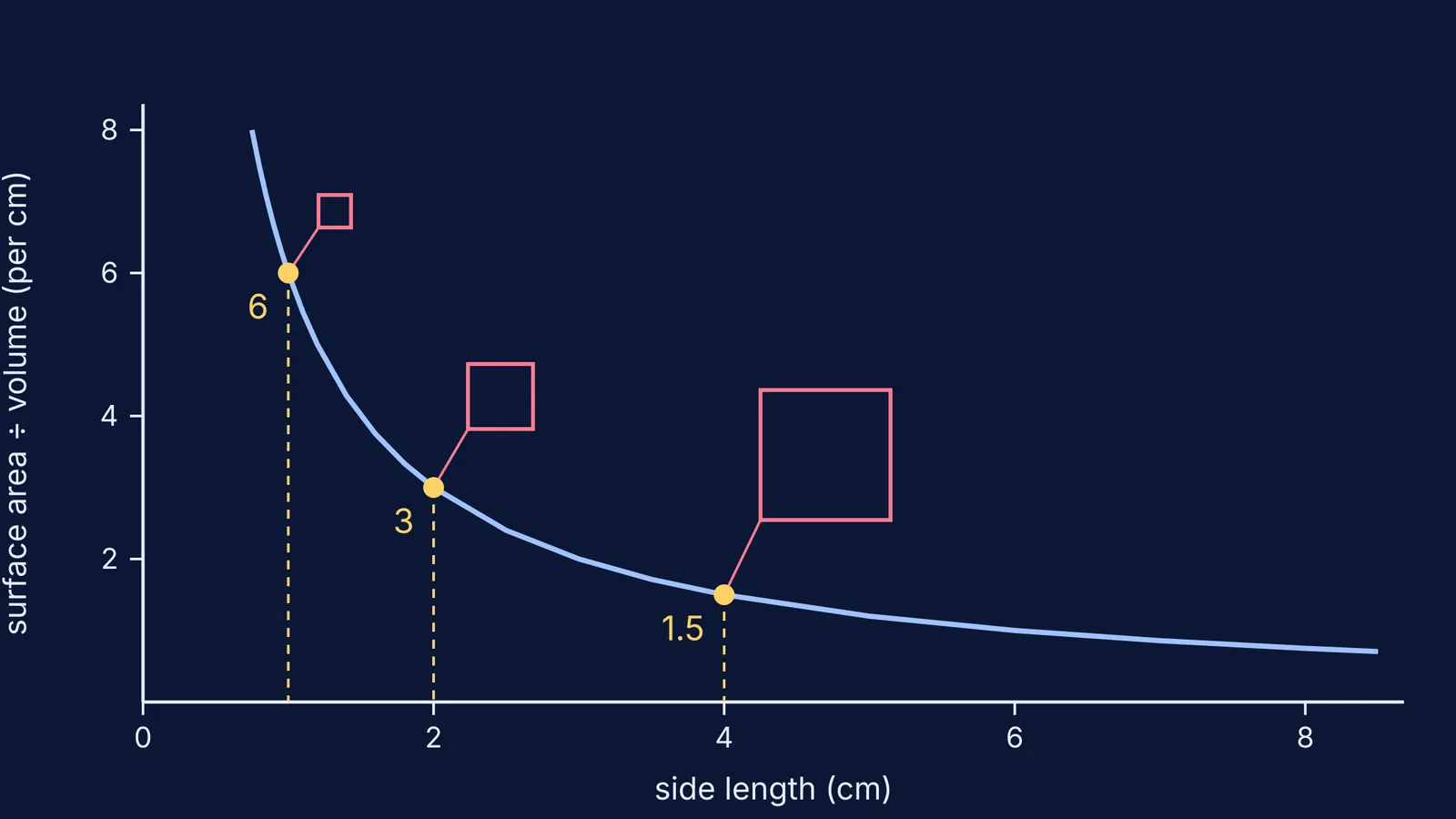
Side 1 cm: surface area = 6 × 1 × 1 = 6 cm², volume = 1 cm³, ratio = 6 per cm.
Side 2 cm: surface area = 24 cm², volume = 8 cm³, ratio = 3 per cm.
Side 4 cm: surface area = 96 cm², volume = 64 cm³, ratio = 1.5 per cm.
Each time the side doubles, surface area goes up 4 times but volume goes up 8 times, so the surface-to-volume ratio halves. For any shape scaled up evenly, the ratio falls as 1 divided by length. In a cold place, a lower ratio means less heat lost for each unit of heat made. That is the advantage Bergmann proposed for large bodies.
Our piece on D'Arcy Thompson and On Growth and Form shows how size shapes bodies. If the formulas feel shaky, revise surface areas and volumes for Class 10.
Does Bergmann's rule actually hold?
Mostly, yes, as a pattern. A review of published studies by Shai Meiri and Tamar Dayan in the Journal of Biogeography (2003) covered 94 bird species and 149 mammal species.
Over 72% of the bird species and 65% of the mammal species in that review followed Bergmann's rule (Meiri and Dayan, 2003). Birds that stay put all year fitted the rule better than migratory birds, and the authors concluded that the rule is a valid ecological generalisation for birds and mammals.
An earlier analysis of mammals by Ashton, Tracy and de Queiroz in The American Naturalist (2000) found that 78 of 110 species were larger at higher latitudes, and 48 of 64 were smaller in warmer places. But their analyses did not support heat conservation as the explanation. The pattern is real; the cause is still debated, which is why the Oikos authors urge testing mechanisms, not just describing trends.
Is climate change making animals smaller?
If warmth favours smaller bodies, a warming world might shrink some animals. Rising summer temperatures over four decades predicted consistent drops in body size across 70,716 birds from 52 North American migratory species, while wing length increased, according to Weeks and colleagues in Ecology Letters (2020). The authors suggest longer wings may help the birds keep migrating as smaller bodies make flight more costly.
For how populations change over generations, see Darwin, Wallace and natural selection.
How should you check a "bigger in the cold" claim?
Use this checklist in a textbook, a quiz or the news:
Related animals? The rule compares populations within a species or close relatives, not an elephant with a mouse.
Warm-blooded? The evidence above is about birds and mammals.
Pattern or cause? A size trend does not prove heat conservation is the reason.
Resident or migrant? Resident birds fitted the rule better in the 2003 review.
What is the ratio doing? Run the cube calculation.
If scaling ideas are hard to picture, the Fermi Simulation Lab has interactive simulations for ideas that are easier to see than to read, and the Fermi Concept Library gives every concept in physics, chemistry, biology, mathematics and computing its own lesson.
Next time chai cools fast in small cups, you are watching the geometry Bergmann described in 1847.


