

On this page
"How many divisions?" has two correct answers, depending on what is being counted. NCERT's Class 11 chapter on cell cycle and cell division states that all cells reproduce by dividing into two, with each parent cell giving rise to two daughter cells each time it divides.
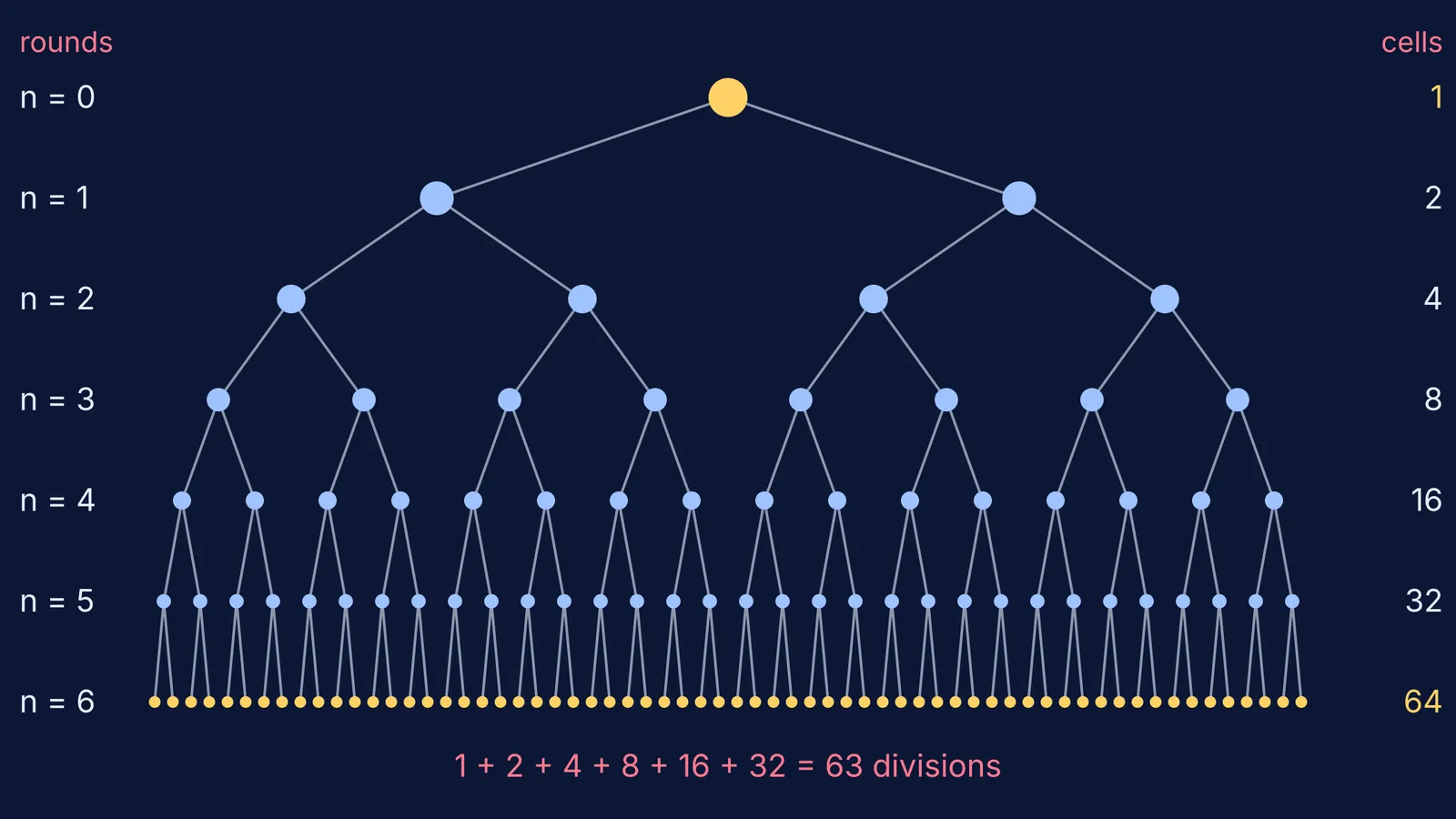
How many mitotic divisions produce 64 cells?
First check whether the question counts rounds (generations) or individual division events.
Rounds: after n rounds, one cell becomes 2^n cells. Since 64 = 2^6, you need 6 rounds.
Division events: each division turns one cell into two, so it adds exactly one cell. Going from 1 cell to 64 cells takes 64 − 1 = 63 divisions. Check it round by round: 1 + 2 + 4 + 8 + 16 + 32 = 63.
"Generations", "rounds" or "cycles" point to log2 N; "how many divisions in total" points to N − 1. In an MCQ, if 6 is offered and 63 is not, the question is almost certainly asking for rounds. In a written answer, say which count you used.
If you start with more than one cell, use N = c × 2^n, where c is the starting number. Going from 8 cells to 256 cells: 256 ÷ 8 = 32 = 2^5, so 5 rounds, and 256 − 8 = 248 division events.
NCERT notes that human cells in culture divide about once every 24 hours, while yeast can complete the cell cycle in about 90 minutes. If every cell keeps dividing at that pace, 6 rounds take about 6 days for those human cells and about 9 hours for yeast.
How many cells does one meiosis produce?
A meiocyte is a diploid cell that undergoes meiosis. According to the NCERT cell division chapter, meiosis involves two sequential nuclear and cell divisions, meiosis I and meiosis II, but only a single cycle of DNA replication, and it ends with four haploid cells.
So m meiocytes give 4m haploid cells, and N haploid cells need N ÷ 4 meiocytes. In seed questions, "one meiosis" means meiosis I and II in one meiocyte, not each half. For where this happens, see our guide on where meiosis occurs in plants and animals.
How many meiotic divisions are needed to produce 100 seeds?
The trap: the male and female sides are not symmetric. From NCERT's Class 12 chapter on sexual reproduction in flowering plants:
Each pollen mother cell undergoes meiosis to form a tetrad of four microspores, and these develop into four pollen grains.
Each megaspore mother cell also produces four megaspores, but in most flowering plants only one is functional; the other three degenerate. That one megaspore develops into the embryo sac, which has one egg cell.
At fertilisation the pollen tube releases two male gametes: one fuses with the egg to form the zygote, the other fuses with the polar nuclei. After fertilisation, ovules mature into seeds.
So one seed needs one egg (one full megaspore mother cell meiosis) and one pollen grain (a quarter of a pollen mother cell meiosis).
Worked example for 100 seeds:
Eggs needed: 100, so 100 megaspore mother cells.
Pollen grains needed: 100, so 100 ÷ 4 = 25 pollen mother cells.
Total meioses: 100 + 25 = 125.
In general, S seeds need S + S/4 = 5S/4 meioses, so 400 seeds need 500. If S is not a multiple of 4, round the pollen side up: 10 seeds need 10 + 3 = 13 meioses, because a meiocyte cannot divide in half.
How many mitoses build the embryo sac and the pollen grain?
NCERT describes the functional megaspore nucleus dividing mitotically into 2, then 4, then 8 free nuclei. That is 3 rounds (2^3 = 8) and 1 + 2 + 4 = 7 nuclear divisions. The mature embryo sac is 8-nucleate but 7-celled.
On the male side, the mature pollen grain holds a vegetative cell and a generative cell, so the microspore divides once. The generative cell divides once more into two male gametes, before shedding or in the growing pollen tube. For the chromosome side of these questions, see our cell division assertion-reason traps and the significance of mitosis.
A 30-second check before you write the answer
Mitosis or meiosis? One mitosis gives 2 cells; one meiosis gives 4.
Rounds or events? Use log2(N ÷ c) for rounds and N − c for division events.
Male or female side? Pollen: divide by 4. Eggs: one per megaspore mother cell.
In textbook counts, seeds = zygotes = eggs = pollen grains used.
Free-nuclear divisions count nuclei, not cells.
If your count keeps slipping at the same step, the Fermi Problem Library has worked problems with a step-by-step solver that explains the reasoning rather than printing an answer. If the gap is the idea underneath, the Fermi Concept Library gives each biology concept its own lesson.


