

On this page
Meiosis is the specialized cell division that halves the chromosome number from diploid (2n) to haploid (n). While you might know *what* it does, biology exams often test *when* and *where* it happens in different organisms. The timing of meiosis determines an organism's entire life cycle—whether it is diplontic, haplodiplontic, or haplontic 2.
Where does meiosis occur in animals?
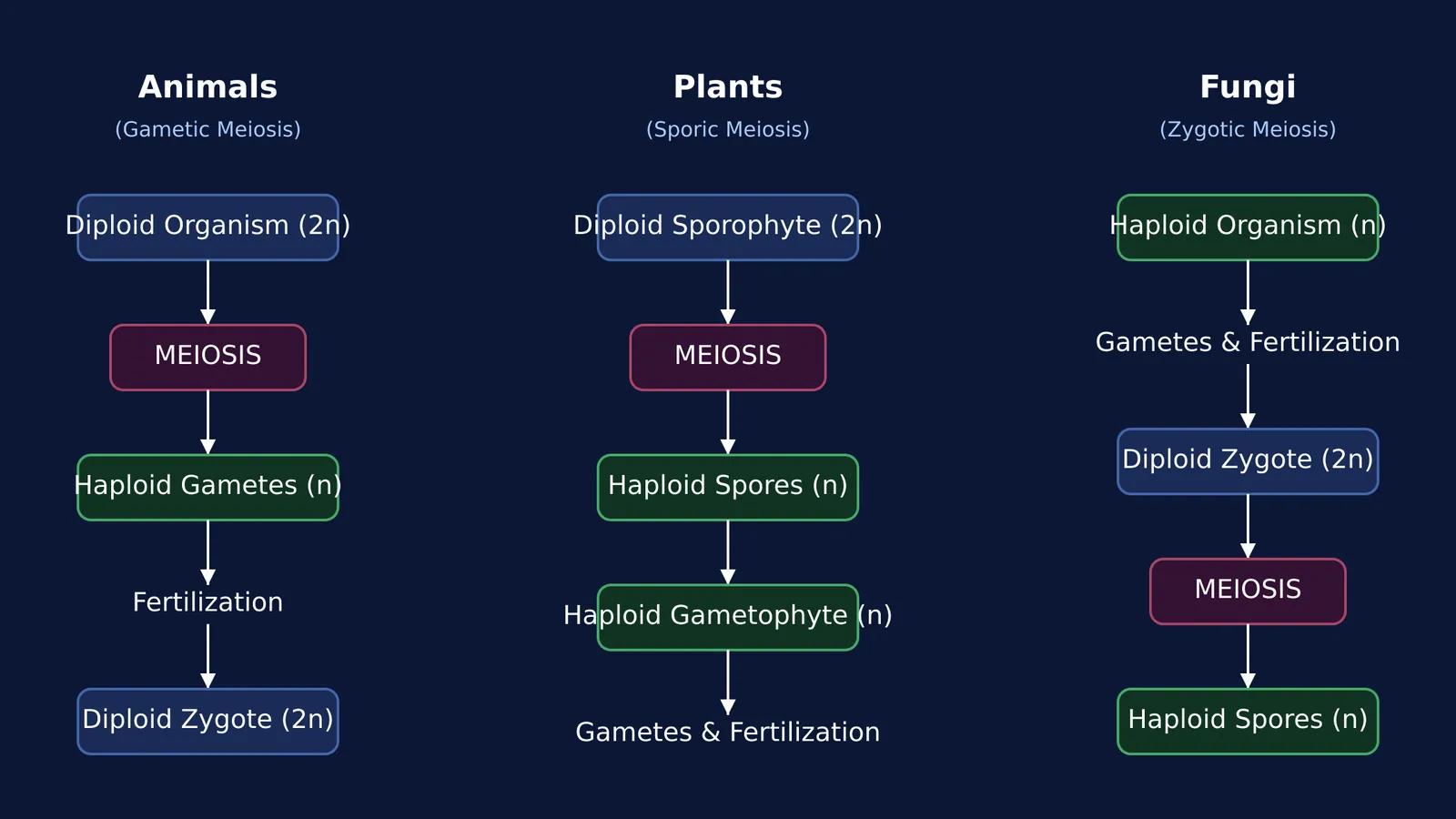
In animals—including humans—meiosis occurs in the reproductive organs, known as gonads. This process is called gametic meiosis.
Because animals spend almost their entire lives as diploid organisms (a diplontic life cycle), meiosis takes place specifically to form gametes directly from diploid germ cells 1. In males, it occurs in the testes during spermatogenesis to produce sperm. This maturation process begins at puberty and is continuous throughout adult life, with millions of sperm produced daily 1.
In females, meiosis happens in the ovaries during oogenesis to produce eggs (ova). This is a very different timeline; oogenesis is initiated during embryonic development before birth. The primary oocytes remain suspended in prophase I until puberty, resuming later in life and only completing upon fertilization 1. Another key difference is the outcome: spermatogenesis yields four functional sperm, whereas oogenesis yields only one functional ovum alongside polar bodies that degrade 1.
These gametes are the only haploid cells in the animal life cycle. When a sperm and egg fuse during fertilization, they immediately restore the diploid state, creating a zygote that grows into a new animal through mitosis.
Where does meiosis occur in plants?
In plants, meiosis does not produce gametes directly. Instead, it produces spores. This is known as sporic meiosis.
Unlike animals, all land plants (such as mosses, ferns, conifers, and flowering plants) have a haplodiplontic life cycle 2. They alternate between two multicellular generations: a diploid sporophyte and a haploid gametophyte. Meiosis happens within the diploid sporophyte, specifically inside structures called sporangia 3.
In all seed plants, spores are produced by meiosis while still protected inside the sporangium 3. In flowering plants (angiosperms), these sporangia are located within the flowers 3:
Anthers: Meiosis occurs in the microsporangia to produce microspores. These microspores become microgametophytes, which we commonly call pollen grains 3.
Ovules: Meiosis happens in the megasporangium (inside the ovary) to produce a megaspore. This megaspore then develops into the megagametophyte, or embryo sac 3.
The resulting haploid spores grow into a multicellular gametophyte, which then produces gametes through mitosis, rather than meiosis. This means the plant actually delays gamete formation, allowing the haploid phase to grow and develop its own multicellular body first.
What is zygotic meiosis and where does it happen?
Zygotic meiosis is a process where the diploid zygote is the only cell in the entire life cycle that undergoes meiosis 2.
This occurs in organisms with a haplontic life cycle, such as most fungi (like *Rhizopus* and *Neurospora*) and many green algae (such as *Volvox*, *Spirogyra*, and *Chlamydomonas*), which are distinct when comparing green, brown and red algae. In these organisms, the main vegetative body is haploid. They spend the vast majority of their life cycle with only one set of chromosomes 2.
When two haploid cells fuse during sexual reproduction, they form a transient diploid zygote. Instead of growing into a multicellular diploid body, this zygote is the only diploid cell in the whole cycle 2. It immediately undergoes meiosis to produce haploid cells 2. These resulting haploid cells then divide by mitosis to form the dominant haploid organism. In many fungi, the zygote forms a thick-walled zygospore to survive harsh environmental conditions before undergoing meiosis when favourable conditions return.
Why does the location of meiosis matter?
Understanding where and when meiosis occurs is essential because it dictates how organisms reproduce and pass on genetic variation. Meiosis introduces genetic diversity through crossing over and independent assortment. In animals, this diversity is directly packaged into the gametes. In plants, the diversity is first packaged into spores, which then grow into a gametophyte generation that might be subjected to natural selection before gametes are even formed 2. For fungi, shuffling genes in the zygote ensures that the next generation of haploid spores is genetically distinct from the parent cells.
How to map cell division for exams?
For biology exams, simply memorizing the terms is not enough. You must be able to match the type of meiosis to the organism's life cycle. If you struggle to connect specific events like microsporogenesis and the structure of a pollen grain to the broader plant life cycle, try mapping the relationships in the Fermi Concept Library. It shows how individual biological processes link together, helping you understand the whole system instead of isolated facts.
When revising, create a simple list matching the organism to its dominant phase and meiosis type:
Animals use gametic meiosis and live a diplontic life.
Land plants use sporic meiosis and alternate generations (haplodiplontic).
Fungi and green algae use zygotic meiosis and live a haplontic life.
Recognizing these patterns is the key to solving assertion-reasoning questions efficiently without second-guessing yourself.


